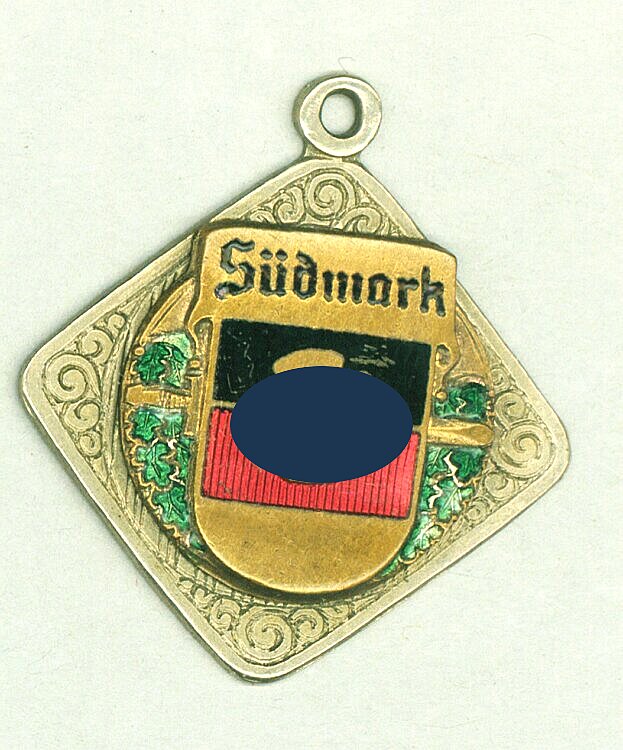
Germandom Abroad - German School Association Südmark
The Honor Badge of the German School Association Südmark represents a significant chapter of the German-national movement in the late Imperial period and the interwar years. The German School Association Südmark (Deutscher Schulverein Südmark) was founded on September 25, 1880, in Vienna and dedicated itself to promoting German educational institutions in ethnically mixed areas of the Habsburg Monarchy.
The organization emerged during a time of increasing national tensions within the multinational state of Austria-Hungary. The association's name “Südmark” (Southern March) referred to the southern border regions of the German-speaking area, particularly in Styria, Carinthia, and Carniola (present-day Slovenia). Its founding was a response to the growing Slovenian national movement and the associated struggle for cultural and linguistic dominance in these regions.
The original name was “German School Association,” but from 1905 onward, the official designation “German School Association Südmark” was used. The association's primary mission was to establish and maintain German schools, kindergartens, and educational facilities in areas where the German population was a minority or threatened to become one. By 1914, the association maintained over 400 schools and kindergartens with more than 35,000 students.
The present honor badge, designed as a larger variant and wearable as a chain pendant, was awarded to deserving members and patrons. Such decorations were an important element of association culture in the Wilhelmine and Habsburg era. They served not only to honor individual merit but also to create a visible community of supporters of the German national idea.
The wearing of these honor badges typically occurred at official occasions, association meetings, and national holidays. The larger execution as a chain pendant suggests special significance and distinguished it from smaller versions worn as lapel pins. The hierarchy of decorations reflected the internal structure and honor system of the association.
The iconography of such association badges typically included national symbols such as oak leaves, Germanic runes, or regional coats of arms. The term “Deutschtum im Ausland” (Germandom Abroad) refers to the broader movement to support German minorities outside the Reich's borders, which gained considerable importance in the late 19th century.
After World War I and the collapse of the Habsburg Monarchy in 1918, the situation changed fundamentally. German minorities in the newly created successor states (particularly Czechoslovakia, Yugoslavia, and Poland) faced new political realities. The German School Association Südmark continued its work in the First Austrian Republic, albeit under changed conditions.
During the interwar period, such organizations became increasingly politicized. With the rise of National Socialism, the association became part of the larger “Volkstumspolitik” (ethnic policy) coordinated from Berlin. After the “Anschluss” (annexation) of Austria in 1938, the association was integrated into the Nazi organizational structure.
The end came with Germany's defeat in 1945. The expulsion of the German population from the former Südmark territories and the political reorganization of Central Europe meant the end of the association's original objectives. In the postwar period, such organizations were dissolved, and their activities were critically evaluated as part of nationalist movements.
Today, honor badges like the present one are historical documents of a complex and controversial period in Central European history. They testify to the national conflicts in the Habsburg Monarchy, education as an instrument of nationality politics, and the importance of association culture in society at that time. For collectors and historians, they offer insights into the material culture of nationalism and the mechanisms of social recognition in this era.
The worn condition of the badge underscores its authentic use and makes it a witness to lived history, documenting the personal connection of a wearer to the German-national movement.