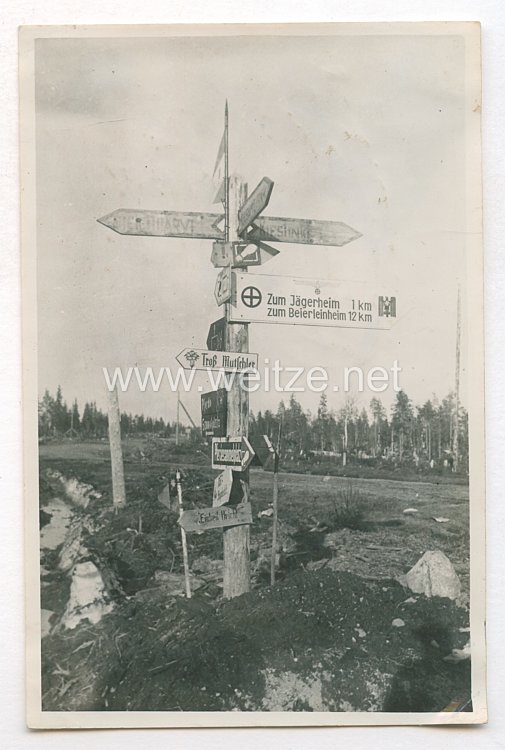
Wehrmacht Heer Photograph, Road Sign in Norway
This photographic document shows a Wehrmacht directional sign in Norway and represents an authentic testament to the German occupation period from 1940 to 1945. Such photographs document not only the military infrastructure but also the daily life of German forces during Operation Weserübung and the subsequent occupation.
The German invasion of Norway began on April 9, 1940, as a combined Wehrmacht operation that simultaneously seized several Norwegian ports and strategic points. Norway held extraordinary strategic significance for the German Reich: Norwegian ports secured access to the Atlantic, the coastline offered U-boat bases, and ore shipments from Sweden through the Norwegian port of Narvik were vital for German armaments industry. Following the successful invasion, an occupation administration was established under Reichskommissar Josef Terboven, while militarily the Wehrmacht Commander Norway was responsible for the armed forces.
Directional signs played a central role in military organization. The Wehrmacht had to establish a functioning traffic and supply system in the extensive and geographically challenging Norwegian terrain. Norwegian topography with its fjords, mountains, and limited road connections presented particular challenges. Military signposts were erected in standardized form to enable troops, supply columns, and couriers to navigate. These signs were typically inscribed in German and showed distances to military facilities, quarters, supply points, and strategic locations.
The photograph itself, measuring approximately 15 x 10 cm, corresponds to the standard format of the era. Such photographs were taken by soldiers with private cameras or by propaganda companies (PK). Many Wehrmacht members documented their service photographically, with subjects such as signposts, landscapes, and everyday scenes being popular. These images served both personal memory and often were sent home to give relatives an impression of the theater of war.
At times, over 300,000 German soldiers were stationed in Norway – a disproportionately high number compared to the Norwegian population of approximately three million people. The Wehrmacht established a dense network of bases, coastal fortifications (part of the Atlantic Wall), airfields, and supply facilities. The military infrastructure also included developed roads and transport routes organized through appropriate signage.
Photographic documents like the present one are today of historical and documentary value. They offer insights into the material culture of the occupation period and show details often not recorded in official documents. While propaganda photographs conveyed a staged image, private photographs frequently show unvarnished everyday situations. Signpost photographs concretely document the German presence and administrative penetration of occupied territory.
The occupation period was characterized for the Norwegian population by considerable restrictions, economic exploitation, and political oppression. Simultaneously, an active Norwegian resistance developed, ranging from sabotage acts to the rescue of persecuted Jews. Wehrmacht members in Norway experienced a relatively quiet time compared to other theaters of war, especially in the early war years, which is also reflected in the type of photographic documentation.
Such photographs today are part of military history collections and are preserved by historians, museums, and collectors. They serve the scholarly examination of the occupation period and enable a visual reconstruction of historical conditions. The used condition of the photograph is typical for documents carried by soldiers in the field and subsequently preserved over decades.