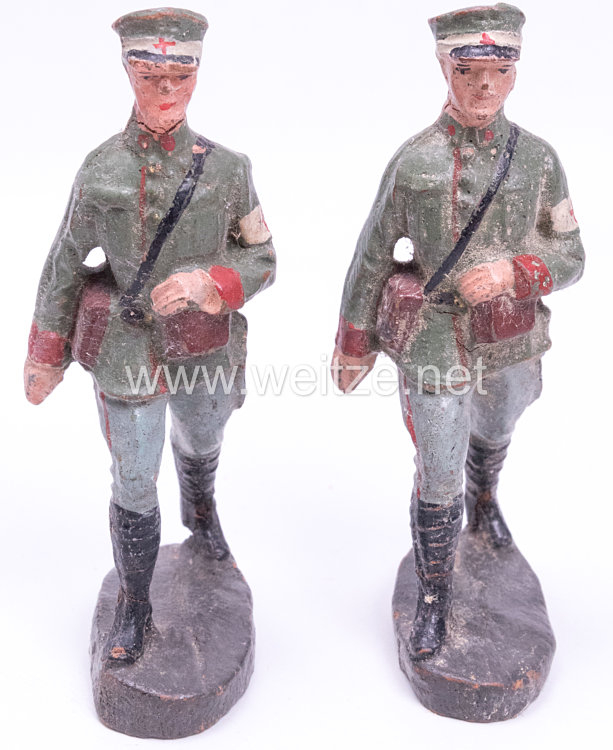
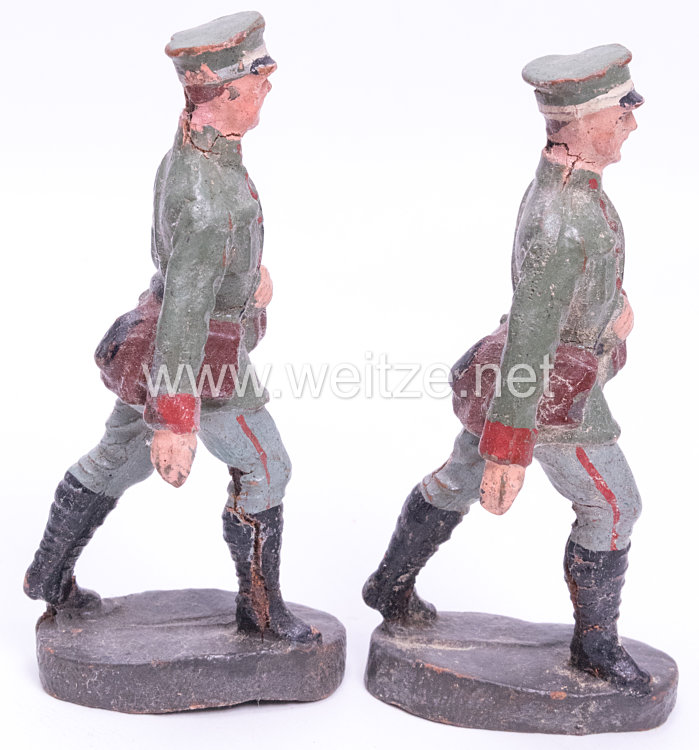
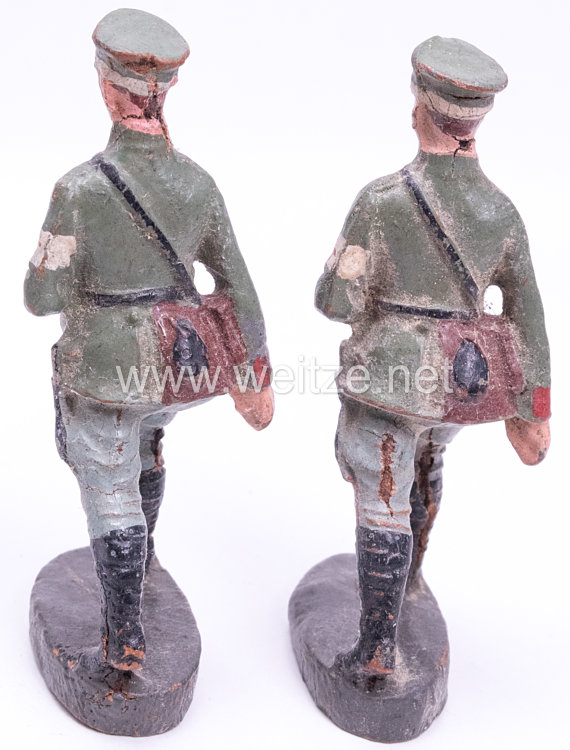
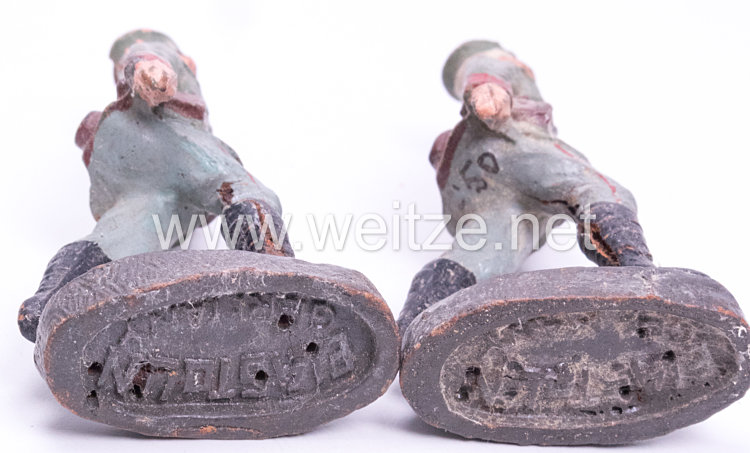
Elastolin - Army 2 Medics Marching
Elastolin Medical Orderly Figures: Military Toys and Historical Representation of the Wehrmacht
The Elastolin figures in question represent two marching medical orderlies of the German Army and belong to a significant category of German military toys from the first half of the 20th century. Standing 7 cm tall, these figures correspond to the classic standard size of Hausser-Elastolin production, manufactured between the 1920s and the end of World War II.
The Hausser Company and Elastolin
The company O. & M. Hausser was founded in 1904 in Ludwigsburg and developed into one of Germany's leading manufacturers of toy figures. The brand name “Elastolin” designated a special material composed of a mixture of casein, chalk, glycerin, and other binding agents formed around a wire core. This material proved more resistant than lead and allowed for more detailed modeling than conventional composition figures.
The 7 cm figures were produced from the late 1920s onward and depicted various military units, professional groups, and historical scenes. Elastolin figures were distinguished by their careful painting and realistic representation, accurately reproducing contemporary uniforms and equipment.
Medical Services in the Wehrmacht
The depicted medical orderlies represent an essential component of military organization. The Wehrmacht Medical Service was divided into several levels: from immediate casualty care at the front through regimental aid stations to field hospitals and homeland hospitals.
Medical orderlies wore the regular field uniform of the Army but were identified by a white armband with a red cross, which designated them as protected medical personnel under the Geneva Convention. Their equipment typically included a medical bag with bandaging materials, stretchers, and medical instruments. The depiction as “marching” suggests figures in action or en route to transport wounded soldiers.
Historical Context and Production
The production of military toys had a long tradition in Germany and served both entertainment and the transmission of military values. During the National Socialist period, such toys were also used for propaganda and the militarization of youth. The Hausser factory produced during this time both for the civilian toy market and for propaganda purposes.
The figures were hand-painted, with stencils used for recurring details. Painting was usually done in several layers to represent the various uniform elements, equipment items, and facial features. The quality of painting varied depending on the production period, with pre-war figures often more detailed than wartime productions.
Condition Assessment and Collector Context
The designation “Condition 2” corresponds to standard collector classification and indicates very good preservation. For Elastolin figures, this typically means that the paint is largely preserved, possibly with slight signs of use, but the figures have no major damage such as cracks in the material or missing parts.
While Elastolin composition was more durable than many other materials, it was prone to cracking and material fatigue with improper storage. Moisture, extreme temperatures, and direct sunlight could damage the material. Well-preserved examples from the pre-war and wartime periods are highly sought after by collectors today.
Collector Value and Historical Significance
Elastolin figures today have significant historical documentary value. They show contemporary uniforming, equipment, and organization of military units with remarkable attention to detail. For military historians and uniform specialists, they serve as three-dimensional sources for reconstructing historical appearances.
The collector value of such figures depends on various factors: rarity of representation, condition, completeness of sets, and production period. Medical orderly figures are relatively common in Elastolin collections, as they belonged to standard production. Nevertheless, well-preserved examples achieve considerable prices on the collector market, especially when they are part of larger thematic assemblages.
Today, Elastolin figures are valued not only as toys of the past but also as cultural-historical witnesses to a specific epoch of German history, reflecting both the craftsmanship quality of German toy production and the social and political conditions of their time of origin.