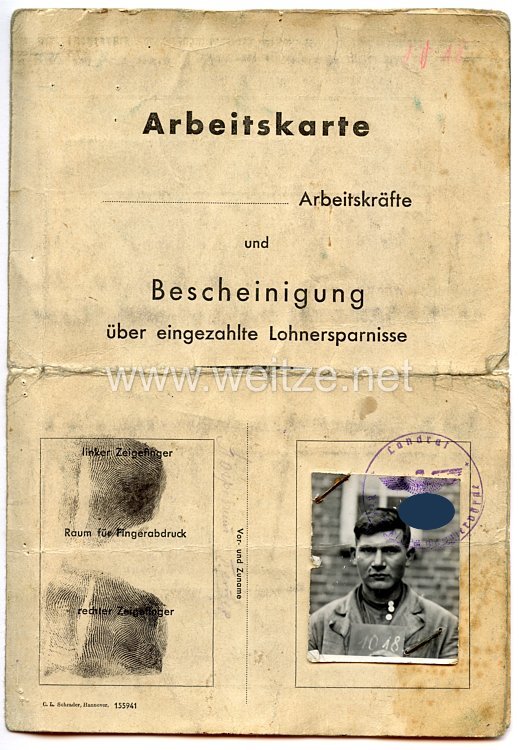
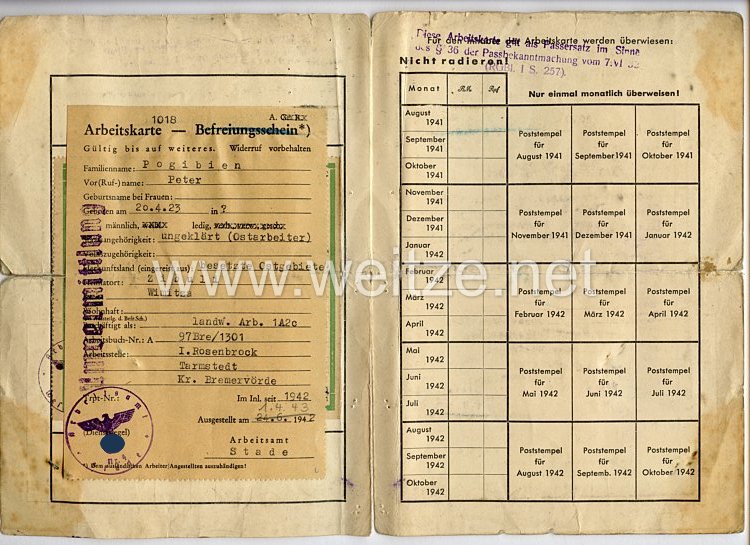
Third Reich - Work Card for Laborers from the Occupied Eastern Territories
The work card for laborers from the occupied Eastern territories represents a significant artifact of Nazi forced labor policy during World War II. This document from 1943 belongs to a comprehensive bureaucratic system that enabled and documented the exploitation of millions of people from German-occupied territories.
Following the invasion of the Soviet Union in June 1941, the Third Reich developed a systematic program for recruiting and deporting laborers from the occupied Eastern territories. The increasing labor shortage in Germany, caused by the conscription of German men into the Wehrmacht, led to the mass deportation of civilians from Poland, Ukraine, Belarus, and other occupied areas. Fritz Sauckel, appointed General Plenipotentiary for Labor Deployment in March 1942, organized these forced recruitments with brutal efficiency.
The work card served as an official identification and control document. It contained personal information such as name, date of birth, place of origin, a photograph, and details about work assignments. The multilingual form enabled its use in various occupied territories and documented the Nazi regime's bureaucratic claim to make forced labor appear as an “orderly” administrative procedure.
The issuance in Stade on April 1, 1943 indicates the decentralized organization of labor deployment. Local employment offices were responsible for registering, assigning, and monitoring foreign workers. Stade, as a city near Hamburg, benefited from the allocation of forced laborers for agriculture, industry, and infrastructure projects. The notation “in the country since 1942” suggests that the individual was deported to Germany during the first year of mass deportations.
Particularly noteworthy is the discriminatory legal status of the so-called Ostarbeiter (Eastern workers). People from the Soviet Union, including Ukraine, were racially classified as “subhumans” and subjected to particularly strict restrictions. They had to wear a special badge marked “OST,” received lower wages than Western European forced laborers, were housed in guarded camps, and were not allowed to move freely. Violations of the numerous regulations could result in drastic punishments, from labor education camps to deportation to concentration camps.
Working conditions for Eastern workers were often catastrophic. Long working hours, inadequate food, lack of medical care, and violent treatment were part of daily life. Many forced laborers died from exhaustion, disease, or direct violence. It is estimated that approximately 2.8 million Soviet civilians were deported to the German Reich as forced laborers, with Ukraine providing a substantial share.
The year 1943, when this card was issued, marks a turning point in the course of the war. After the defeat at Stalingrad, the Nazi regime further intensified the exploitation of foreign labor to maintain war-critical production. The work card thus documents not only an individual fate but symbolically represents a crime of enormous magnitude.
From a historical perspective, such documents are of immeasurable value. They serve as evidence of systematic forced labor under National Socialism and enable the reconstruction of individual biographies. After the war, work cards and similar documents were used in searches for missing persons, in compensation proceedings, and in war crimes trials. Today, archives and memorial sites preserve such objects as memorials and research sources.
The work card reminds us that behind the cold bureaucracy of the Nazi regime stood human tragedies. Each of these documents represents a person who was deported from their homeland, deprived of their freedom, and forced to work. Academic and educational engagement with such objects is essential to keep alive the memory of the victims and to educate future generations about the dangers of totalitarian systems.