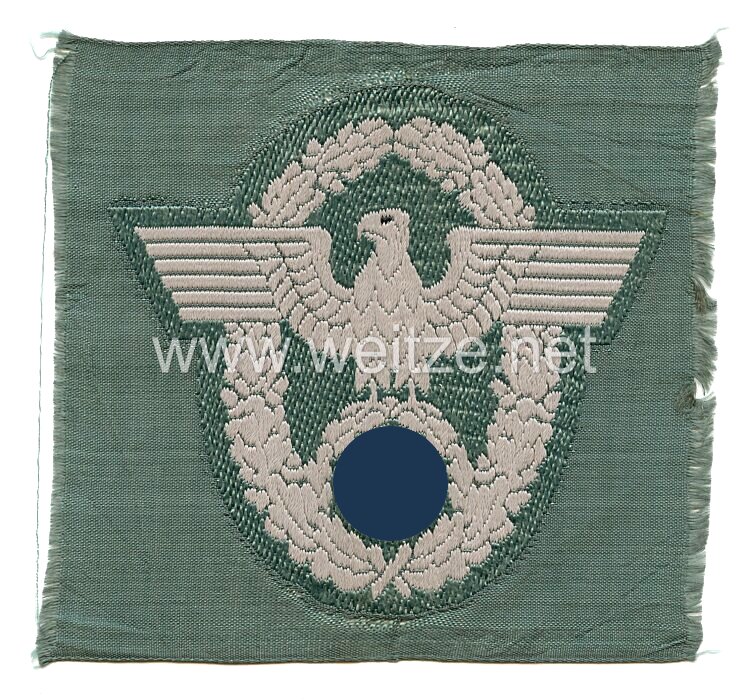
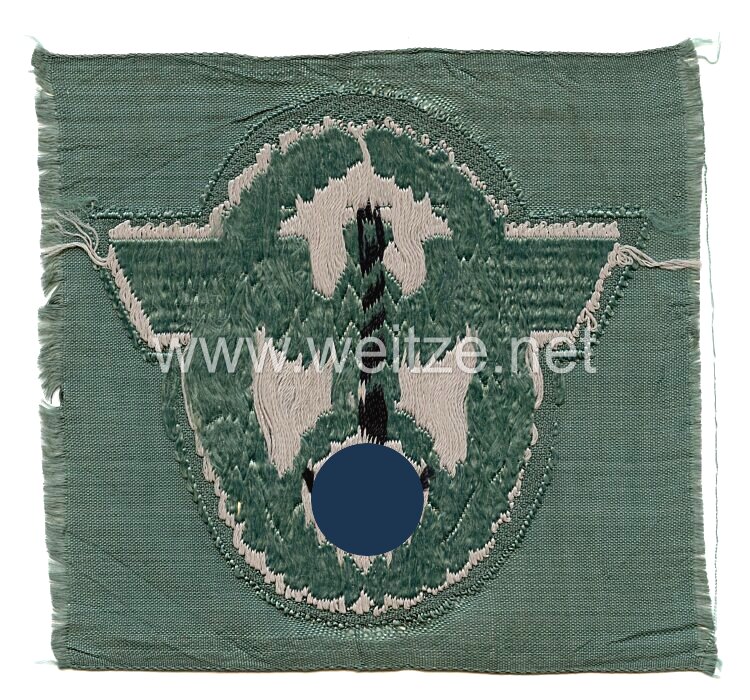
Police Sleeve Eagle for Enlisted Men, Polizei-Felddivision

BeVo woven construction on field gray, circa 1942/43. Unissued condition, Condition 2.
455461
150,00

Police Sleeve Eagle for Enlisted Men, Polizei-Felddivision

The Police Arm Eagle for Enlisted Men of the Police Field Division represents a significant chapter in the history of the German Ordnungspolizei (Order Police) during World War II. This distinctive badge was worn by members of the Police Field Divisions, which formed a bridge between civilian police work and military deployment.

The Police Field Divisions (Polizei-Felddivisionen) were established from 1939 onwards and combined members of the Order Police with military organization and equipment. These units were initially deployed for security duties in occupied territories but increasingly found themselves engaged in direct combat operations. The first Police Division was established in October 1939, with additional divisions following between 1940 and 1945.

This particular specimen dates from approximately 1942/43, a period of intense military engagement on the Eastern Front. During this phase, the Police Field Divisions became increasingly involved in conventional combat operations, especially after the Wehrmacht's heavy losses in the Battle of Stalingrad.

The Bevo weaving technique refers to a special manufacturing process developed by the company Bandfabrik Ewald Vorsteher (BeVo) in Wuppertal. This technique enabled the machine production of insignia with fine details and clear contours. Bevo-woven badges were widespread during World War II and were considered high quality and durable.

The arm eagle was manufactured on a field-grey background, the standard color of German uniforms of this period. The field-grey color was introduced in the German Army in 1907/08 and remained the predominant uniform color until 1945. For the Police Field Divisions, this was an important identifier of their military function, while specific badges simultaneously marked their affiliation with the police.

The enlisted men's version differed from officer and NCO badges in material and execution. While higher ranks often wore hand-embroidered or metal badges, enlisted men received the more practical and cost-effective woven versions. This corresponded to the hierarchical structure and uniform regulations of the time.

The Police Field Divisions were initially subordinate to Reichsführer-SS Heinrich Himmler in his capacity as Chief of the German Police, but were placed under operational command of the Wehrmacht. This dual structure was also reflected in the uniforms: the basic uniform was military, but special insignia such as the arm eagle marked the police origin.

The unworn condition of this specimen is remarkable, as most uniform items from this period were damaged or destroyed through intensive use or postwar turmoil. Such unused pieces can have various explanations: they could be leftover depot stocks, prepared for a uniform that was never completed, or originate from production surpluses.

The classification as Condition 2 in military-historical collecting tradition indicates a very good to excellent state of preservation with possibly minimal storage traces, but without signs of use or damage.

Historically speaking, the Police Field Divisions played a complex role. They were involved in heavy combat, especially on the Eastern Front, where several of these divisions were nearly completely decimated. The 1st Police Division, for example, fought in France, Greece, and later on the Eastern Front. The 4th SS Police Panzergrenadier Division originated in 1939 as a Police Division and was transferred to the Waffen-SS in 1942.

For military historians and collectors, such insignia are important objects of study for understanding uniform development, organizational structures, and material culture of World War II. They document the fusion of police and military structures in National Socialist Germany and the increasing militarization of civilian institutions during the war.

These artifacts serve as tangible reminders of a complex historical period and provide insight into the administrative and organizational details that characterized the German war effort. The production quality and standardization evident in such pieces also reflect the systematic approach to military organization that characterized German military institutions of this era.