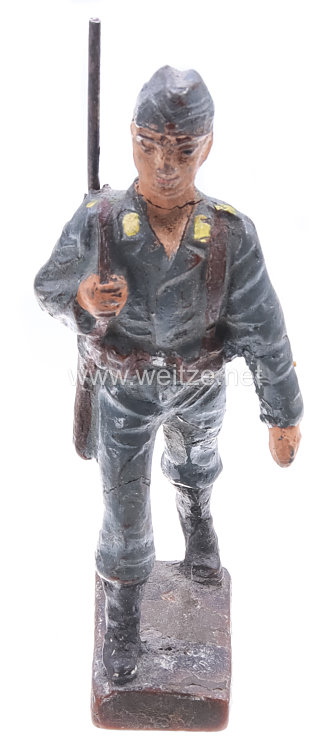
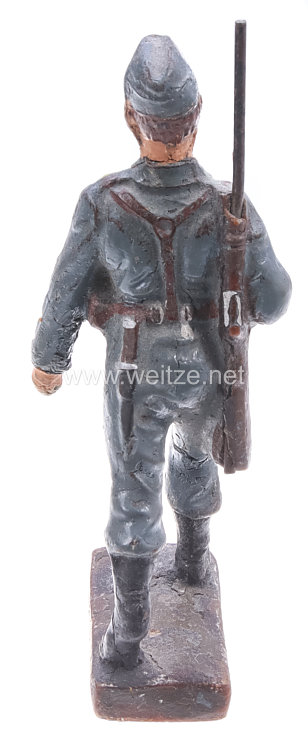
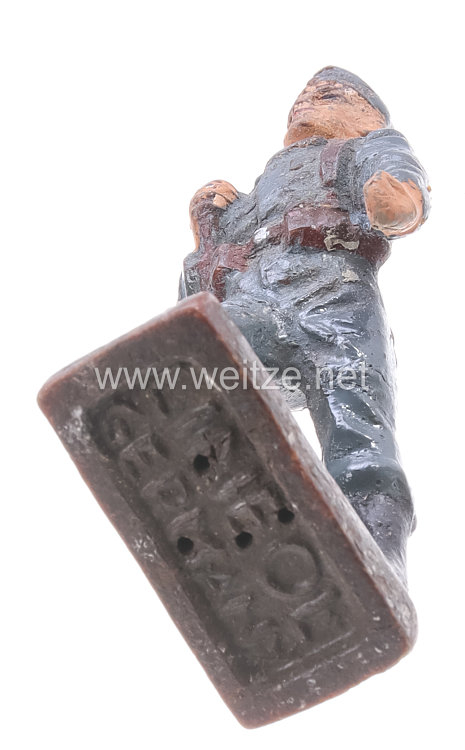
Lineol - Luftwaffe Aviation Corps Soldier Marching with Garrison Cap

7.5 cm, condition 2.
406561
30,00

Lineol - Luftwaffe Aviation Corps Soldier Marching with Garrison Cap

The described Lineol figure of a marching Luftwaffe Fliegertruppe soldier wearing a Schiffchen (side cap) represents a fascinating example of German toy production from the National Socialist era. The company Lineol, founded in 1906 by Oskar Wiederhholz in Brandenburg an der Havel, developed into one of the most significant manufacturers of composition figures in Germany.

Lineol specialized in producing soldier figures from composition mass, a material made from sawdust, glue, casein, and other binding agents. These figures were manufactured at a scale of approximately 7.5 cm, making them direct competitors to traditional lead soldiers. The advantage of composition figures lay in their more cost-effective production and lighter weight.

During the 1930s, Lineol adapted its production program to political circumstances and increasingly manufactured figures of the Wehrmacht and its branches. The Luftwaffe, officially founded on March 1, 1935, represented a modern and prestigious branch of the German armed forces. The Fliegertruppe (aviation troops) enjoyed special prestige and was strongly emphasized in propaganda.

The Schiffchen, the characteristic headgear of the Luftwaffe, was officially designated as the Fliegermütze or side cap. This cap was part of various Luftwaffe uniform variants and was worn by both flight personnel and ground crew. The light blue branch color of the Luftwaffe and specific insignia made this uniform easily recognizable.

The depiction of a marching soldier corresponded to the military ideal of the time and was frequently implemented in toy productions. The marching pose symbolized discipline, order, and military strength. Lineol figures were characterized by relatively detailed painting and anatomical design, with uniform details, equipment items, and insignia reproduced with considerable care.

Condition 2 in the collector's world denotes a very good state of preservation with only minimal signs of use. For composition figures, this is particularly noteworthy, as the material is sensitive to moisture, mechanical stress, and temperature fluctuations. Many Lineol figures have not survived the decades undamaged, making well-preserved examples highly sought-after collector's items.

The production of military toys during the NS era served not only entertainment purposes but also had a pedagogical and ideological function. Children were to be playfully introduced to military themes and inspired by the Wehrmacht. This was part of the comprehensive military education implemented in all areas of society.

After World War II, Lineol production was initially discontinued. The company was expropriated in the Soviet occupation zone. Later attempts were made to resume production under the Lineol name in West Germany, but without the former success. Today, original Lineol figures from the pre-war and war period are coveted collector's items.

The military-historical significance of such figures lies not in their military value but in their function as historical documents. They demonstrate how military themes were integrated into everyday life and children's rooms of that era. For collectors and historians, they offer insights into uniform design, military equipment, and the visual propaganda of the time.

The scholarly examination of such objects requires a critical perspective that considers the historical context without glorifying the ideology. Lineol figures are important study objects for research into everyday culture, toy history, and the militarization of society in the Third Reich.