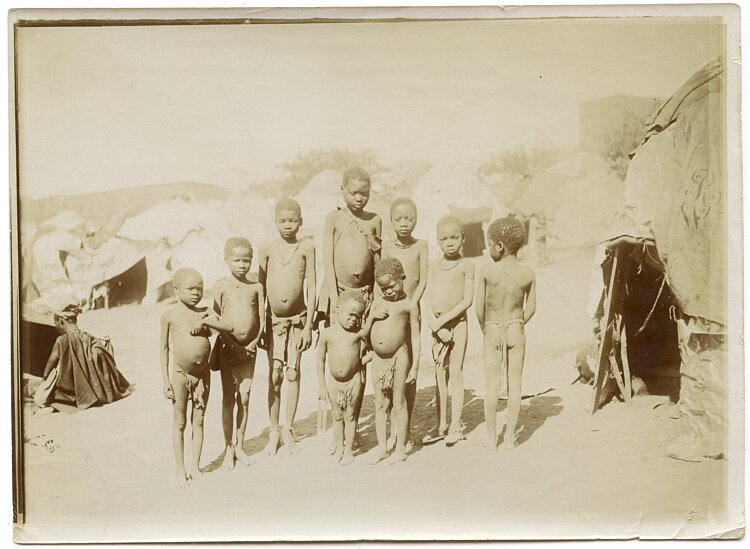
Photograph German South West Africa

18 x 13cm, Condition 2
150761
30,00

Photograph German South West Africa

This photograph from German South West Africa, measuring 18 x 13 cm, documents a significant chapter of German colonial history between 1884 and 1915. Such photographic testimonies from this era are today important historical sources that provide insights into life, military operations, and social structures during the German colonial period in southwestern Africa.

German South West Africa, present-day Namibia, was a German colony from 1884 to 1915 and was approximately one and a half times the size of the German Empire. The colony was placed under the administration of the German Colonial Society following the Berlin Congo Conference of 1884/85 and later incorporated as a protectorate into the German Reich. Military presence was maintained by the Imperial Schutztruppe for German South West Africa, which was systematically built up from 1889 onwards.

Photographs from this period were produced under technically challenging conditions. Photographers had to transport their heavy equipment, including glass plates and chemical developing materials, often over long distances through inhospitable terrain. The format of approximately 18 x 13 cm corresponds to the then-common cabinet card formats or larger postcard formats, which were used for both private and official documentation purposes.

Particularly during the Herero and Nama Uprising (1904-1908), the importance of photographic documentation increased significantly. The German colonial administration and military used photographs for reporting to Berlin, for propaganda, and for military reconnaissance. Private photographers and soldiers also produced images that were frequently sent home as postcards or mementos.

The Schutztruppe reached a strength of over 15,000 men during the uprising, making it the largest German military presence in the colonies. Photographs documented military installations such as Fort Namutoni, Windhoek, Swakopmund, and Lüderitzbucht, showing troop parades, transport columns, railway construction, and the establishment of telegraph lines. Daily life of settlers, colonial urban architecture, and landscapes were also captured.

Photographic documentation was carried out both by professional photographers such as Arthur Kaiser or the Atelier Trau in Windhoek, and by amateurs among the officers and soldiers. After 1900, improved camera technologies such as Kodak roll-film cameras enabled even less skilled photographers to produce acceptable quality images.

The historical context of these photographs is shaped by the dramatic events of the colonial period. The uprising of the Herero under Samuel Maharero began in January 1904 as a reaction to increasing expropriation and oppression by the German colonizers. The military response under Lieutenant General Lothar von Trotha led to a campaign of extermination that is considered one of the first genocides of the 20th century. The “Extermination Order” of October 1904 ordered the expulsion of the Herero into the Omaheke Desert, where tens of thousands died of thirst.

Photographs from this period document, whether unwittingly or deliberately, the consequences of this policy: concentration camps, prisoners, destroyed settlements, and the military infrastructure of oppression. Today, such images are important evidence for the historical examination of these crimes and play a central role in discussions about reparations and historical responsibility between Germany and Namibia.

After World War I, the colony passed to South Africa in 1915, which administered it until Namibia's independence in 1990. Photographs from the German colonial period reached Germany through returning soldiers, settlers, and officials, where they were kept in family albums, private collections, and later in museums and archives.

Today, such historical photographs possess considerable documentary and scientific value. They are analyzed in colonial history research, visual anthropology, and memory culture studies. Archives such as the Bundesarchiv Berlin, the Photo Archive of the German Colonial Society, and the National Archives of Namibia preserve extensive collections.

The condition rating of 2 indicates a well-preserved photograph, which is remarkable for images over a hundred years old. Such objects require conservation attention, as historical photographic papers are susceptible to yellowing, fading, and chemical deterioration.