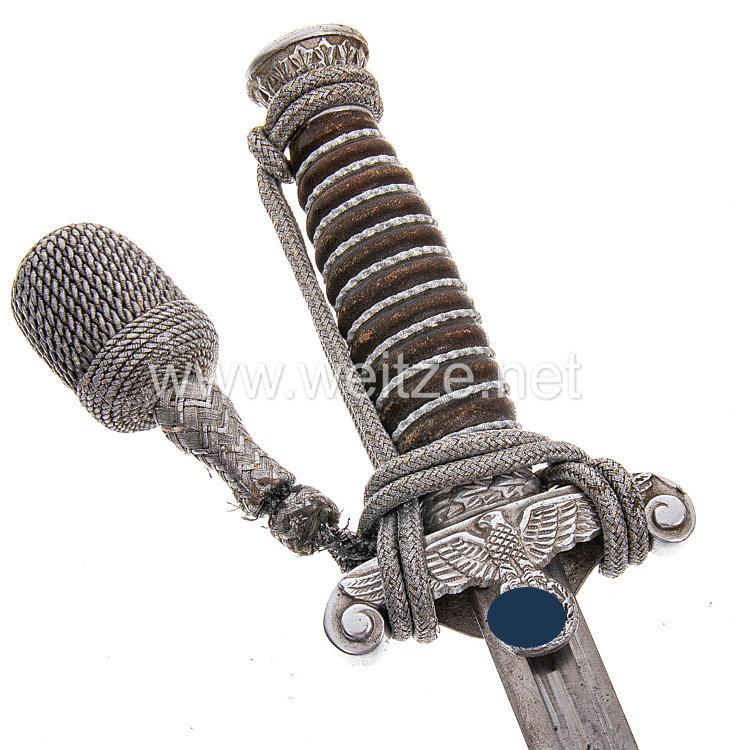
Reich Finance Administration Dagger for Land Customs Officials
The Reichsfinanzverwaltung Dagger for Land Customs Officers represents a fascinating testimony to German administrative history between 1933 and 1945. This service weapon was carried by officials of the Reich Finance Administration who were active in border service and customs surveillance.
The Reichsfinanzverwaltung was reorganized after the seizure of power in 1933 and included various departments, including the Customs Administration, which was responsible for monitoring the Reich's borders and collecting customs duties. Land customs officers formed an important component of border security and the financial system of the German Reich.
The introduction of service daggers for finance officials occurred as part of the general uniformization and hierarchization of state administration during the Nazi period. The dagger served less as a practical weapon and more as a status symbol and part of the service uniform. It emphasized the paramilitary orientation that many civil administrative areas experienced during this time.
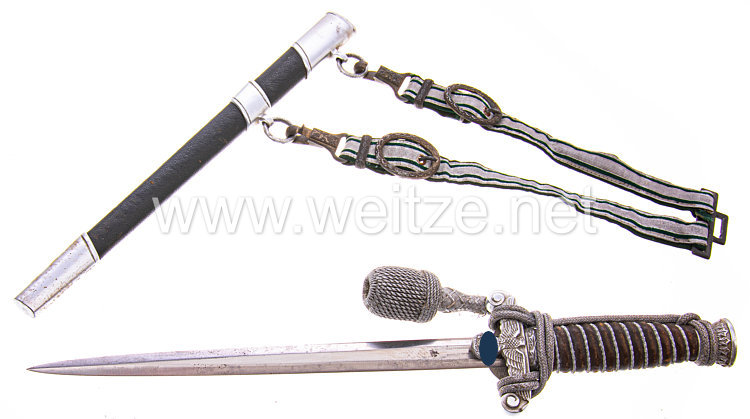
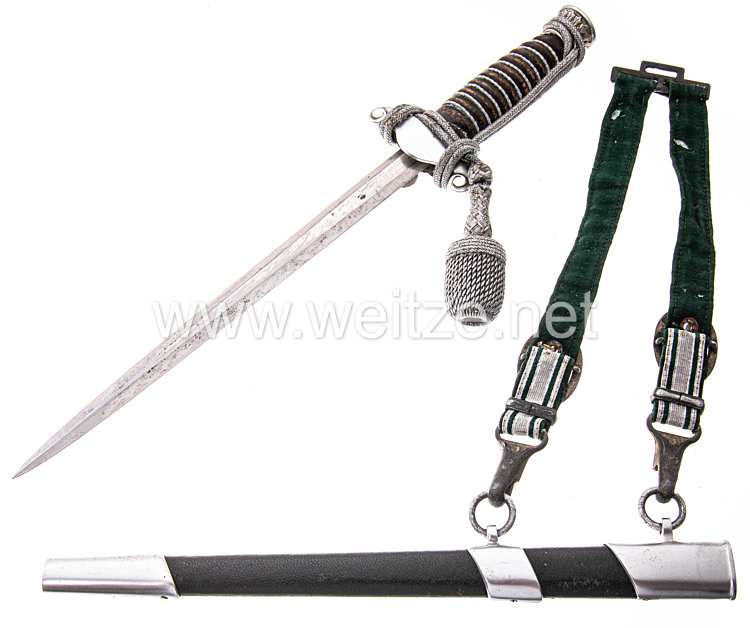
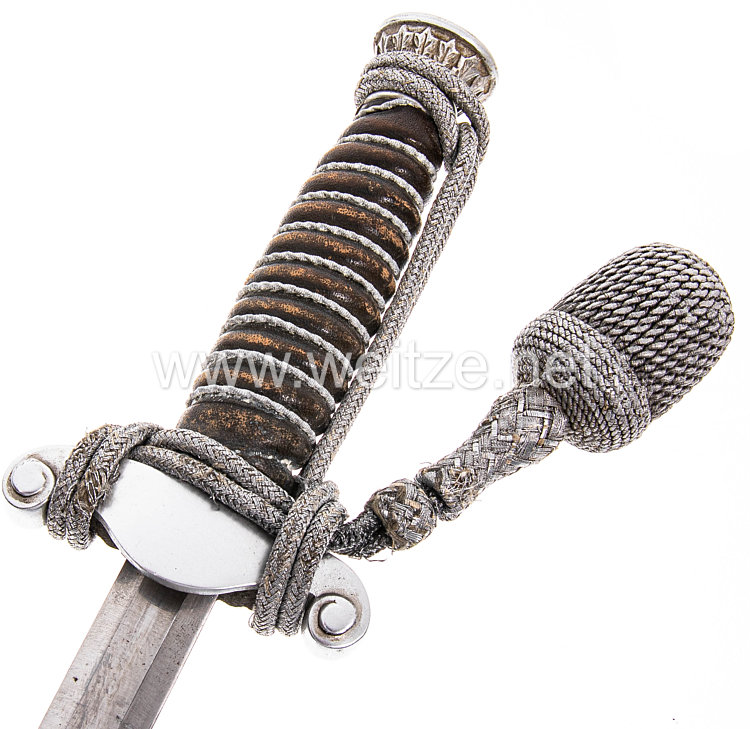
The present specimen displays the typical characteristics of this category of dagger: The blade bears no manufacturer's mark, which was not unusual for finance service daggers, as various manufacturers produced for the Reich Finance Administration. Pommel and crossguard made of aluminum were characteristic of these daggers and distinguished them from versions of other organizations. The use of aluminum was chosen for both economic and practical reasons – the material was lighter and available in sufficient quantities.
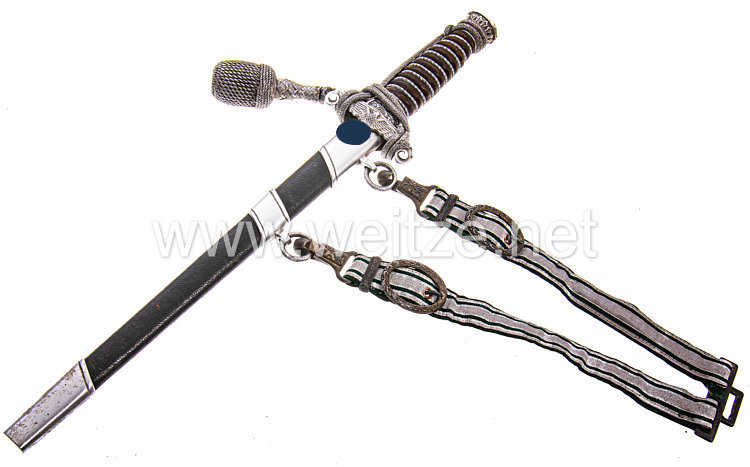
The scabbard fittings, also made of aluminum, show the typical design of finance service daggers. The scabbard was usually covered with leather, and in the present case, the leather covering is well preserved, while it shows slight signs of wear on the grip. This indicates regular wearing.
Particularly noteworthy is the complete hanger with the associated Army portepee. The portepee was a braided carrying strap attached to the dagger grip that originally prevented the weapon from being lost in combat. In the context of 20th-century service daggers, however, it had primarily decorative and rank-indicating functions. The fact that an Army portepee was used here indicates the close connection between military and civil administrative structures during this period.
The Land Customs Service was a demanding activity that required special knowledge and authority. Officers were authorized to conduct border controls, pursue smugglers, and prosecute customs offenses. They wore uniforms during service and were equipped with various items, with the dagger being an integral part of the full dress uniform.
The historical classification of these daggers is complex. On the one hand, they document the administrative structures of a past era; on the other hand, they are inextricably linked to the Nazi regime. For collectors and historians, they offer important insights into the organizational structure and symbolic representation of state authority during this time.
After 1945, these daggers were no longer worn, and many were destroyed or ended up in private collections. Today they are objects of study for military historians and collectors who deal with the study of uniforms and administrative structures of the Third Reich. The condition of the present specimen with only slight signs of age and complete hanger makes it an informative historical document of this special category of German service daggers.