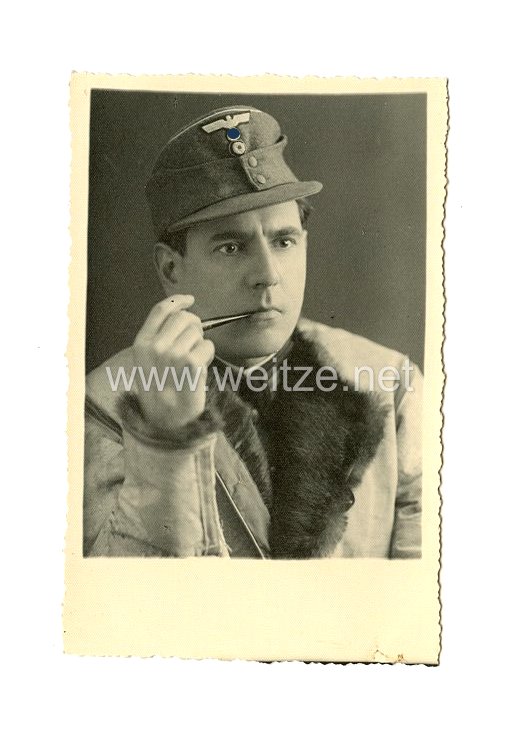
Wehrmacht Heer Portrait Photograph, Officer with Unit Field Cap

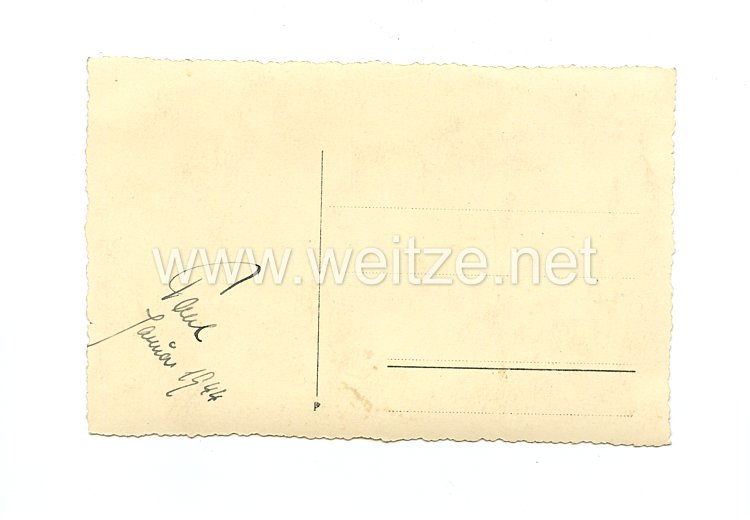
Postcard size, condition 2.
416858
15,00

Wehrmacht Heer Portrait Photograph, Officer with Unit Field Cap

This portrait photograph depicts an officer of the Wehrmacht Heer (German Army) in uniform wearing an Einheitsfeldmütze (standard field cap), a characteristic piece of headgear of the German land forces during World War II. Such photographs in postcard size were widespread between 1935 and 1945, serving both personal and official purposes.

The Einheitsfeldmütze, often referred to as “Schiffchen” (little ship) in colloquial German, was officially introduced on May 25, 1934, through the Heeresverordnungsblatt (Army Regulations Gazette) for the newly established Wehrmacht. This headgear replaced the various cap forms of the Reichswehr and represented a standardization of headgear for all ranks. The field cap was made of field-gray wool fabric and bore the corresponding insignia: the national eagle on the right side and the black-white-red cockade on the front.

Portrait photographs of soldiers and officers had a long tradition in German military culture. During World War II, they were particularly popular as they served as mementos for family members and were often taken before deployment to the front or during home leave. The standard postcard size (approximately 9 x 14 cm) made it easy to mail these pictures or keep them in photo albums.

The photographic representation of officers followed certain conventions. Usually, the photographs were taken in professional photo studios located near barracks or in larger cities. The officer typically wore his service uniform with all decorations, badges, and rank insignia. The Einheitsfeldmütze was a common headgear for such portrait photographs, as an alternative to the peaked cap (Schirmmütze), which was considered more formal headgear.

The uniform of a Wehrmacht officer was characterized by various elements that indicated his rank, branch of service, and decorations. The shoulder straps bore rank stars and were underlined with branch colors that indicated affiliation with specific troop types such as infantry (white), artillery (red), or armored troops (pink). The collar patches were also in the corresponding branch colors.

During the war, millions of such photographs were produced, representing an important aspect of military culture and personal memory. They were often sent home to families, exchanged among comrades, or kept as personal souvenirs. Many were also used for official documents such as military identification cards or personnel files.

Such photographs today are important contemporary historical documents. They provide information about uniforms, rank insignia, and photographic practices of the time. For military historians and collectors, they are of particular interest as they make the development of uniform regulations traceable and document personal destinies. The indicated condition 2 suggests a well-preserved photograph with minor signs of use, which is remarkable for a document over 75 years old.

The Einheitsfeldmütze itself underwent several modifications during the war. The Model 1934 was the original design, followed by the Model 1938, which featured slight changes in construction. From 1943 onwards, simplified versions were produced due to material shortages, omitting unnecessary details. This development reflects the general tendency toward simplification and rationalization in the later war phase.

For collectors of military historical objects, such photographs represent an accessible entry point. Unlike uniform parts or equipment items, they are often better preserved and authentically document the appearance of soldiers of the time. They enable research into biographies, unit affiliations, and regional photographic practices.

The scientific significance of such documents also lies in their function as a source for uniform studies (uniformology). By comparing numerous photographs, historians can determine the correct wearing of uniforms, regional peculiarities, and the timing of regulation changes. At the same time, they are testimonies of everyday history and the history of mentalities, as they provide insights into the self-representation and self-understanding of the people depicted.

r