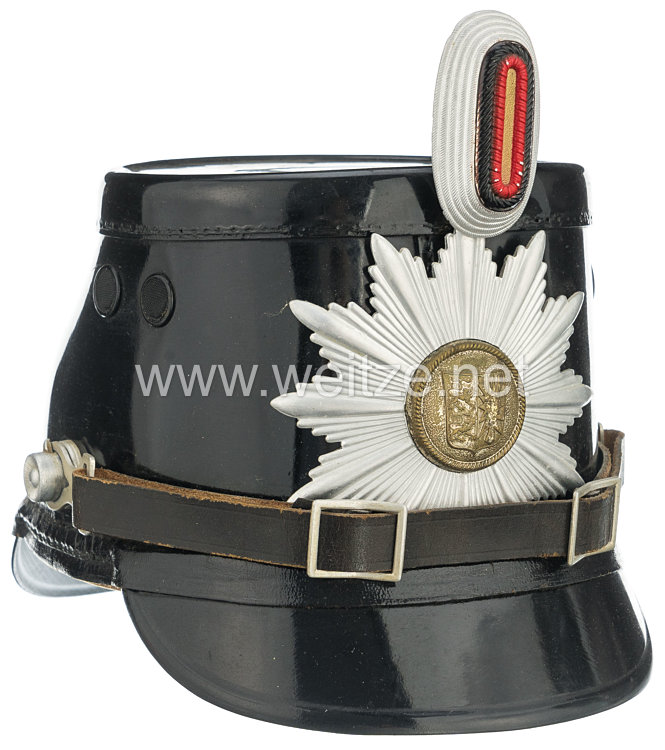
Federal Republic of Germany (FRG) Police Shako for Enlisted Men, State of Schleswig Holstein
Police Shako for Enlisted Personnel from Schleswig-Holstein
The police shako for enlisted personnel from the state of Schleswig-Holstein represents an important component of German police uniform history in the early Federal Republic of Germany. This characteristic headgear embodies the tradition and organization of state police forces in the post-war period and reflects the federal structure of the West German state.
Historical Background and Development
Following the end of World War II in 1945, the German police were completely reorganized under Allied supervision. The victorious powers insisted on decentralization of police power to prevent a concentration of authority as had occurred during the Nazi era. As a result, state police forces (Landespolizeien) were created, each subordinate to the newly founded federal states. Schleswig-Holstein was established as a state in 1946 and developed its own police organization with specific uniform regulations and rank insignia.
The shako as a form of headgear has a long military tradition dating back to the 19th century. Originally derived from Hungarian military dress, this cylindrical headgear spread throughout Europe and became a symbol of military and paramilitary organizations. In Germany, Prussian troops and later police units wore various forms of shakos.
Construction and Materials
The described shako is made of vulcanized fiber, a pressed hardboard material characterized by its robustness, weather resistance, and lightness. This material was frequently used in the post-war period because it was inexpensive to manufacture while still offering an attractive appearance. The black color was traditionally characteristic of German police uniforms and symbolized authority and seriousness.
The vulcanized fiber construction ensured a stable form while keeping the weight bearable for wearers. The interior features a lashed lining, meaning the lining is connected to the body of the shako through straps or bands. This allowed for better fit and ventilation.
Emblems and Symbolism
The most distinctive feature of this shako is the large silver-colored police star on the front, which represents the central identification symbol of the German police. At the center of the star is the coat of arms of Schleswig-Holstein, showing the two Schleswig lions and the Holstein nettle leaf. This combination of general police insignia and state coat of arms illustrates the federal organization of police in the Federal Republic.
The black leather chin strap serves to secure the shako to the wearer's head, particularly in wind or during rapid movement. The strap is attached to buttons, with the designation “Button 91” indicating specific standardization. The lacquered cockade in the federal colors of black-red-gold symbolizes belonging to the Federal Republic of Germany and clearly distinguishes this headgear from equipment from earlier epochs of German history.
Use and Wearing
Shakos of this type were worn by enlisted personnel, meaning the lower ranks of the police, at representative occasions, parades, and in regular outdoor service. Size 55 corresponds to a head circumference of approximately 55 centimeters and was a common standard size. Officers often wore differently designed or decorated versions to indicate their higher position.
During the 1960s and 1970s, the shako was increasingly replaced by more modern headgear. The peaked cap became the standard headgear as it was more practical for daily service and better suited the changing role of the police. Nevertheless, shakos remained partially in use for honor guards and ceremonial occasions.
Schleswig-Holstein and Its Police Tradition
Schleswig-Holstein, as Germany's northernmost state, held a special position due to its geographical location and history. The state police had to consider both maritime aspects and monitor the border with Denmark. While uniforming and equipment followed nationwide standards, the state coat of arms provided a clear regional identity.
Collector Value and Historical Significance
Today, such police shakos are sought-after collector's items that document an important chapter of German post-war history. They testify to the transformation of German police from a centralized, militarized organization to decentralized, citizen-oriented state police forces. The indicated condition grade 2 suggests a well-preserved shako with minimal signs of use, which is remarkable for an object from the 1950s or 1960s.
This headgear symbolically represents the democratic reorganization of Germany and the establishment of rule-of-law structures in the young Federal Republic. It recalls a time of reconstruction when the police also had to find their new role in a democratic society.