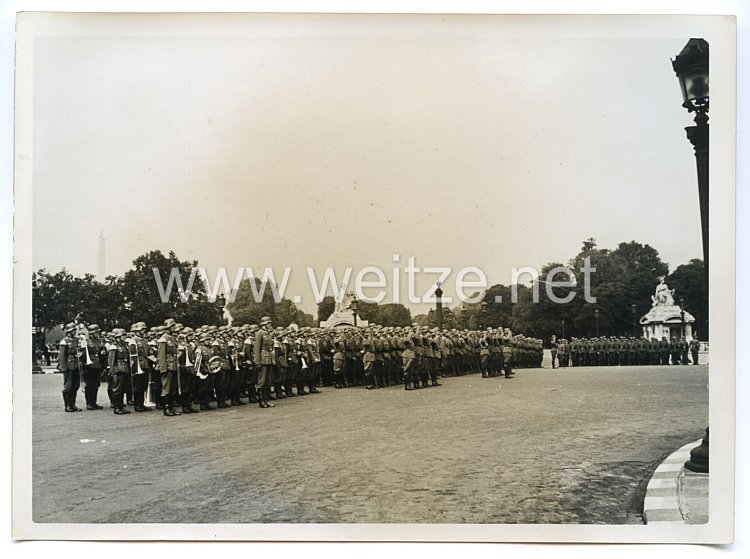
Wehrmacht Press Photograph: Parade at Place de la Concorde in Paris (France)

Dimensions approx. 13 x 18 cm, with inscription on reverse. Used condition.
344657
25,00

Wehrmacht Press Photograph: Parade at Place de la Concorde in Paris (France)

This Wehrmacht press photograph documents a military parade at the Place de la Concorde in Paris during the German occupation of France in World War II. Measuring approximately 13 x 18 cm, it corresponds to the standard format for press photographs of that era, which were produced and distributed by the Wehrmacht's Propaganda Companies (Propaganda-Kompanien or PK).

Following the successful Western Campaign in May and June 1940, the Wehrmacht entered Paris on June 14, 1940. The French government had previously declared the capital an open city to avoid its destruction. The Armistice of Compiègne was signed on June 22, 1940, dividing France into an occupied zone in the north and west, and an unoccupied zone in the south under the Vichy government. Paris lay in the occupied territory under German military administration.

The Place de la Concorde, one of Europe's most famous squares, became a preferred venue for German military parades and propaganda stagings during the occupation. The square with its historical monuments, including the Luxor Obelisk, offered an imposing backdrop for demonstrating German military might. The occupying power systematically exploited the symbolic significance of the French capital to celebrate military victory and display its superiority.

The Wehrmacht's Propaganda Companies were specialized units responsible for photographic and film documentation of war events. They were established before the war began and subordinated to the High Command of the Wehrmacht (OKW). PK photographers and war correspondents accompanied combat troops and produced material for coverage in newspapers, magazines, and newsreels. Their photographs were intended not only to document but primarily to portray German warfare in a positive light and strengthen morale on the home front.

Press photographs in the 13 x 18 cm format were the standard size for distribution to newspaper editorial offices and archives. The reverse inscription present on this specimen was a characteristic feature of these photos. Typically, these inscriptions contained information about the date of capture, location, photographer, an image number, and a brief caption. Stamps from various propaganda offices were also frequently found, such as those from the Press Department of the OKW or the Reich Ministry for Public Enlightenment and Propaganda under Joseph Goebbels.

The occupation period in Paris lasted from June 1940 until Liberation on August 25, 1944. During these four years, the cityscape was marked by the German military presence. Swastika flags flew from public buildings, German traffic signs replaced French ones, and clocks were set to German time. The symbolic occupation of urban space was an essential component of occupation policy.

Military parades in Paris served several purposes: they demonstrated military control over the conquered capital, aimed to intimidate the French population and break their will to resist. At the same time, photographic documentation of these events was directed at the German public to illustrate war success and emphasize the continuity of German military tradition.

From today's perspective, such press photographs are important historical sources that provide insight into the propaganda machinery of the Nazi regime. They document not only military-historical events but also the mechanisms of visual warfare and opinion manipulation. Historians and collectors value these photographs as authentic contemporary documents, though the propagandistic context of their creation must always be considered.

The used condition of this photograph suggests that it was actually employed in press operations, possibly in an editorial office or archive. This enhances its documentary value as an authentic object of contemporary history.

r