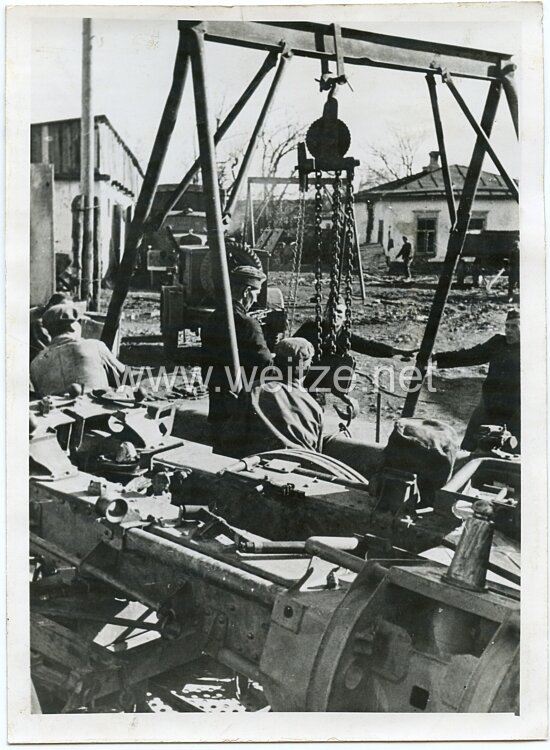
Wehrmacht Press Photograph, Repair of a Field Gun

Dimensions approx. 18 x 13 cm. Condition 2.
289257
15,00

Wehrmacht Press Photograph, Repair of a Field Gun

This Wehrmacht press photograph documents the repair of a field gun during World War II and represents an authentic testament to German military propaganda as well as the technical realities at the front.

Press Photography in the Wehrmacht

The Wehrmacht's Propaganda Companies (Propagandakompanien or PK) were established in October 1938 and were directly subordinate to the High Command of the Armed Forces (Oberkommando der Wehrmacht or OKW). These units were tasked with photographically and cinematically documenting the course of the war. The photographers, usually designated as war correspondents (Kriegsberichter), were specially trained soldiers equipped with professional photographic equipment. Their images served not only for military documentation but primarily for propaganda purposes at home and in occupied territories.

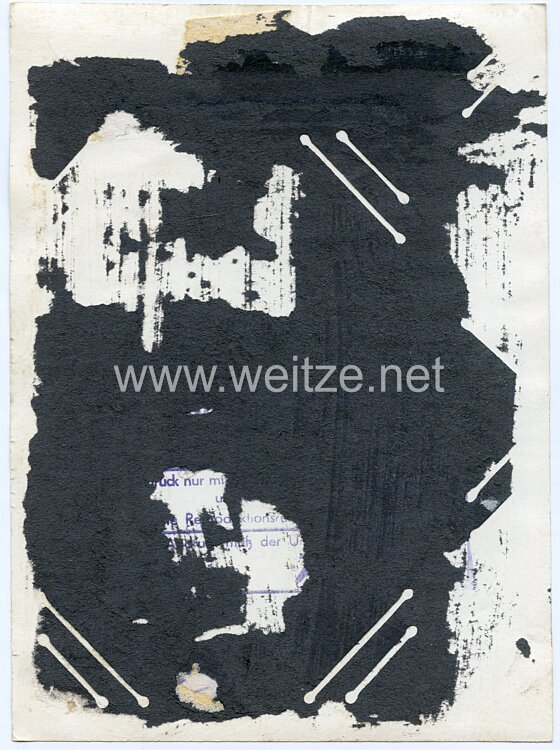
Press photographs were centrally managed by the Propaganda Ministry under Joseph Goebbels and distributed to German and international newspapers and magazines. On the reverse, these photos typically bore stamps, censorship marks, and captions documenting their intended use and approval for publication.

Field Guns and Their Maintenance

During World War II, the Wehrmacht employed a wide variety of field guns, including the widely used 7.5 cm Pak 40 anti-tank gun, the 10.5 cm leFH 18 (light field howitzer), and the 15 cm sFH 18 (heavy field howitzer). These artillery weapons formed the backbone of German firepower and were deployed on all theaters of war.

The repair and maintenance of field guns was a constant necessity at the front. Through intensive combat operations, wear and tear, weather conditions, and enemy action, the guns regularly sustained damage. The Wehrmacht had a sophisticated system of workshop companies and repair troops that formed mobile repair units. These were equipped with specialized tools, spare parts, and lifting devices.

Organization of Repair Operations

The repair of artillery pieces occurred in several stages. Minor repairs were carried out directly by the gun crews themselves at the unit level. For moderate damage, the Artillery Workshop Companies assigned to divisions were responsible. Severe damage required transport back to Army workshops or even to the Reich to specialized industrial facilities.

The photographic documentation of such repair work served multiple purposes: it was intended to demonstrate the technical competence of German troops, boost morale on the home front, and convey the image of a functioning, professional army. At the same time, these photographs today document everyday life at the front beyond combat operations.

Format and Preservation

The format of approximately 18 x 13 cm corresponds to the standardized postcard format typical for Wehrmacht press photographs. This size allowed for easy handling, archiving, and mailing. The photos were usually produced on high-quality baryta-coated photographic paper, which explains their sometimes good preservation to the present day.

The stated condition grade 2 indicates, according to typical collector grading scales, a good to very good state of preservation, possibly with slight signs of use such as minimal creases or slight edge damage, but without significant impairment to the image itself.

Historical Source Value

Such press photographs are important historical sources today. They document not only military equipment and tactics but also the propaganda strategies of the Nazi regime. For military history research, they provide insights into the technical daily life of the Wehrmacht, uniforms, equipment, and working conditions at the front. At the same time, they must be viewed critically as staged propaganda, since the motifs were often posed and the captions tendentious.

Collector Value and Ethical Aspects

Wehrmacht press photographs are today sought after by militaria collectors, military historians, and museums. Their value is determined by the rarity of the subject matter, condition, documentary content, and historical significance. Responsible handling of such objects requires placing them in historical context and critically examining the Wehrmacht's role in World War II and the crimes of the Nazi regime.

These photographs serve as important reminders of a dark chapter in history and must be studied with appropriate historical awareness and educational purpose.