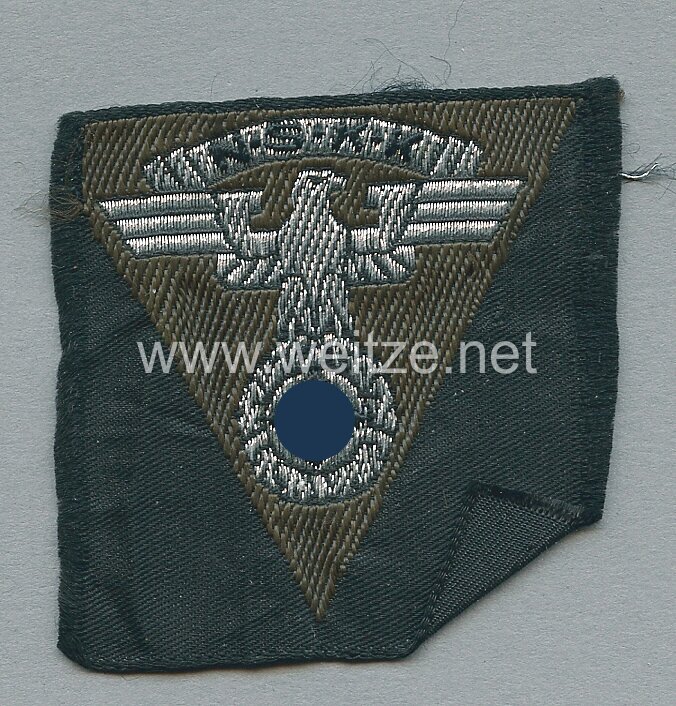
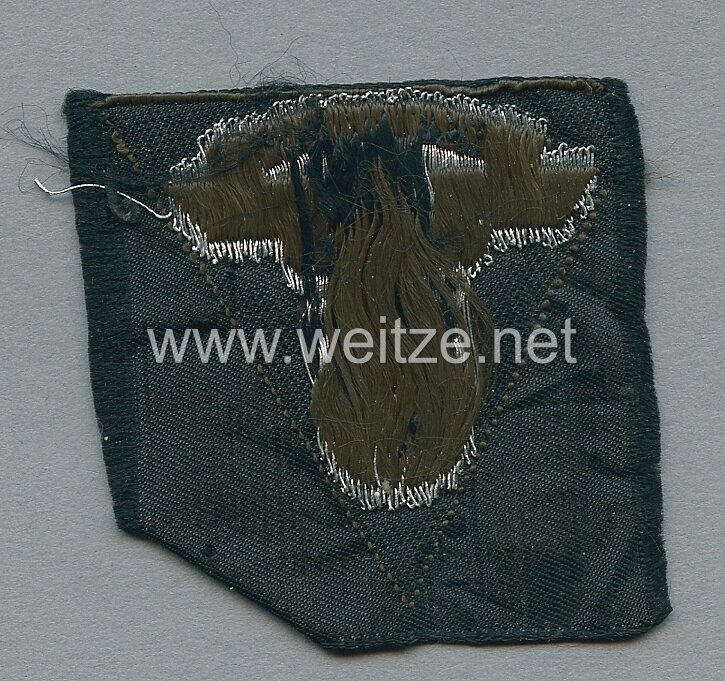
NSKK Overseas Cap Eagle for Führer of Motorgruppe Niedersachsen
The NSKK cap eagle for leaders of Motor Group Niedersachsen represents a significant example of the rank insignia and badges of the National Socialist Motor Corps (NSKK) during the Third Reich era. This particular badge was worn by leaders of the Motor Group Niedersachsen on their side caps and indicated their position within the hierarchical structure of this paramilitary organization.
The NSKK was founded on April 1, 1931, initially as a sub-organization of the Sturmabteilung (SA) and was elevated to an independent organization of the NSDAP on August 23, 1934. Under the leadership of Adolf Hühnlein, who served as Corps Leader from 1934 until his death in 1942, the NSKK developed into a significant motorized formation with over 500,000 members at its peak.
The organization was divided into various Motor Groups that corresponded geographically to German regions. The Motor Group Niedersachsen was one of these regional units and encompassed the area of present-day Lower Saxony as well as adjacent territories. Each Motor Group was led by a Motor Group Leader who commanded various Motor Standards, Motor Storms, and smaller units.
The present badge is woven in metal thread technique on a dark brown background, which corresponds to the characteristic coloring of NSKK uniforms. Metal thread weaving represented a high-quality manufacturing method in which aluminum or silver threads were directly incorporated into the fabric. This technique created a three-dimensional, lustrous appearance and was significantly more elaborate than simple cloth embroidery or printing processes.
The eagle as a symbol had central significance in National Socialist Germany and was used on nearly all uniforms and insignia. The national emblem typically showed a stylized eagle with spread wings holding a swastika in its talons. The specific design and positioning of the eagle varied according to organization and purpose. The NSKK used various eagle forms, with headgear badges generally designed smaller and more compact than the breast eagles on uniform jackets.
The side cap, also referred to as an overseas cap or garrison cap, was part of the NSKK uniform and was particularly favored by motorized units. The eagle was attached to the front of this cap, usually positioned centrally above the forehead. The authorization to wear such badges was strictly regulated and precisely specified by the NSKK service regulations.
The rank structure of the NSKK was complex and comprised numerous service grades from the simple NSKK-Man to the Corps Leader. Motor Group Leaders belonged to the higher ranks within the organization and wore special markings on their uniforms. These included special collar patches, shoulder boards, and indeed the headgear badges that signaled their position and affiliation.
The tasks of the NSKK included pre-military motor vehicle training, promotion of motorsports, and support of the Wehrmacht through technical services. During World War II, NSKK units were increasingly employed for military transport duties, training of drivers and technical personnel, and occupation duties in conquered territories.
The present specimen is described in condition grade 2, indicating a worn but still well-preserved piece. The signs of wear are characteristic of badges actually worn in service and distinguish them from unworn depot or warehouse pieces. Such signs of use may include slight oxidation of the metal threads, minimal damage to the fabric, or a certain patina.
From a historical perspective, such insignia document the pronounced hierarchy and complex system of rank badges in National Socialist Germany. They testify to the importance attached to the visual representation of authority and belonging. Today they serve as important study objects for military historians and uniform experts who research the structures and material culture of this period.
The metal thread construction technique used in this badge represents the craftsmanship standards of the period. Specialized manufacturers produced these insignia according to official patterns and specifications, with quality control ensuring uniformity across the organization. The dark brown backing material corresponds to the standard NSKK color scheme, distinguishing it from other Nazi organizations that used different color combinations.