Third Reich - WHW - “Opferschiessen 1934/1935”
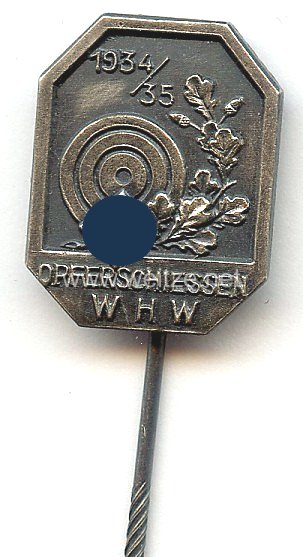
Winterhilfswerk Badge "Opferschießen 1934/1935"
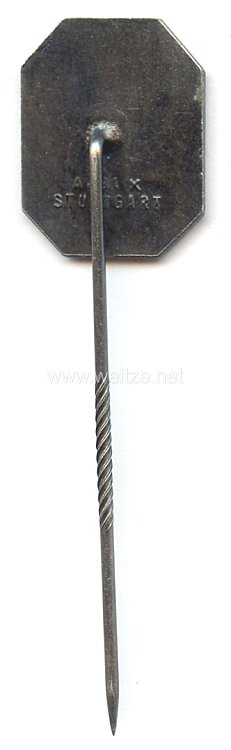
This badge documents a specific form of National Socialist fundraising during the early years of the Third Reich. It is a Winterhilfswerk (WHW) badge inscribed with "Opferschießen 1934/1935" (Sacrifice Shooting 1934/1935), manufactured by the firm A. Bux of Stuttgart, a well-known producer of badges and metal awards of this period.
The Winterhilfswerk des Deutschen Volkes (Winter Relief Organization of the German People) was established in September 1933 as a National Socialist welfare organization. Officially, it was meant to support needy Germans during the winter months, but in reality it primarily served as a propaganda instrument and means of social control. Participation in the WHW was formally voluntary, but in practice there was considerable social and political pressure to participate. Those who did not wear a WHW badge aroused suspicion and had to reckon with professional or social consequences.
The "Opferschießen" (Sacrifice Shooting) was a special type of fundraising event that was particularly popular in the first years of the NS regime. At such events, citizens could participate in organized shooting competitions in exchange for a donation. The term "Opfer" (sacrifice) refers to the financial sacrifice that the participant made for the supposedly charitable cause. These events cleverly combined the traditionally popular sport of shooting in Germany with National Socialist donation propaganda.
The 1934/1935 season was the second Winterhilfswerk campaign of the NS regime. After the seizure of power in 1933, the regime had begun to penetrate all areas of social life, and the WHW played a central role in this. In the winter of 1934/35, the consolidation of NS rule was already well advanced, and WHW collections reached a high degree of organization.
The badge is made of non-ferrous metal, a copper alloy typical of WHW badges. The use of simple materials corresponded on the one hand to the propagated "Volksgemeinschaft" (people's community) ideology, but on the other hand was also due to the economic situation. Precious metals were needed for armament purposes. The attachment was made by means of a pin on the back, which allowed it to be worn on the lapel or on clothing.
The manufacturer A. Bux of Stuttgart was one of numerous companies that produced badges on behalf of NS organizations. The production of such mass-produced items was a significant industry that employed thousands of workers. Manufacturers had to register and meet certain quality standards. Many badges therefore bore manufacturer's marks for identification.
WHW badges were issued in various series. In addition to monthly collections, there were special campaigns such as the Opferschießen documented here. The badges served as visible proof of the donation made and as an instrument of social control. Anyone not wearing a current badge stood out and came under suspicion of withdrawing from the "Volksgemeinschaft."
The legal basis of the WHW was created through various ordinances. The regime also used the organization to register the population and enforce ideological goals. The collections were strictly organized, with block wardens and other party functionaries monitoring participation.
From today's perspective, WHW badges are important contemporary historical documents that illustrate the penetration of everyday life by the NS dictatorship. They show how the regime instrumentalized even seemingly harmless activities such as charity and sports for its purposes. The large number of preserved badges testifies to the mass production and widespread distribution of these propaganda instruments.
Collectors and historians today value such objects as material witnesses of the NS era. They provide insights into the everyday history of the Third Reich and document the mechanisms of social control and propaganda. At the same time, they require critical historical contextualization to make their role in the totalitarian system understandable.