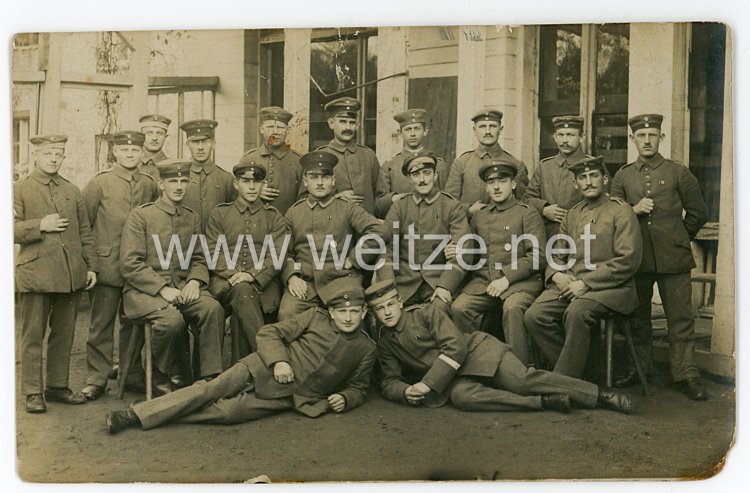
German Army Group Photograph
German Army group photographs in postcard format represent a fascinating testimony to the military photographic culture of the German Empire, Weimar Republic, and National Socialist era. Such photographs were an essential part of soldier life between the 1870s and 1945, serving both personal remembrance and military self-representation.
Technical and Historical Development
The postcard format, which became established from the 1870s onward, became the standard format for private photographs. With the introduction of the picture postcard by the German Imperial Post in 1872 and its increasing popularity in the 1890s, a flourishing market for photographic postcards developed. Military group photographs in this format experienced their heyday between 1890 and 1945.
The photographs were typically produced by professional court and military photographers who operated studios in garrison towns or visited troop locations as mobile photographers. Soldiers could purchase these images and send them to family members or keep them as mementos.
Military and Social Context
Group photos of the German Army documented various occasions and contexts: company or platoon shots after basic training, oath ceremonies, maneuvers, farewell photographs before front deployment, or camaraderie pictures during service time. They reflect the military hierarchy, with officers and non-commissioned officers typically positioned centrally or seated in the front row, while enlisted ranks arranged standing in the background.
The uniforms in such photographs provide important clues for dating and identifying units. In the Imperial period, soldiers wore characteristic Pickelhauben (spiked helmets), shakos, or helmets depending on their branch of service. After 1918, the Reichswehr's uniforms changed fundamentally, and from 1935 the Wehrmacht introduced new uniform standards.
The First World War
During the First World War (1914-1918), military photography gained particular significance. Millions of soldiers had their photographs taken before going to the front. These images became valuable mementos for those left behind, often the last photographs of fallen soldiers. The field-grey uniforms, steel helmets from 1916 onward, and equipment items document the material culture of the war.
Interwar Period and Second World War
In the Weimar Republic (1919-1933), the Reichswehr, limited to 100,000 men, continued the tradition of group photography. With the Nazi seizure of power and rearmament from 1935, the production of military photographs increased considerably. The Wehrmacht also used photography for propaganda purposes, while private photographs continued to play an important role.
During the Second World War (1939-1945), countless group photographs were taken on all fronts. These photographs document not only military units but also the geographical extent of the war from Norway to North Africa, from the Atlantic to the Eastern Front.
Collector Value and Historical Significance
Today, such photographs possess significant historical source value for military history research. They provide insights into uniforms, armament, equipment, and soldiers' daily life. For genealogical researchers, they can help identify ancestors and their military careers.
The condition of such photographs varies considerably. Signs of use such as creases, discoloration, or damage are typical for objects that were stored, mailed, or handled for decades. These traces of use are themselves part of the object's history and document its significance for the original owners.
Conclusion
Military group photographs of the German Army in postcard format represent a significant category of photographic militaria. They combine personal memory with historical documentation and offer valuable insights into German military history from the Empire to the end of the Second World War. As collectibles and historical sources, they contribute to understanding the lived reality of millions of soldiers.