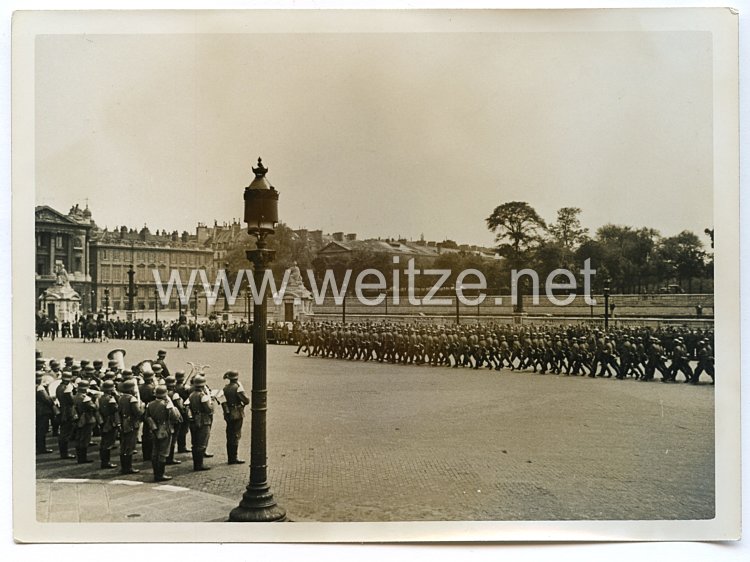
Wehrmacht Press Photograph: Parade at Place de la Concorde in Paris (France)
Wehrmacht Press Photography: The Parade at Place de la Concorde in Paris
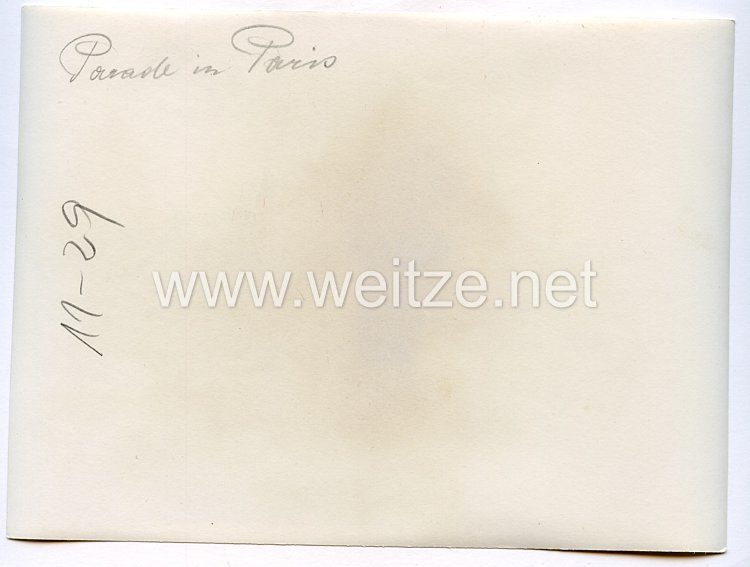
Wehrmacht press photography constituted a central element of National Socialist propaganda during World War II. The present object, a press photograph measuring 13 x 18 cm with inscription on the reverse, documents a military parade at the symbolically significant Place de la Concorde in Paris during the German occupation of France between 1940 and 1944.
Following the successful Western Campaign in May and June 1940, France capitulated on June 22, 1940, at Compiègne. The German Wehrmacht marched into Paris on June 14, 1940, and the French capital became the center of German occupation power in Western Europe. The Place de la Concorde, one of the world's most famous squares, quickly became a preferred venue for German military parades and propaganda events.
The Wehrmacht's Propaganda Companies (Propaganda-Kompanien or PK) were specialized units systematically built up from 1938 onwards. These companies consisted of war correspondents, photographers, filmmakers, and journalists whose task was to document the course of the war and prepare it for propaganda purposes. PK photographers were equipped with high-quality equipment and received special training in war photography.
Press photographs like the present one were used in multiple ways: they served for reporting in German newspapers and magazines, were utilized for propaganda publications, and were intended to convey the Wehrmacht's success to the home front. The inscription on the reverse of such photographs typically contained information about the date, location, photographer, PK unit, and a caption explaining the context.
The occupation of Paris held enormous symbolic significance for the National Socialist leadership. Paris was regarded as the cultural center of Europe, and the conquest of the French capital represented one of the Third Reich's greatest propaganda successes. Military parades at the Place de la Concorde, in the shadow of the Arc de Triomphe, or along the Champs-Élysées were carefully staged and photographically documented.
The 13 x 18 cm format was a standard size for press photographs of this period. This size allowed for good reproduction in newspapers and magazines while remaining manageable enough for archiving and distribution. The photographs were typically printed on high-quality photographic paper and stamped by the issuing authorities.
Wehrmacht press photography followed strict guidelines. Images had to first pass military censorship before being cleared for publication. The presentation was always meant to emphasize the superiority and discipline of the German armed forces. Scenes of defeat, suffering, or chaos were strictly forbidden.
Today, such historical press photographs represent important sources for historical research. They document not only military events but also the propaganda machinery of the NS regime and the staging of power. Collections of such photographs are housed in numerous archives, including the Federal Archives in Koblenz, the Institute for Contemporary History in Munich, and various international archives.
The authenticity of such photographs can be verified through various characteristics: the paper quality and signs of aging, the type of stamps and inscriptions on the reverse, and stylistic features of the photography itself. Collectors and historians must always critically examine such objects to determine whether they are original prints from the period or later reproductions.
Research into Wehrmacht press photography has gained increasing importance in recent decades. Scholars analyze not only the depicted events but also the visual language, composition, and intention behind these images. They form part of the critical examination of National Socialist visual propaganda and its effect on contemporaries and posterity.
The study of these photographs provides insights into how the Nazi regime sought to control and shape public perception through carefully curated images. The parades in occupied Paris were not merely military exercises but elaborate theatrical performances designed to demonstrate German dominance and the supposed inevitability of Nazi victory.