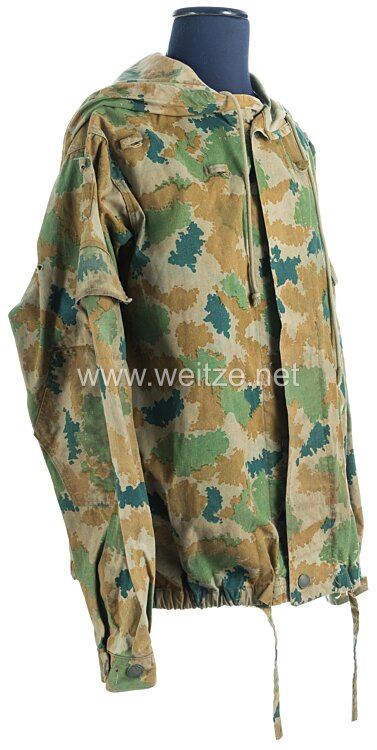
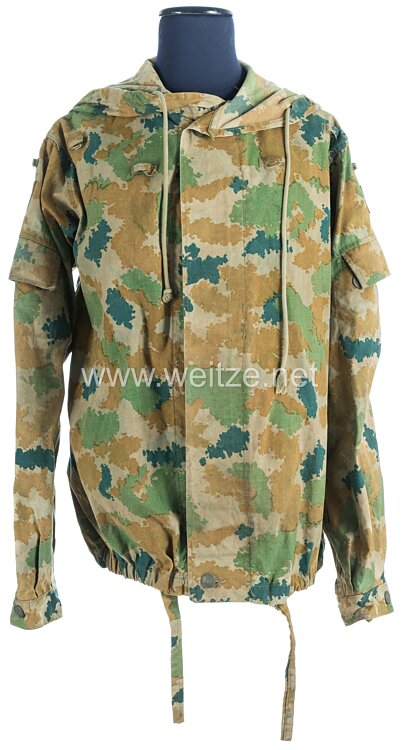
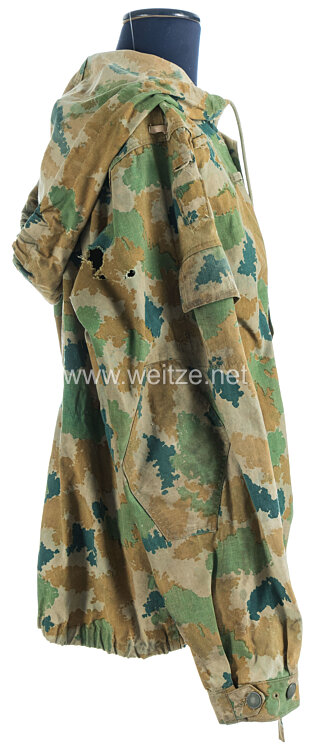
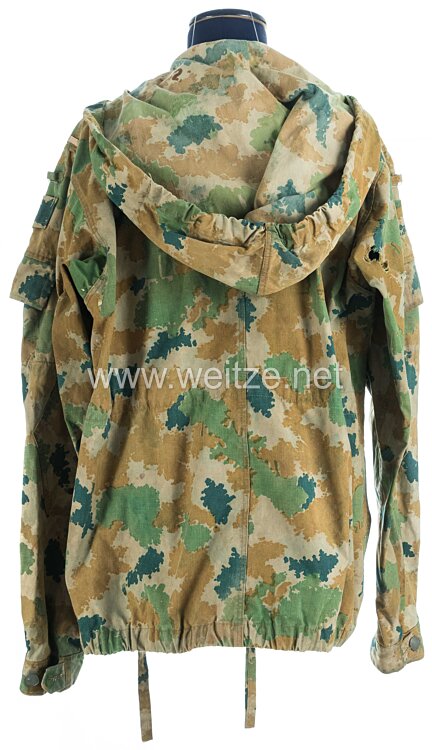
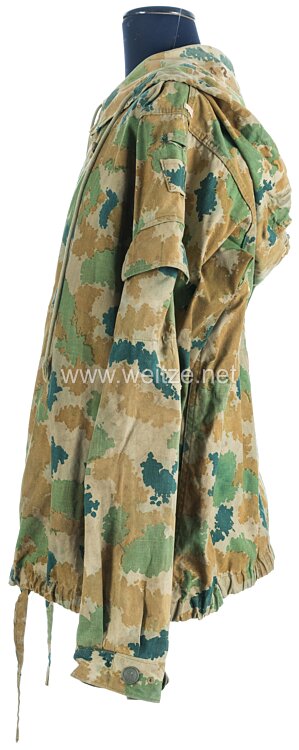
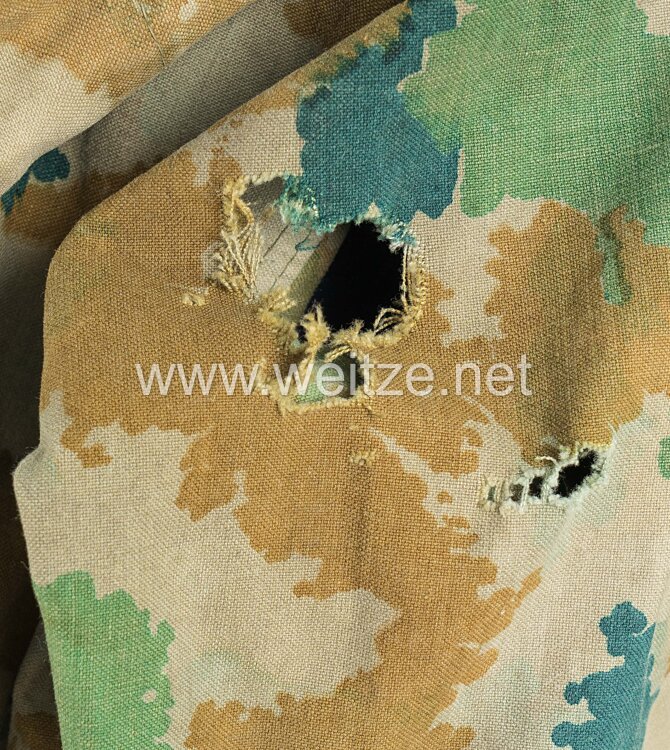
German Democratic Republic (GDR) National People's Army (NVA) Camouflage Jacket

Area camouflage pattern, 3rd quarter 1963, hood with camouflage net and drawstring. Interior marked "NVA 2 1802 III/63" with drawstring. Measurements: shoulder width approx. 49 cm, outer sleeve length approx. 70 cm, overall length approx. 73 cm. Condition 2.
454656
350,00

German Democratic Republic (GDR) National People's Army (NVA) Camouflage Jacket

The camouflage jacket of the National People's Army (NVA) of the German Democratic Republic represents an important component of the military equipment of the socialist German state during the Cold War. This specific specimen from the third quarter of 1963 documents a decisive phase in the development of NVA uniforms and reflects the military doctrine as well as the textile production of the GDR.

The National People's Army was officially founded on January 18, 1956, after the GDR joined the Warsaw Pact in 1955. The armament and equipment of the NVA were strongly oriented toward the Soviet model, but developed independent characteristics over the years. The development of specialized camouflage clothing was part of the comprehensive modernization efforts of the armed forces in the early 1960s.

The surface camouflage pattern (Flächentarnmuster) used on this jacket represented a characteristic development of GDR military textiles. Unlike earlier camouflage patterns that were still heavily influenced by pre-war German patterns or Soviet designs, the GDR developed an independent camouflage system in the 1960s. The surface camouflage pattern was characterized by large, irregular color fields, typically in shades of green, brown, and black, optimized for Central European vegetation.

The interior marking “NVA 2 1802 III/63” follows the standardized identification system of GDR military production. The designation “NVA” clearly identifies the equipment as property of the National People's Army. The subsequent numbers provide information about size, production number, and manufacturing quarter. The notation “III/63” precisely dates the manufacture to the third quarter of 1963, a time of intense rearmament after the construction of the Berlin Wall in 1961 and during the tense phase of the Cold War following the Cuban Missile Crisis.

The technical features of this camouflage jacket correspond to the military requirements of the early 1960s. The integrated hood with camouflage net and drawstring allowed soldiers to additionally camouflage their head and face and protect against weather influences. The camouflage net could be pulled over the helmet or head and provided additional visual fragmentation of the silhouette. The drawstrings on the hood and inside allowed individual adjustment to different body sizes and weather conditions.

The measurements of the jacket – shoulder width approximately 49 centimeters, outer sleeve length approximately 70 centimeters, and total length approximately 73 centimeters – correspond to a medium size and were part of a standardized sizing system that enabled efficient mass production and distribution.

The production of such camouflage jackets took place in various people-owned enterprises (VEB) of the GDR textile industry. Quality control was subject to strict military standards, and each garment was inspected before being issued to troops. The use of cotton blend fabrics was typical for this period, with synthetic fibers also being used later.

In tactical deployment, the camouflage jacket was typically worn over the regular field uniform. It was particularly used during field exercises, maneuvers, and in case of emergency. The NVA placed great emphasis on camouflage and deception, which was reflected in extensive training programs. Soldiers were intensively trained in the correct application of camouflage clothing and techniques.

The historical context of 1963 is significant: The GDR was in a phase of consolidation after the construction of the Berlin Wall. The NVA was continuously upgraded and professionalized, with conscription playing a central role. The armed forces comprised approximately 170,000 active soldiers at this time and represented an essential pillar of the Warsaw Pact.

Today, such original pieces of NVA equipment represent important contemporary historical documents. They document not only the military history of the GDR but also the industrial capability, textile technology, and the general everyday culture of the socialist German state. For collectors, museums, and historians, they offer authentic insights into the material culture of the Cold War.

The preservation in condition 2 indicates a well-preserved specimen that has survived the decades since its production and today serves as historical testimony to a bygone era.

r