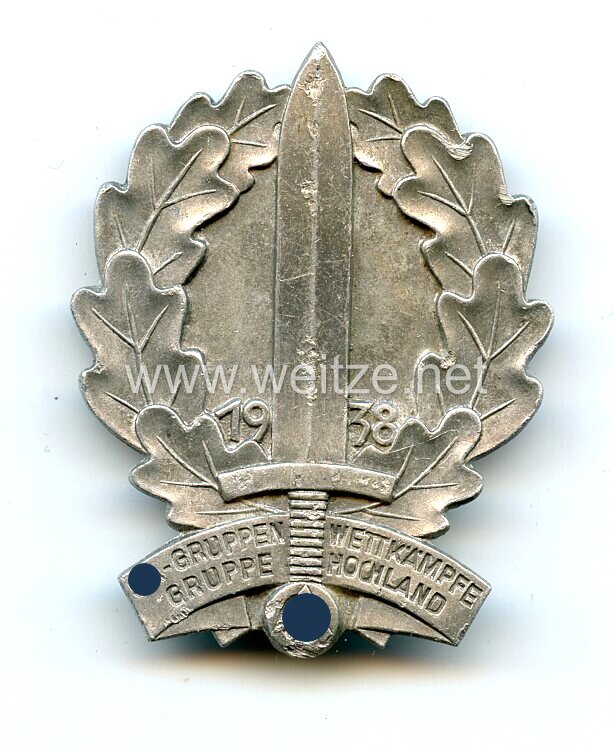
SA Group Competition Badge SA-Gruppe Hochland 1938
This badge for the SA Group Competitions of SA-Gruppe Hochland 1938 represents a significant artifact of the paramilitary organizational structure and competitive culture of the National Socialist Sturmabteilung (Storm Troopers). This award was presented on the occasion of athletic and military competitions that took place in 1938 within SA-Gruppe Hochland.
The SA-Gruppe Hochland was one of the regional administrative units of the Storm Troopers, encompassing southern Germany, particularly Bavaria. The SA was organized into various groups, each comprising several brigades, standards, and smaller units. Gruppe Hochland had its headquarters in Munich and played an important role in the National Socialist power structure of southern Germany.
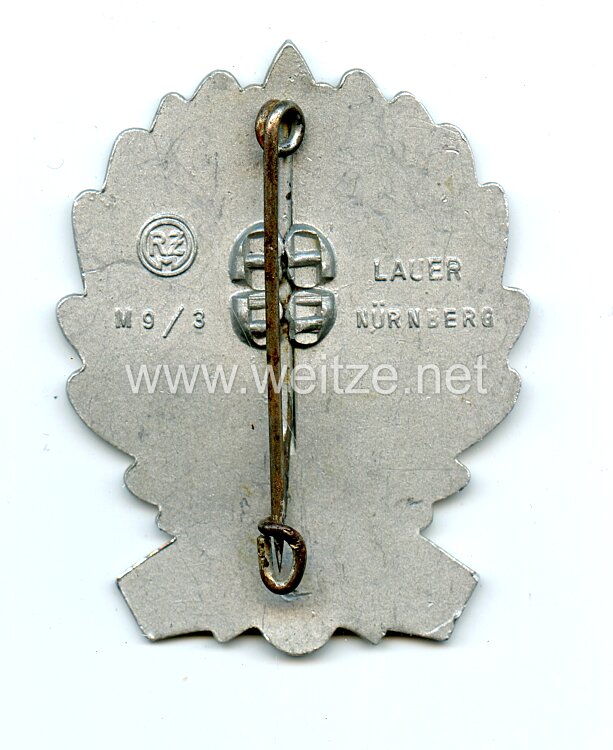
The badge was manufactured by the firm Lauer of Nuremberg, identifiable by the RZM manufacturer marking M9/3. The Reichszeugmeisterei (RZM) was the central procurement and inspection office of the NSDAP, which from 1929 oversaw quality control and standardization of party badges, uniforms, and equipment. The RZM issued manufacturer licenses and introduced a numbering system to prevent counterfeiting and ensure quality. The Lauer firm was among the established manufacturers of party insignia and had a long tradition in metalworking.
The Group Competitions of the SA were part of a comprehensive system of athletic and paramilitary events designed to promote camaraderie, physical fitness, and military training. These competitions included various disciplines such as cross-country marches, shooting exercises, close combat, and other militarily relevant skills. The year 1938 was of particular significance in this context, as it marked the period after the Anschluss of Austria in March 1938 and before the beginning of World War II.
Following the events of the Röhm Affair in June 1934, during which the SA leadership under Ernst Röhm was eliminated, the Storm Troopers had largely lost their originally dominant position within the Nazi state. Power shifted in favor of the SS under Heinrich Himmler. Nevertheless, the SA remained as a mass organization and increasingly focused on athletic and pre-military training. The organization still counted several million members in the late 1930s.
The competition badges fulfilled multiple functions: they served as visible recognition of special achievements, strengthened esprit de corps within units, and contributed to member motivation. Wearing such awards in public also demonstrated the presence and strength of the National Socialist movement. The badges were manufactured in various versions, with aluminum being a common material for mass production.
The technical execution of the badge displays the typical craftsmanship of the period: the stamped aluminum badge features a pin construction for attachment to uniforms or civilian clothing. The stamping process involved multiple work steps and could include both raised and recessed elements. Surface treatment varied by manufacturer and could be polished, matted, or enameled.
The historical context of 1938 is of considerable significance: in this year, National Socialist expansion policy achieved its first foreign policy successes with the annexation of Austria and the Sudetenland. The SA played a supporting role in these events, particularly in organizing marches and intimidating political opponents. The group competitions also served to strengthen the physical and psychological readiness of members for coming tasks.
From today's perspective, such objects are important material witnesses to a dark epoch of German history. They document the organizational structure, propaganda, and paramilitary orientation of the Nazi regime. Collectors and museums preserve these items for research and educational purposes, to convey to future generations the mechanisms of totalitarian rule. Handling such objects requires historical sensitivity and clear contextualization to prevent their instrumentalization for extremist purposes.
The production by a licensed RZM manufacturer like Lauer demonstrates the systematic control the Nazi Party exercised over even seemingly minor aspects of organizational life. Every badge, uniform piece, and insignia had to meet specific standards and bear official markings. This system ensured uniformity across the vast Nazi organizational structure while also generating revenue for approved manufacturers and the party apparatus itself.
Competition badges like this one from 1938 also reflect the regime's emphasis on physical culture and martial preparedness. The SA's athletic competitions were not merely sporting events but ideologically charged rituals that reinforced Nazi concepts of racial superiority, masculine strength, and military readiness. Participants were evaluated not only on their athletic performance but also on their embodiment of Nazi ideals.