Prussia Battle Clasp “Mézières” from the France Campaign 1870/71 for the Ribbon of a Battalion Color

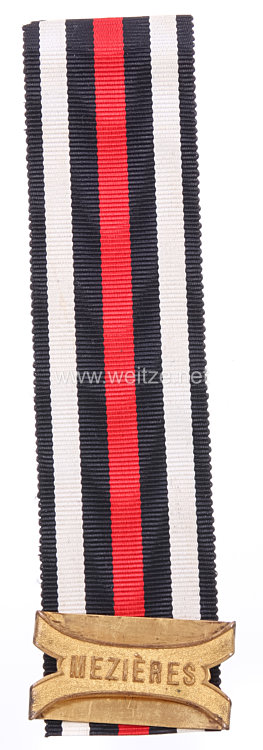
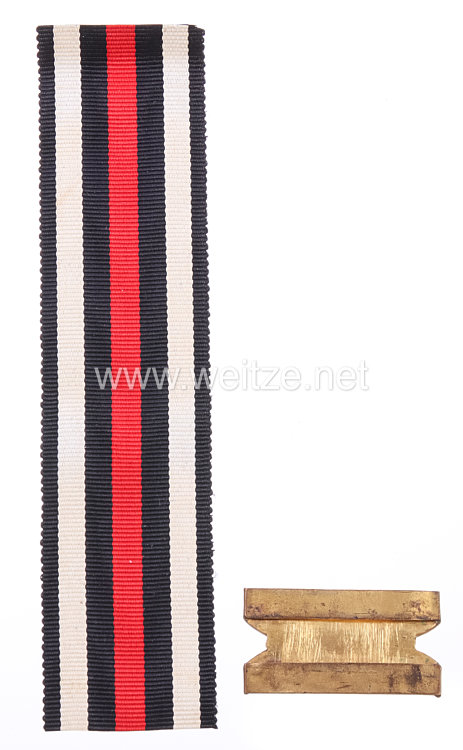
Campaign ribbon of the War Commemorative Medal 1870/71, with battle clasp “Mézières” in the special curved pattern for the color ribbon. Condition 2.
389755
350,00

Prussia Battle Clasp “Mézières” from the France Campaign 1870/71 for the Ribbon of a Battalion Color

The battle clasp “Mézières” represents a remarkable testimony to Prussian military history during the Franco-Prussian War of 1870/71. This special version was specifically created for the ribbon of a battalion flag and thus differs significantly from the ordinary battle clasps intended for individual soldiers.

The campaign against France 1870/71 marked a turning point in European history and led to the founding of the German Empire. The Prussian army and its allies achieved a series of decisive victories, which were honored with the War Commemorative Medal for 1870/71. This decoration was instituted by royal cabinet order on May 20, 1871, and was awarded to all participants in the campaign.

The Battle of Mézières took place in connection with the larger Battle of Sedan, which on September 1 and 2, 1870, led to the capitulation of the French army under Napoleon III. Mézières, a fortified town in the Ardennes near the Belgian border, played a strategically important role in the fighting during this decisive phase of the war. The encirclement and conquest of this area represented a significant military success.

The curved design of the battle clasp is characteristic of flag ribbon clasps and differs in shape and size from the rectangular clasps for ribbon bars on breast medals. These special clasps were attached to the ribbon of battalion or regimental flags to publicly display the unit's special merits and participation in specific battles. The flag itself was the most sacred symbol of a military unit, and its decoration with battle clasps documented the combat history of the formation.

The ribbon of the War Commemorative Medal 1870/71 was designed in black and white, the Prussian national colors. This color combination symbolized allegiance to the Prussian Crown and was used for numerous Prussian decorations. The War Commemorative Medal itself showed on the obverse the portrait of King Wilhelm I and on the reverse the Iron Cross with the inscription “GOTT WAR MIT UNS IHM SEI DIE EHRE” (God was with us, to Him be the glory).

The awarding of battle clasps followed a precise system. Not every battle or engagement was honored with its own clasp, but only particularly significant combat actions. For the French campaign of 1870/71, various battle clasps were authorized, including those for Gravelotte, Metz, Sedan, and indeed Mézières. The clasps were worn on the ribbon of the War Commemorative Medal and displayed the name of the respective battle in raised or recessed letters.

The manufacture of such flag ribbon clasps was carried out in specialized workshops and manufactories that specialized in military decorations. The curved shape required particular craftsmanship and made these pieces more elaborate to produce than the simple rectangular clasps for individual decorations. Materials varied, with brass and bronze frequently used, sometimes with gilding or other surface treatments.

In the Prussian military system, the battalion flag held outstanding symbolic significance. It was carried on ceremonial occasions, parades, and in the field and represented the focal point of the unit. The loss of a flag was considered the greatest disgrace, while its defense was regarded as the highest duty. The attachment of battle clasps to the flag ribbon documented the unit's participation in significant battles and served both as historical documentation and as a source of pride for the soldiers.

The condition grade 2 of the present clasp indicates a well-preserved example that, despite being over 150 years old, vividly documents historical events. Such flag ribbon clasps are significantly rarer today than individual medal clasps, as they were produced in much smaller quantities – typically only one example per participating unit for the flag.

The scholarly study of such militaria enables important insights into the organization, tradition maintenance, and commemorative culture of the Prussian army in the 19th century. Each battle clasp tells the story of a military unit and its participation in the events that led to the founding of the German Empire.

These artifacts represent not merely decorative objects but primary historical sources that illuminate the military, political, and social dimensions of one of Europe's most consequential conflicts. The Mézières clasp, with its distinctive curved form for flag ribbons, stands as a tangible connection to the soldiers and units that fought in the Ardennes region during that fateful autumn of 1870.