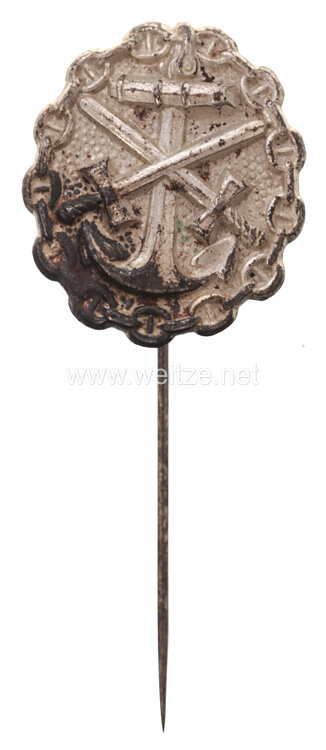
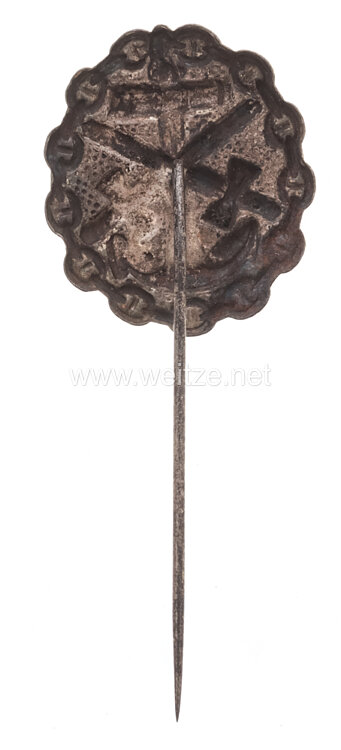
Naval Wound Badge in Silver - Miniature
The Naval Wound Badge in Silver represents a significant decoration of the German Imperial Navy from the First World War era. This miniature version, measuring 20mm, was intended for discreet wearing on civilian clothing or as a piece of jewelry, reflecting the military tradition of officially recognizing wounds sustained in service to the fatherland.
The Naval Wound Badge was instituted by Imperial decree on March 22, 1918, by Kaiser Wilhelm II. Its introduction occurred at a time when the First World War was already in its fourth year and German forces had suffered considerable losses. The Imperial Navy, engaged in numerous naval battles, submarine operations, and coastal defense actions, required a specific decoration for its wounded members that distinguished itself from the Army's wound badges.
The silver version was awarded for three or four wounds, while the black version was designated for one or two wounds, and the gold variant was reserved for five or more wounds. The badge typically displays an anchor as its central motif, surrounded by a laurel wreath, along with the Imperial Crown – symbols representing maritime tradition and imperial authority.
The miniature version described here differs from the regular wear version through its reduced size of 20mm. Miniature badges were widespread in the German Empire and Weimar Republic, serving various purposes. They were frequently worn on civilian clothing, particularly at festive occasions or veterans' gatherings where wearing full uniform was inappropriate. The hollow-embossed construction was a common manufacturing method that saved material and made the badge lighter without diminishing its aesthetic value.
The long pin on the reverse allowed secure attachment to various garments. This construction was characteristic of miniature badges of the era and differed from standard versions, which often featured shorter pins and sometimes screw attachments.
The manufacture of such miniature badges was carried out by various jewelers and goldsmiths, who often also produced official orders and decorations. Well-known manufacturers included firms such as Godet & Sohn in Berlin and other established medal factories. Quality varied depending on the manufacturer and price range, with high-quality pieces often made from genuine silver, while simpler versions consisted of silver-plated metal.
The Naval Wound Badge remained a valued decoration even after the end of the Empire in 1918 and throughout the Weimar Republic. Veterans of the Imperial Navy wore their badges with pride, and miniature versions were particularly popular among former officers working in civilian professions who did not wish to forget their military past.
During the period of National Socialism, imperial orders and decorations were initially tolerated but later supplemented or replaced by new National Socialist awards. The Wound Badge of the Second World War had a different design, with the Kriegsmarine's naval war badges taking on their own forms.
From a collector's perspective, miniature versions of the Naval Wound Badge are sought-after objects today. Their smaller size and often finer workmanship make them interesting objects of study. Condition plays an important role in historical and monetary value. A condition grade of 2 (as described here) indicates a well-preserved piece with minimal signs of wear, which is remarkable for an object over a hundred years old.
These miniature badges tell not only of military bravery and sacrifice but also of the social significance of military decorations in early 20th-century German society. They represent an era when military honors held high social standing and wearing such badges was a visible sign of personal sacrifice and national belonging.
The Naval Wound Badge, in all its variations, remains an important historical artifact that provides insight into the recognition systems of the Imperial German Navy and the broader military culture of the period. For historians and collectors alike, these pieces serve as tangible connections to the experiences of sailors who served during one of history's most devastating conflicts.