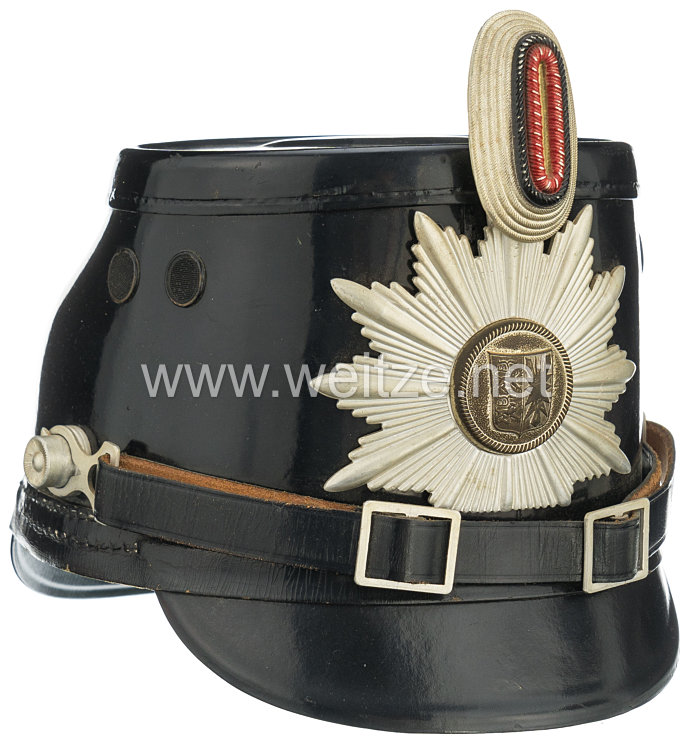
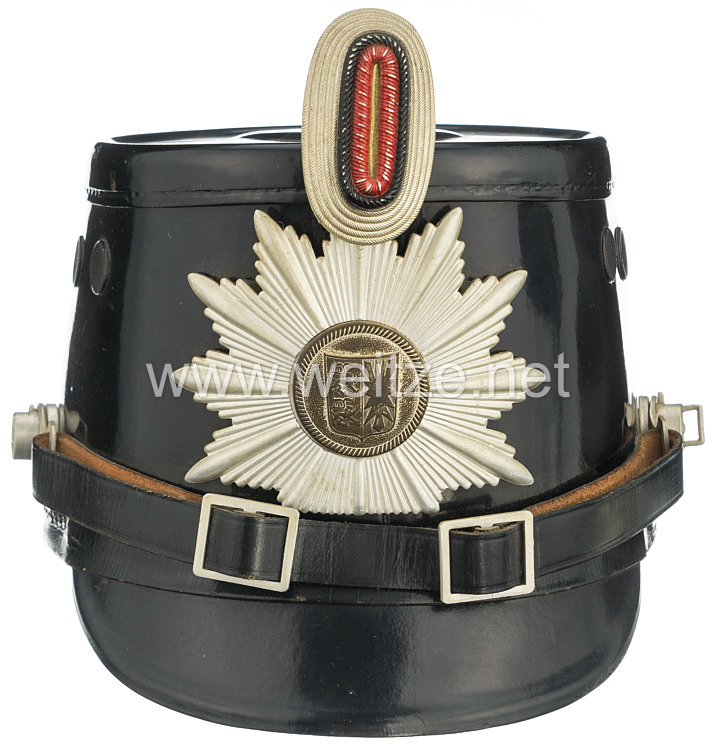
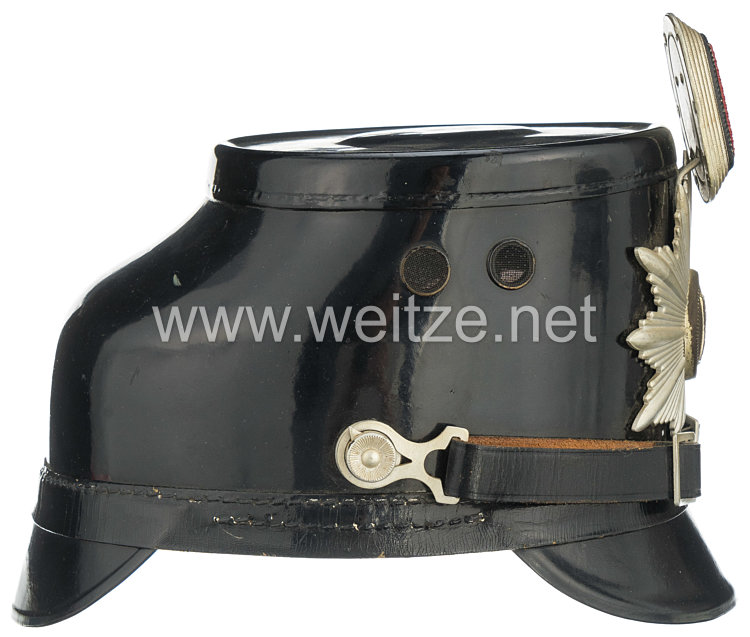
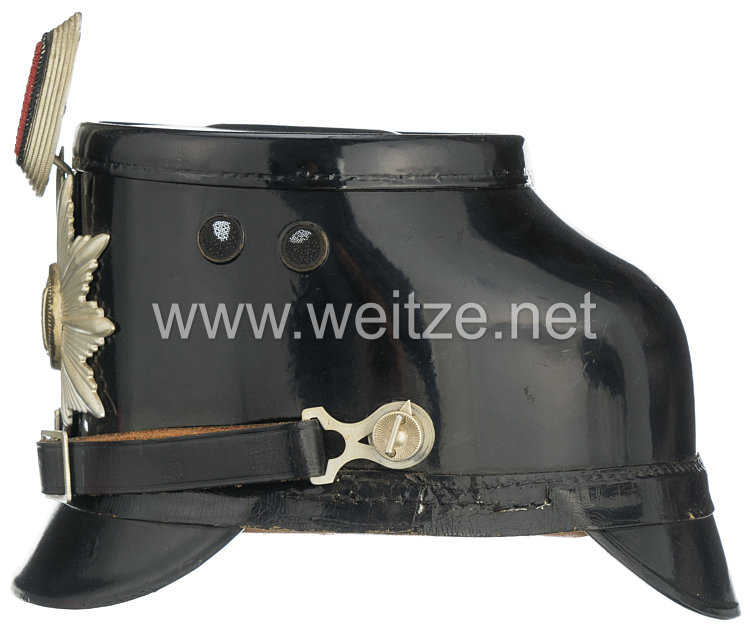
Federal Republic of Germany (FRG) Police Shako for Enlisted Men, State of Schleswig Holstein
Police Shako for Enlisted Personnel of the State of Schleswig-Holstein
This police shako represents an important chapter in German post-war police history and documents the development of state police forces in the Federal Republic of Germany. This traditional headgear made of black vulcanized fiber combines police functionality with the symbolism of the young democratic state.
Historical Context and Origins
After the end of World War II in 1945 and the unconditional surrender of the German Reich, the occupying powers assumed complete control over German territory. Police authority was initially exercised by military governments. With the founding of the Federal Republic of Germany on May 23, 1949, the gradual reorganization of the German police system began under democratic principles.
According to the Basic Law (Grundgesetz), police authority rested with the newly established federal states. Schleswig-Holstein, the northernmost federal state, established its own state police force with independent uniform regulations and equipment. The shako as a traditional headgear was deliberately chosen to connect with Prussian and German police traditions while placing them in a democratic context.
Material and Manufacturing
The use of vulcanized fiber as material was common for such headgear in the 1950s and 1960s. Vulcanized fiber is a cellulose-based material created by treating cotton fabric with zinc chloride. The material is characterized by its robustness, relative lightness, and dimensional stability. It could be produced cost-effectively, which was an important factor in the economically strained post-war period.
The black coloring corresponded to the traditional German police uniform. The shako was manufactured in various sizes to accommodate different head circumferences of police officers. Size 54 corresponds to a head circumference of 54 centimeters.
Symbolism and Identification
The large silver-colored police star on the front was the central identification mark of the German police. This star had its roots in Prussian police tradition and was retained after 1945 as a neutral, non-military symbol. In the center of the star was the coat of arms of Schleswig-Holstein, showing the two Schleswig lions and the Holstein nettle leaf. This combination of an all-German police symbol and state coat of arms illustrated the federal structure of the Federal Republic.
The lacquered cockade in the colors of the Federal Republic (black-red-gold) marked the democratic orientation of the new police force and its integration into the liberal-democratic constitutional state.
The Chin Strap
The black leather chin strap, attached to buttons marked “91,” served to securely fasten the shako during wind or physical activity. The numbering of buttons followed military and police equipment regulations and enabled assignment to specific manufacturers or production series.
Wearing and Use
The shako was worn by enlisted ranks of the Schleswig-Holstein police for representative occasions, parades, and guard duty. For daily patrol duty, more practical headgear such as peaked caps were increasingly used. The shako symbolized authority and state order and was meant to inspire respect and trust among the population.
The stitched inner lining provided wearing comfort and sweat absorption. This construction also allowed for some size adjustment.
Chronological Classification and End of Use
The active use of shakos by the Schleswig-Holstein police extended mainly through the 1950s and 1960s. With progressive modernization and professionalization of the police, these traditional headgear items were gradually replaced by more contemporary equipment. From the 1970s onward, shakos largely disappeared from active service but remained partially in use with police bands and for special ceremonial occasions.
Collector Value and Historical Significance
Today, police shakos from the early Federal Republic represent sought-after collector's items that document an important chapter of German post-war history. They testify to the reorganization of state structures, the federal order of the Federal Republic, and the effort to connect with positive traditions while consistently avoiding National Socialist symbolism. Objects like this shako from Schleswig-Holstein are material witnesses to the democratic new beginning and the development of rule-of-law institutions in Germany after 1945.