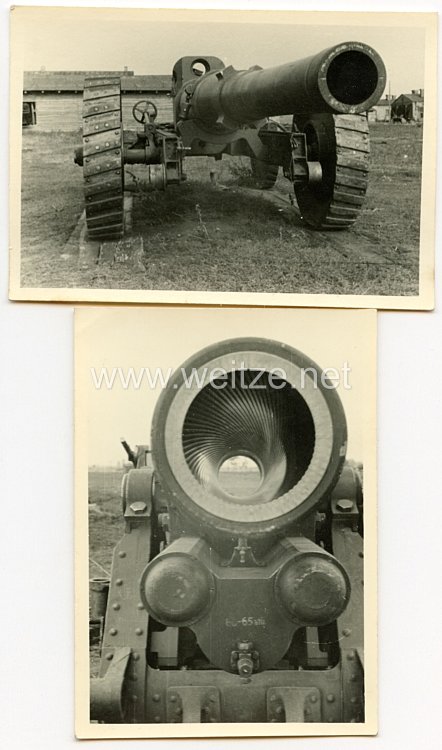
Wehrmacht Photograph, Russian Artillery

2 photographs, dimensions approximately 7 x 10 cm, condition 2.
445054
10,00

Wehrmacht Photograph, Russian Artillery

Wehrmacht Photographs: Russian Artillery in World War II

These two photographs from the World War II era document Soviet artillery pieces, captured by German Wehrmacht soldiers during Operation Barbarossa and the subsequent fighting on the Eastern Front between 1941 and 1945. Such images were significant both for intelligence purposes and as personal mementos for the soldiers.

Historical Context of the Eastern Front

The German attack on the Soviet Union on June 22, 1941 marked the beginning of the largest and most devastating land campaign in history. The Wehrmacht encountered a Red Army that, despite initial catastrophic losses, possessed considerable material resources. Soviet artillery played a decisive role in Soviet warfare and was referred to by Stalin himself as the “God of War.”

Soviet Artillery in World War II

The Red Army deployed a wide variety of artillery systems during the war. Among the most important were the 76.2mm divisional gun M1942 (ZiS-3), considered one of the best guns in its class, and the infamous Katyusha rocket launchers, called “Stalin's Organ” by German soldiers due to their characteristic sound. Soviet doctrine emphasized massive concentration of artillery fire, frequently massing several hundred guns on narrow front sectors.

Soviet artillery production far exceeded German output. Between 1941 and 1945, the Soviet Union produced over 480,000 artillery pieces of various calibers, while Germany manufactured approximately 160,000. This numerical superiority became particularly evident in the major offensives from 1943 onwards.

Wehrmacht Photography on the Eastern Front

The Wehrmacht maintained Propaganda Companies (PK) that officially documented the war. However, countless soldiers also took private photographs. Service Regulation H.Dv. 481 regulated the handling of photographic material and technically prohibited private photography of militarily sensitive objects, though this was often not strictly enforced in practice.

Photographs of captured or destroyed Soviet weapons were popular subjects. They served both as trophy documentation meant to demonstrate German superiority, and also documented the reality of combat and the enemy's strength. Many soldiers sent such pictures home or kept them as personal memories.

Intelligence Significance

Images of enemy equipment also had military value. The Foreign Armies East department under Major General Reinhard Gehlen systematically collected information about Soviet forces. Photographs helped identify weapon systems, assess Soviet capabilities, and evaluate enemy strength. Particularly in the first months of the war, the Wehrmacht was surprised by the quality and quantity of Soviet weapons such as the T-34 tank.

Technical Aspects of the Photographs

The specified format of approximately 7 x 10 cm corresponds to the then-common contact print format from roll film negatives. Most German soldiers used small format cameras such as Leica or Contax, or more affordable models like Agfa or Kodak cameras. These devices were robust enough for frontline use, and black-and-white film was relatively easy to develop even under difficult conditions.

Collector Value and Historical Significance

Such private photographs are important historical sources today. They show perspectives beyond official propaganda and document everyday war life from the viewpoint of ordinary soldiers. The stated Condition 2 according to the standard collector's scale (1 = mint to 6 = very heavily damaged) suggests well-preserved photographs with possibly minor signs of use.

For military historians and collectors, such images provide insights into equipment, tactics, and the reality of the Eastern Front war. They complement official documents and help paint a more complete picture of this traumatic period in history.

Ethical Considerations

Handling Wehrmacht materials requires historical sensitivity. These objects document a war of annihilation that claimed millions of victims. Their value lies in their function as historical witnesses that help us understand the past and learn from it.

r