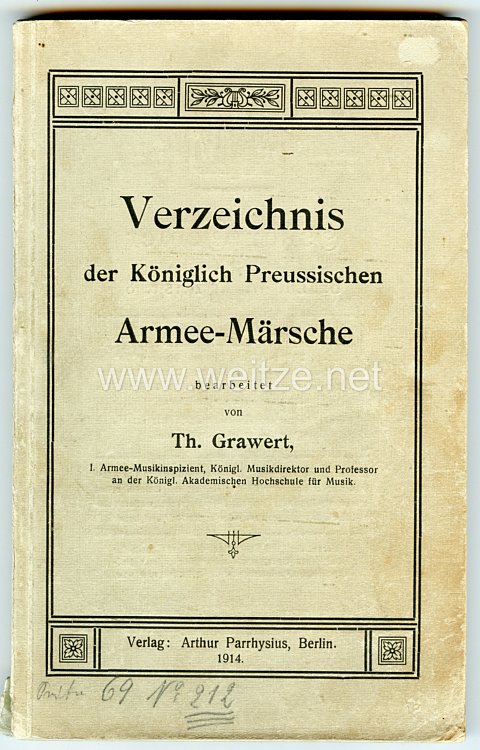
Directory of Royal Prussian Army Marches for the Infantry

Chapter 1: Slow Marches for the Infantry,
Chapter 2: Quick Marches for the Infantry,
Chapter 3: Cavalry Marches, Presenting Arms and Parade Marches for the Mounted Troops,
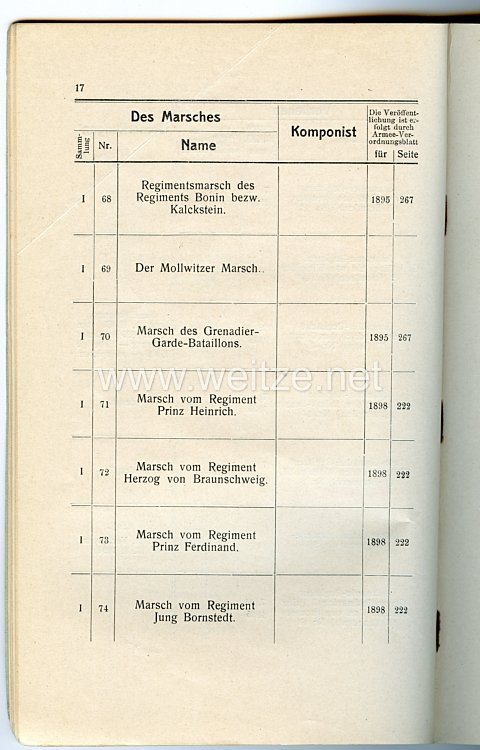
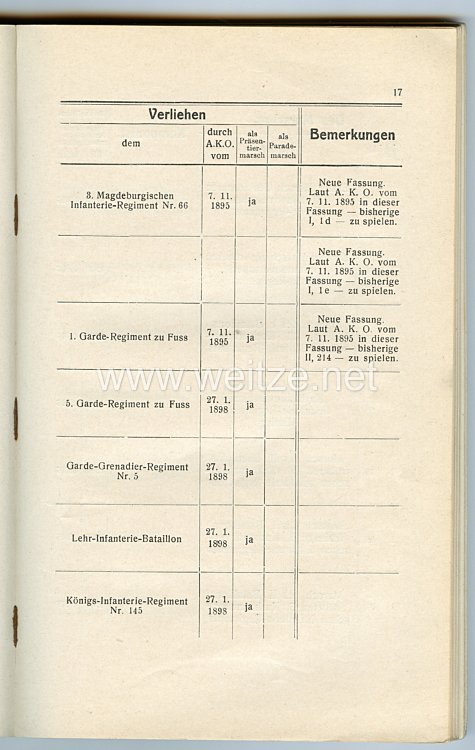
Of particular interest due to the assignment of marches to various units
Publisher: Arthur Parrhysius, Berlin 1914, edited by Th. Grawert, Army Music Inspector, Royal Music Director and Professor at the Royal Academy of Music, 94 pages, Format: 14.5 x 22.5 cm, Condition 2
422354
90,00

Directory of Royal Prussian Army Marches for the Infantry

The Directory of Royal Prussian Army Marches for the Infantry, published in 1914 by Arthur Parrhysius Publishing House in Berlin, represents a significant music-historical document of German military history. This compendium was carefully edited and compiled by Theodor Grawert, an Army Music Inspector, Royal Music Director, and Professor at the Royal Academic College of Music.

Military march music formed an indispensable component of Prussian and later German military affairs. Since the days of Frederick William I, the so-called “Soldier King,” and his son Frederick the Great in the 18th century, an elaborate system of regimental and troop marches developed that not only fulfilled practical military functions but also served identity formation and tradition maintenance.

This directory from 1914 appeared at a time marking a pinnacle of Prussian-German military tradition, immediately before the outbreak of World War I. It is systematically divided into three main chapters: slow marches for the infantry, quick marches for the infantry, and cavalry marches, presentation and parade marches for mounted troops. This structure reflects the functional differentiation of military music.

The slow marches, also called parade-step marches, were played at ceremonial occasions, parades, and representative deployments. They followed a tempo of approximately 60-75 beats per minute and were meant to express dignity and military splendor. The quick marches, on the other hand, served the practical purpose of rapid advance and followed a tempo of about 114-120 beats per minute, corresponding to the natural stepping rhythm of marching troops.

Of particular historical significance is the assignment of marches to various troop units documented in the directory. This practice was established during the 19th century and served to assign each regiment, brigade, or division a characteristic musical identity marker. A regiment was recognized not only by its flags and uniforms but also by its specific regimental march. These marches were borne with great pride and played at official occasions as well as during march-ins and march-outs.

The role of the Army Music Inspector was of considerable importance in the Prussian army. This position was institutionalized in the 19th century and was responsible for supervising musical standards, training military musicians, and maintaining the march repertoire. Theodor Grawert, as Professor at the Royal Academic College of Music, embodied the connection between academic music education and military practice.

The year 1914 marks a caesura in European and German history. The directory appeared in the last months of peace or possibly in the first months of the war. It thus documents a military tradition that would undergo considerable changes during the following four years of World War I. The Prussian army, whose marches are catalogued here, was a central component of the German armed forces in the Empire.

The cavalry marches and presentation marches for mounted troops had to fulfill special requirements. They had to be adapted to the tempo and rhythm of mounted troops and were played during parades and ceremonial march-pasts of cavalry regiments. The cavalry enjoyed a special status in the Prussian army, and its musical tradition reflected this elite character.

The publishing house Arthur Parrhysius in Berlin specialized in military and musical publications in the early 20th century. The publication of such directories served not only the practical purpose of standardization and documentation but also the dissemination and popularization of military music to the broader public.

The format of 14.5 x 22.5 cm and the scope of 94 pages suggest a handy, practice-oriented reference work that could be used by military musicians as well as officers and music enthusiasts. The preservation in good condition (condition 2) after more than a century testifies to the quality of printed materials of that era and the careful preservation by collectors and institutions.

Today, such a directory represents an important historical source document that provides insights into the musical culture of the German military on the eve of World War I and documents the significance of tradition, representation, and military identity in the Prussian-German army.