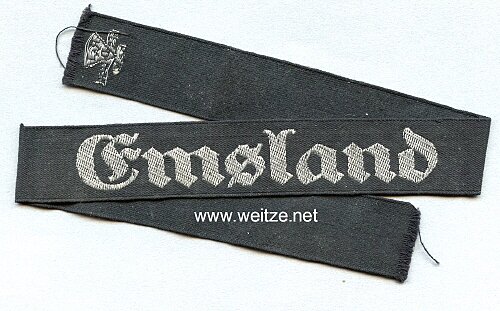
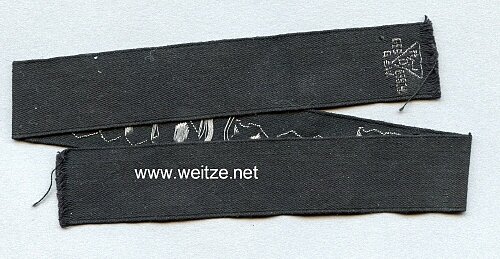
RAD Cuff Title "Emsland" for Leader

Metal thread woven construction, length 41 cm, unissued condition. Condition 2+.
181554
140,00

RAD Cuff Title "Emsland" for Leader

RAD Armband “Emsland” for Leaders – Historical Context

The object described here is an armband of the Reichsarbeitsdienst (RAD) bearing the inscription “Emsland,” designated for leaders (Führer). It is a metal-thread woven version measuring 41 cm in length and in unworn condition, indicating high-quality manufacture and careful preservation.

The Reich Labor Service and Its Organization

The Reichsarbeitsdienst (Reich Labor Service) was established on June 26, 1935, through the “Law for the Reich Labor Service” as a state organization of National Socialist Germany. Under the leadership of Konstantin Hierl, the RAD evolved from the Voluntary Labor Service founded in 1931 into a compulsory organization. From 1935 onward, all young German men aged 18 to 25 were required to complete six months of labor service before being conscripted for military service. In 1939, the labor service obligation was extended to include young women.

The RAD was hierarchically organized into Arbeitsgaue (labor districts), which were further subdivided into groups, districts, and detachments. The organization employed a military-style rank structure with various leadership ranks, from Truppführer (troop leader) to Reichsarbeitsführer (Reich Labor Leader).

The Emsland Region and RAD Camps

The Emsland, a region in Lower Saxony bordering the Netherlands, played a special role in the Reich Labor Service system. The region was already known during the Weimar Republic for moor colonization projects. Under Nazi rule, the Emsland became a focal area for RAD activities, particularly for cultivation and land reclamation work.

Numerous RAD camps were located in the Emsland, where young men worked on drainage projects, the construction of roads and canals, and the reclamation of moorland. These projects were part of the National Socialist autarky policy and aimed to expand Germany's agricultural land. Simultaneously, the Emsland served as a location for penal camps and concentration camps, making the region a symbol of Nazi oppression.

Armbands in the RAD System

The armbands of the Reich Labor Service were important uniform components for identifying affiliation with specific units or regions. They were worn on the left forearm of the RAD uniform and typically displayed geographic designations such as district names or regional identifiers.

The metal-thread woven version described here indicates a leader's armband, reserved for higher ranks. While ordinary RAD men wore armbands made of woven fabric, leaders often received higher-quality versions with metal threads (aluminum or silver-plated), which created a distinct visual difference and emphasized the wearer's rank.

According to RAD uniform regulations, various quality grades were specified for armbands. Metal versions were particularly popular among leaders and were often privately purchased, as they were considered status symbols.

Manufacture and Characteristics

The production of RAD insignia was carried out by various specialized manufacturers throughout the German Reich. Metal-thread woven armbands were manufactured on special looms, with aluminum or silver-plated threads woven into the fabric. The inscription “Emsland” would have appeared in characteristic Gothic script on a dark, usually black or dark blue background.

The length of 41 cm corresponds to the standard measurements for RAD armbands, designed to be wrapped around the forearm and sewn in place. The unworn condition of the described object suggests that it was either manufactured as a reserve item but never used, or that it was carefully preserved after the war.

Historical Significance and Collector Value

RAD armbands with geographic designations document the administrative structure and regional priorities of the Reich Labor Service today. The “Emsland” armband represents a region of intensive RAD activity and is of particular historical interest.

For military-historical research, such objects provide insights into uniform practices, organizational structure, and the regional distribution of the RAD. They document a chapter of German history that served to educate in the spirit of Nazi ideology and prepare for military service.

In contemporary historical research, such objects are viewed as material witnesses to a dictatorial organization that institutionalized forced labor and ideologically indoctrinated young people. The preservation and scholarly documentation of such items serves historical education and remembrance.