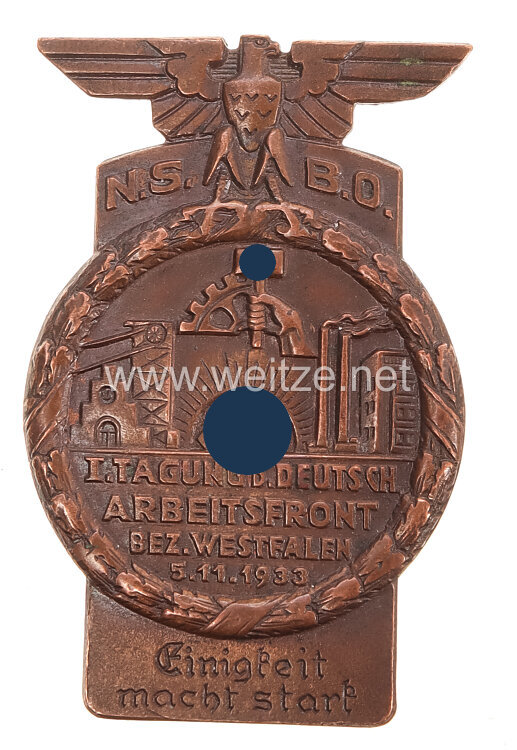
Third Reich - NSBO - 1st Convention of the German Labor Front District Westfalen 5.11.1933

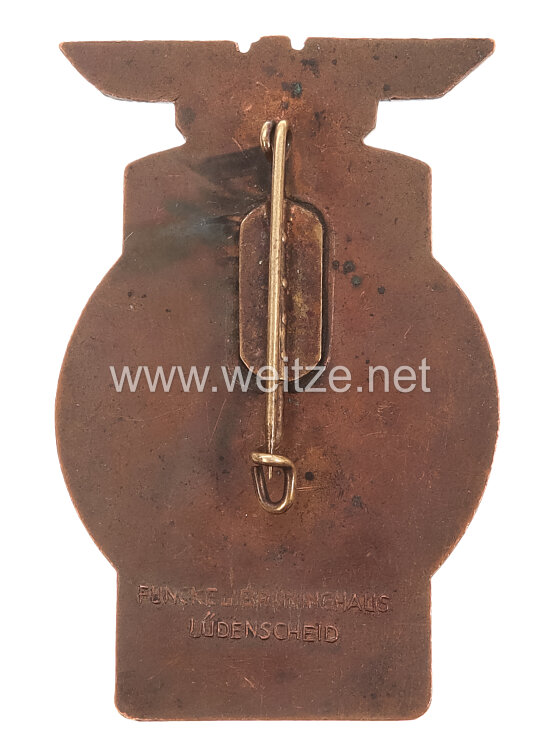
solid metal badge, approx. 54x34mm, Funcke & Brüninghaus Lüdenscheid
455754
120,00

Third Reich - NSBO - 1st Convention of the German Labor Front District Westfalen 5.11.1933

This badge documents a significant chapter in the early history of the German Labour Front (Deutsche Arbeitsfront, DAF) and its predecessor organization, the National Socialist Factory Cell Organization (Nationalsozialistische Betriebszellenorganisation, NSBO). This solid metal badge, manufactured by the renowned firm Funcke & Brüninghaus of Lüdenscheid, was issued to commemorate the first conference of the German Labour Front in the Westphalia district on November 5, 1933.

The NSBO was originally founded as a subordinate organization of the NSDAP to bring National Socialist ideology into factories and undermine traditional trade unions. After the seizure of power in January 1933, the coordination (Gleichschaltung) of the German labor movement accelerated dramatically. On May 2, 1933, the free trade unions were destroyed, their assets confiscated, and their officials arrested. They were replaced by the newly founded German Labour Front under the leadership of Robert Ley.

The DAF was officially established on May 10, 1933 and was intended, according to National Socialist ideology, to unite workers and employers in a “People's Community” (Volksgemeinschaft). The NSBO was initially integrated into the DAF but gradually lost significance as its often radical social policy demands conflicted with the regime's economic policy objectives. The November 1933 conference thus took place during a transitional phase when the structures of the new labor organization were still being consolidated.

The Westphalia district was an important industrial location with significant mining and heavy industry areas, particularly in the Ruhr region. The organization of major events like this first district conference served multiple purposes: it was meant to demonstrate the power of the new organization, indoctrinate the workforce with National Socialist ideology, and simultaneously maintain the appearance of interest representation.

The production by Funcke & Brüninghaus of Lüdenscheid is typical for the manufacture of NS badges and decorations. Lüdenscheid and southern Westphalia were traditional centers of metalworking and the production of awards, orders, and badges. Numerous firms in this region supplied the NS regime with a variety of badges for party organizations, conferences, and special occasions. The designation “solid metal badge” indicates high-quality workmanship, which was still common for early NS badges, particularly from 1933.

Such conference badges fulfilled multiple functions: they served as proof of attendance, as mementos, and as visible signs of belonging to the National Socialist movement. Wearers of such badges demonstrated their loyalty to the party line and their participation in important organizational events. Within the internal hierarchy of NS organizations, wearing such badges could certainly confer status and prestige.

The German Labour Front developed in subsequent years into the largest mass organization of the Third Reich, with at times over 25 million members. It controlled not only labor relations in factories but also organized leisure activities through the sub-organization “Strength Through Joy” (Kraft durch Freude, KdF) and vocational training through the “German Work Education Programme”. The NSBO itself was effectively dissolved in 1935 and completely integrated into the DAF.

From today's perspective, such badges are important contemporary historical documents that illustrate the organizational structures and propaganda methods of the NS regime. They document the systematic capture and control of all areas of life by the National Socialist movement. The conference of November 5, 1933, took place just a few weeks after Germany's withdrawal from the League of Nations on October 19, 1933, and the staged Reichstag elections of November 12, 1933, thus during a phase of intense domestic and foreign policy upheavals.

Collectors and historians value such early badges as sources for researching the organizational history of National Socialism. The size of approximately 54x34mm and the solid metal construction are typical for event badges of this period. Today they serve in museums and educational institutions for historical education about the mechanisms of totalitarian rule.