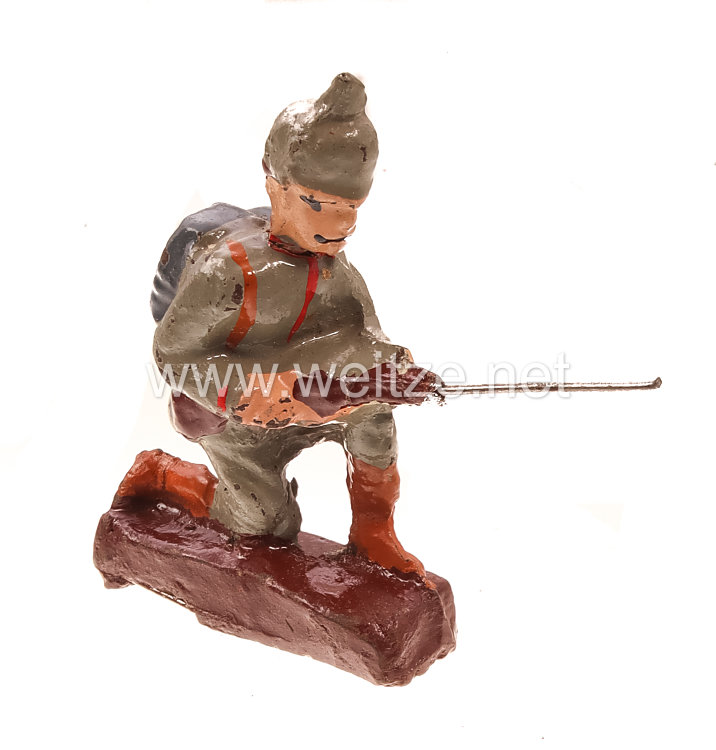
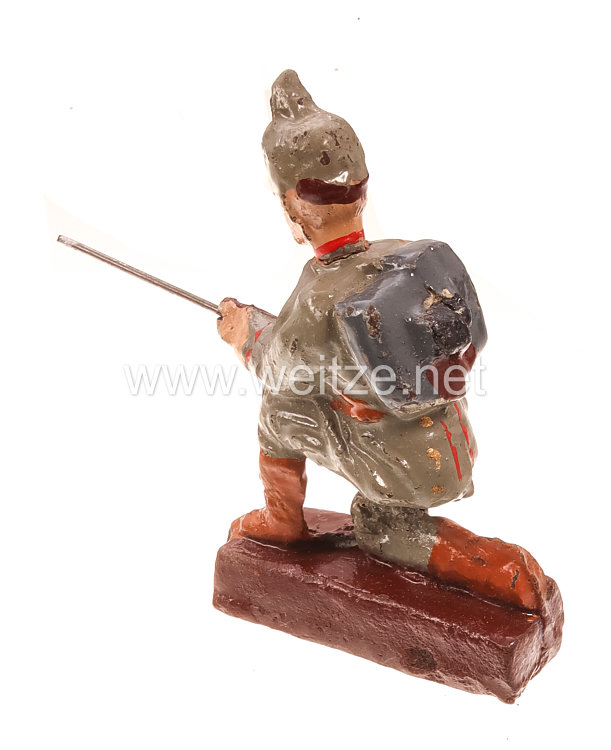
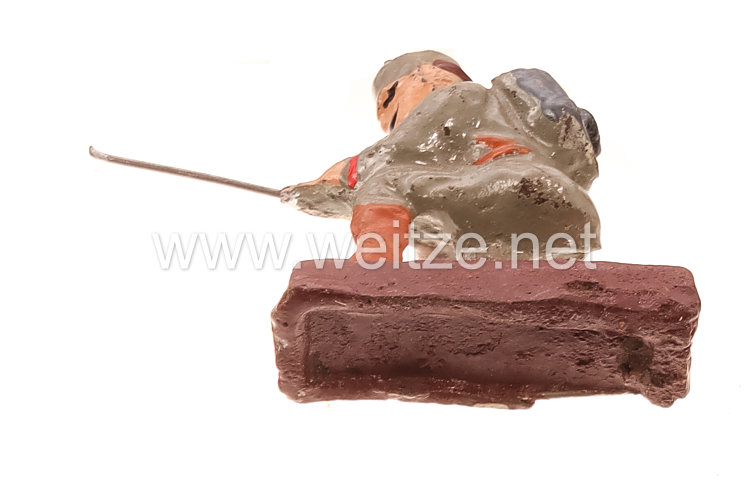
Elastolin - World War I Prussian Soldier Kneeling in Firing Position,
This Elastolin figure depicting a kneeling Prussian soldier in firing position from World War I represents a significant collectible from the golden age of German toy production. Standing 10 cm tall, this figure belongs to the standard size of Hausser-Elastolin composite figures manufactured between the 1900s and the mid-20th century.
The Hausser company, founded in 1904 in Ludwigsburg, Germany, developed the revolutionary material Elastolin – a composition of casein, chalk, glycerin, and other additives molded around a wire armature. This material allowed for much more detailed and durable construction than the lead figures commonly used until then. The company quickly established itself as one of Germany's leading manufacturers of toy and collectible figures.
The figure wears the characteristic field-gray uniform (Feldgrau), which was gradually introduced into the Prussian and German army from 1910 onwards. This uniform marked a radical break from the colorful uniforms of the 19th century. The necessity for camouflage coloring had become apparent in colonial wars and through the development of longer-range and more accurate firearms. Field gray offered better concealment on the modern battlefield and was officially adopted for the entire German army in 1907/08, with complete conversion achieved by 1914.
Particularly noteworthy is the depicted Pickelhaube, the legendary Prussian-German leather helmet with its characteristic spike. The Pickelhaube, introduced in the Prussian army in 1842, became an international symbol of German militarism. During World War I, however, the Pickelhaube was increasingly replaced by the more practical steel helmet (Stahlhelm). From 1916 onwards, the M1916 steel helmet became the predominant headgear at the front, while the Pickelhaube was mainly worn by reserve units, rear echelon troops, and during ceremonial occasions.
The kneeling shooting position in which the figure is portrayed was a fundamental combat stance in World War I. This position offered a compromise between mobility and cover and was a standard component of military training. The Gewehr 98 rifle, which was presumably intended to be represented (here damaged), was the standard weapon of German infantry and was considered one of the finest bolt-action rifles of its time. The system developed by Paul Mauser was renowned for its precision and reliability.
Elastolin figures from World War I were particularly produced and sold during the 1920s and 1930s, when memories of the conflict were still fresh. These figures served not only as toys but also as commemorative items and collectibles. They represented a specifically German perspective on the war and contributed to shaping collective memory.
The condition rating of 2- indicates a well-preserved figure with slight signs of use. The mentioned damage to the rifle is typical for Elastolin figures of this age, as thin, protruding parts were particularly susceptible to breakage. The state of preservation is remarkable considering these figures were originally designed as toys and experienced intensive use.
From a collector's historical perspective, Elastolin figures from World War I are today sought-after objects of militaria and toy history. They document not only military history but also the social and cultural history of the first half of the 20th century. The quality of modeling, attention to detail, and historical authenticity of uniform representation make these figures valuable sources for uniform scholars and military historians.
The production of Elastolin figures was severely restricted during World War II and continued under Allied control after the war. The Hausser company produced figures until the 1980s, with the quality and collectibility of early figures from 1900 to 1945 considered the highest. Today, these figures are not only collectibles but also testimonies to a bygone era of toy manufacturing and society's engagement with war and military.