World War I Field Marshal Hindenburg Turns 70
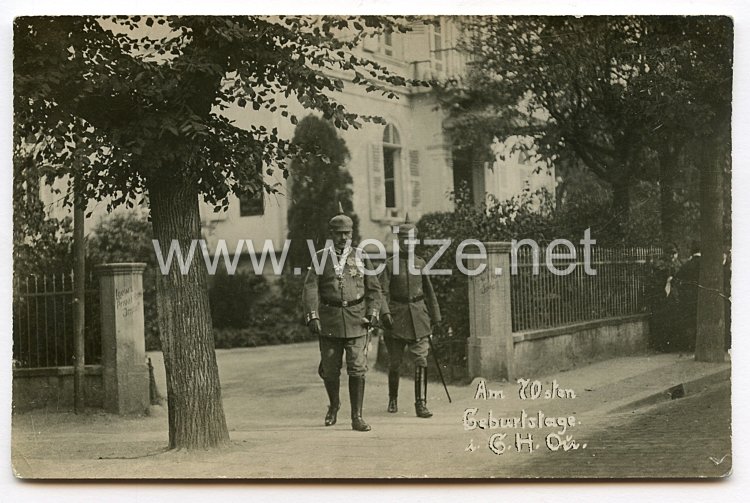
Field Marshal Paul von Hindenburg and his 70th Birthday during World War I
This postcard commemorating the 70th birthday of Field Marshal Paul von Hindenburg represents a typical example of German propaganda and commemorative culture during World War I. Paul von Beneckendorff und von Hindenburg was born on October 2, 1847, in Posen, meaning his 70th birthday occurred on October 2, 1917 – in the midst of the war's fourth year.
By this time, Hindenburg had already achieved legendary status in the German Empire. Following his triumphant victory at the Battle of Tannenberg in August 1914 against Russian forces, he had become a symbol of German resistance. Together with his Chief of Staff Erich Ludendorff, he had repelled the Russian invasion of East Prussia and risen to become a national hero.
In August 1916, Hindenburg was appointed Chief of the Supreme Army Command (Oberste Heeresleitung), effectively assuming military leadership of the German Reich. His 70th birthday in October 1917 thus fell at a time when he was at the height of his power. German propaganda intensively exploited such occasions to strengthen morale on the home front and spread messages of perseverance.
Postcards as Propaganda Medium
Postcards were one of the most important mass media during World War I. They served for communication between the front and home, but were also deliberately employed as propaganda instruments. Millions of picture postcards with patriotic motifs were produced and distributed. They depicted Kaiser Wilhelm II, successful generals, war scenes, symbolic representations, and allegorical figures.
Postcards honoring Hindenburg were particularly popular. They typically showed him in his field marshal's uniform, often with his characteristic mustache and massive appearance that had become part of his public image. The Hindenburg cult reached unprecedented proportions during the war: Hindenburg monuments were erected where citizens could hammer in nails for donations, children were named after him, and his likeness adorned countless everyday objects.
Historical Context of 1917
The year 1917 was a turning point in World War I. In April, the United States declared war on Germany, fundamentally changing the strategic situation. In the East, the Russian Revolution initially led to the collapse of Russian war efforts, providing Germany with short-term advantages. The Third Supreme Army Command under Hindenburg and Ludendorff had ordered withdrawal to the heavily fortified Siegfried Line in February 1917.
The battles of attrition on the Western Front – Verdun and the Somme – had caused enormous losses on all sides. The British offensive at Passchendaele raged in autumn 1917, claiming hundreds of thousands of casualties. The German home front suffered under the British naval blockade, which led to severe supply shortages. The Turnip Winter of 1916/17 had severely affected the civilian population.
Collector Value and Preservation
Postcards from World War I are sought-after collectibles today. They document not only military aspects but also social-historical and art-historical developments. Condition assessment typically follows a grading system from 1 (mint) to 5 (heavily damaged). A condition grade 2 denotes a very well-preserved card with minimal signs of use, possibly slight corner creases or minor signs of aging, but without major damage.
The choice of motif – Hindenburg's 70th birthday – makes this card a historical document of particular interest. It reflects the veneration accorded to the field marshal and illustrates the importance of personalizing military leadership in war propaganda.
Post-War Significance
Hindenburg's popularity survived the German defeat of 1918. From 1925 until his death in 1934, he served as President of the Weimar Republic. His appointment of Adolf Hitler as Reich Chancellor on January 30, 1933, paved the way for the National Socialist dictatorship. This later role gives documents from his time as a war hero an additional historical dimension and makes them important sources for understanding 20th-century German history.