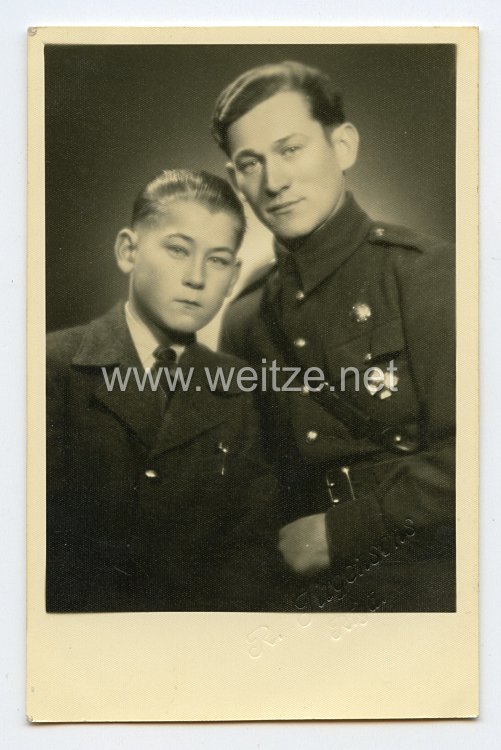
Latvia Portrait Photograph of a Soldier
This portrait photograph of a Latvian soldier from the 1930s represents an authentic testimony to a significant period in the history of the Baltic state. This postcard-sized photograph documents the era of the First Latvian Republic (1918-1940), a time of relative independence between the two World Wars.
Following the end of World War I and the collapse of the Russian Empire, Latvia declared its independence on November 18, 1918. However, the young republic first had to defend its sovereignty in the Latvian War of Independence (1918-1920) against Soviet Russian troops, German Freikorps, and Baltic Landwehr forces. After victory, the Latvian state consolidated and built its own military structures.
The Latvian Armed Forces (Latvijas armija) of the interwar period were organized following French and British models. In the 1930s, the army comprised approximately 20,000 active soldiers in peacetime and could be expanded to up to 150,000 men upon mobilization. The armed forces consisted of infantry, cavalry, artillery, technical troops, and a small air force.
Soldier portraits in postcard format were extremely popular during this era. This standardized size (typically 9 x 14 cm or similar formats) allowed soldiers to send their pictures to family and friends at affordable costs. Photographic studios in garrison towns such as Riga, Liepāja, Daugavpils, and other locations specialized in military portrait photography. The photographs typically showed soldiers in their dress uniforms, often with medals, badges, and rank insignia that documented their status and affiliation.
The Latvian military uniform of the 1930s was characteristic of the period. It typically consisted of a field-gray or khaki uniform tunic that conformed to Central European standards. Officers often wore peaked caps with the Latvian state emblem, while enlisted men and non-commissioned officers wore various headgear depending on their branch of service. The Latvian military placed great emphasis on traditions and national symbolism, which was reflected in uniform details and insignia.
Latvia's political situation in the 1930s was marked by increasing authoritarian tendencies. Following the coup d'état by Kārlis Ulmanis on May 15, 1934, the country developed into an authoritarian presidential republic. Ulmanis, who served as Prime Minister and later also as State President, strengthened the military as an important pillar of his rule. The army was modernized and its social significance emphasized.
Soldier photographs served multiple purposes: they were personal mementos, documents of pride in military service, and testimonies to the national identity of the young Latvian state. In a time when universal conscription existed, virtually every young Latvian man went through military service, making these photographs a widespread cultural phenomenon.
The used condition of such historical photographs is typical for documents that were actually utilized – sent as postcards, kept as mementos in wallets or photo albums. Signs of use such as slight creases, discoloration, or damage to the edges are testimonies to their authentic history and their personal value to the original owners.
The historical significance of such photographs was tragically amplified by the events of 1940. As a consequence of the Molotov-Ribbentrop Pact, the Soviet Union occupied Latvia in June 1940, marking the end of the First Republic. Many of the soldiers depicted in such photographs suffered tragic fates: deportation to Siberia, execution by Soviet authorities, or forced recruitment into various armies during World War II.
Today, such soldier portraits are important historical sources for military historians, uniform specialists, and genealogists. They document not only military details such as uniforms and equipment but also social history aspects of Latvian society during the interwar period. For descendants, they are often the only visual memories of ancestors from this turbulent era.
The collection and preservation of such photographic documents contributes to preserving Latvia's cultural memory and enables future generations to understand their country's history and the individual fates of those who served during this significant period.