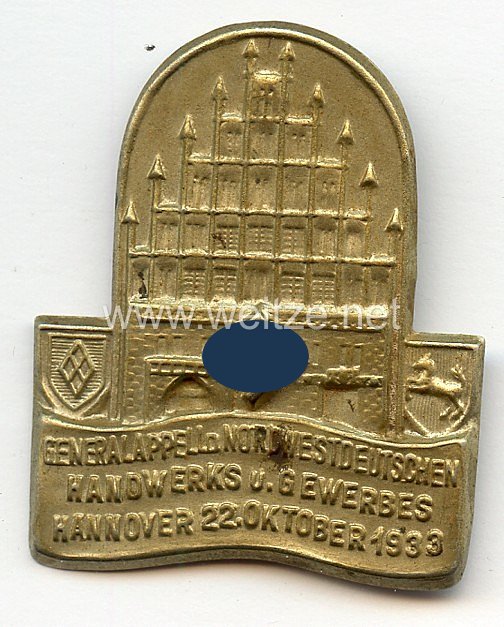
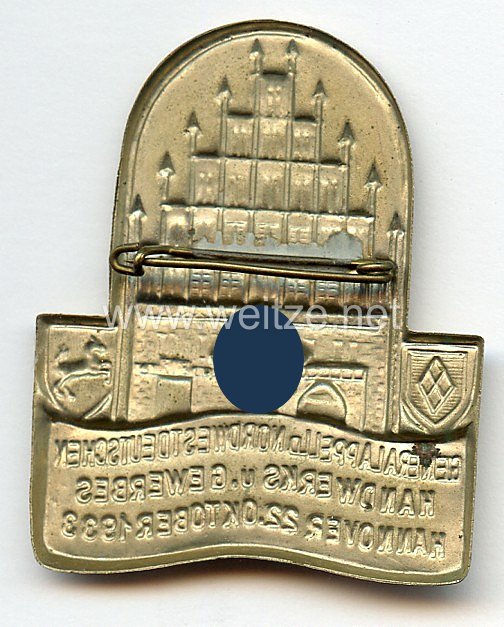
Third Reich - General Assembly of the Northwest German Crafts and Trades Hannover October 22, 1933
The metal badge at hand documents the General Assembly of Northwest German Crafts and Trade that took place on October 22, 1933 in Hanover. This event exemplifies the far-reaching Gleichschaltung (coordination) of German economy and society during the first year of National Socialist rule.
After the seizure of power in January 1933, the National Socialists systematically began to bring all areas of society under their control. Crafts and trade were of particular importance, as they not only represented a significant economic factor but were also to be ideologically appropriated as potential carriers of the “German middle class.” The middle-class ideology was a central element of Nazi propaganda, which glorified the independent craftsman as the embodiment of German productivity.
The event in Hanover in autumn 1933 was part of a series of mass rallies and assemblies through which the regime demonstrated its power and sought to integrate various professional groups into the National Socialist Volksgemeinschaft (people's community). Such general assemblies were carefully orchestrated propaganda events designed to create a sense of community and loyalty to the new state through their symbolism, staging, and mass effect.
The badge itself should be understood as a participant badge distributed to attendees of the event. Such badges served multiple functions: they acted as entry permits, as souvenirs, and not least as visible declarations of participation in an NS event. Wearing such badges was simultaneously a form of public demonstration of political loyalty during a time when conformity was increasingly enforced.
The production as a metal badge with pin fastening was typical for mass production of such event badges. They were inexpensive to manufacture and could be produced in large quantities. The design of such badges usually followed a uniform pattern: they contained the name of the event, the date, the location, and frequently National Socialist symbols such as the swastika or the Reich eagle.
The timing of the event in October 1933 is significant. By this point, the National Socialists had already taken essential steps to consolidate their power: the Enabling Act had been passed in March, trade unions had been crushed in May and replaced by the German Labor Front (DAF), and in July the Law Against the Formation of New Parties had been enacted, making the NSDAP the only legal party.
The crafts sector was incorporated into the system of the Reich Economic Chamber, founded in 1933. Later, further organization occurred through German Crafts, which was under direct control of the regime. These structures were intended on the one hand to direct economic activity and on the other to ensure that small and medium-sized enterprises operated in ideological conformity.
Events like the Hanover General Assembly served to demonstrate the new power relationships and to commit participants to the regime's goals. Typically, such events included speeches by leading NSDAP functionaries, parades, flag ceremonies, and other ritualized elements of National Socialist staging practice.
From a collection-historical perspective, such badges are today important sources for researching National Socialist everyday culture and propaganda. They document the comprehensive organization and mobilization of the population as well as the regime's attempts to penetrate every area of life. The preserved condition grade 2 (very good) suggests that the badge was carefully preserved, which is typical for memorabilia to which the owner attributed significance.
Scientific engagement with such objects serves the historical understanding of the mechanisms of totalitarian rule and the manner in which dictatorships organize consent and penetrate societies. They remind us of a time when political participation was no longer voluntary but increasingly coerced, and when seemingly harmless professional events became instruments of political indoctrination.