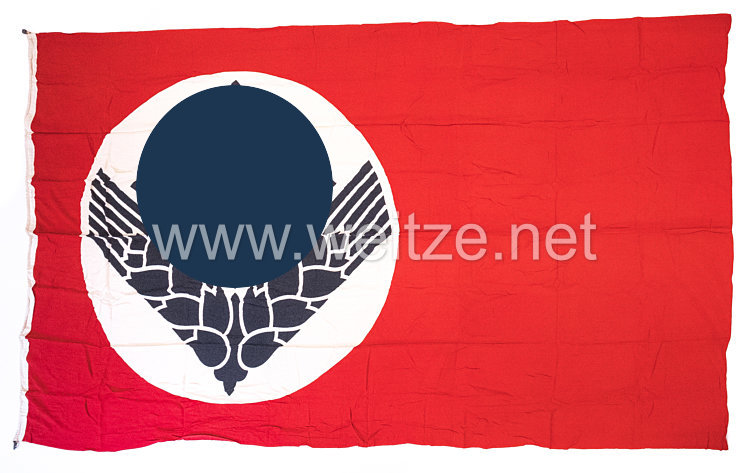
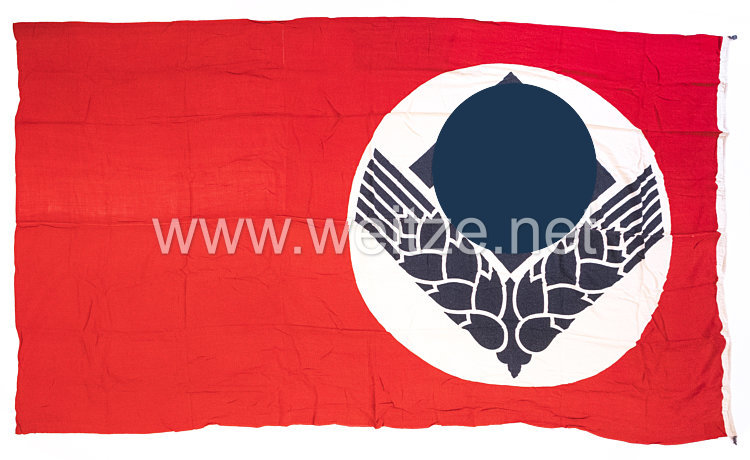
Reichsarbeitsdienst Weibliche Jugend (RADwJ) Large Camp Flag

Large printed execution in flag cloth, laterally with sewn attachment hooks, dimensions 225 x 375 cm. Minor signs of age and use, condition 2.
426752
1.200,00

Reichsarbeitsdienst Weibliche Jugend (RADwJ) Large Camp Flag

This camp flag of the Reich Labor Service for Female Youth (RADwJ) represents a significant chapter in National Socialist youth organization and labor policy in the German Reich between 1933 and 1945. With its considerable dimensions of 225 x 375 cm, this is an official large-format version characteristic of the representative use at camps and roll calls of this organization.

The Reich Labor Service (RAD) was established on June 26, 1935, through the “Law for the Reich Labor Service” as a compulsory service. While initially only male youth were required to serve, the gradual introduction of labor service duty for young women began in 1939. The RADwJ thus developed into one of the largest state organizations for female youth in National Socialist Germany.

The labor service obligation for women was initially conceived as a “duty year” and typically encompassed six months of service. Young women between the ages of 17 and 25 were housed in camps, where they were primarily deployed in agriculture, rural households, and later in areas important to the war effort. The organization followed a strictly hierarchical structure with leaders (Führerinnen), troop leaders (Truppführerinnen), and girl leaders (Mädelführerinnen).

The camp flags played a central role in the ideological and ceremonial life of the RAD camps. They were hoisted during morning flag roll calls, presented at official occasions, and served as identification symbols for the respective camp community. The flags were designed according to uniform specifications from the RAD leadership and typically displayed the characteristic national emblem as well as specific RAD symbols, particularly the stylized spade symbol that became the identifying mark of the Labor Service.

This flag in printed execution made from flag cloth corresponds to standard production for practical camp use. In contrast to hand-embroidered ceremonial flags used on special occasions, these printed versions were intended for daily use. The laterally attached sewn fastening hooks enabled quick and secure hoisting on flagpoles, which were present in every RAD camp.

The camp systems of the RADwJ were distributed throughout the entire Reich territory and increased significantly in importance during the war. From 1941 onwards, service became mandatory for all unmarried women under 25 before they could begin vocational training or take up employment. The number of women deployed rose to over 350,000 by 1945.

Daily life in the camps followed a strictly regulated schedule that included early morning flag roll calls, communal meals, work deployments, and evening “ideological training” sessions. The flag was always present and symbolized the integration of young women into the National Socialist people's community (Volksgemeinschaft).

The organization of the RADwJ was subordinate to the Reich Labor Leadership under Konstantin Hierl, who served as Reich Labor Leader from 1935 to 1945. Special regulations and uniform specifications were issued for the female labor service that differed from those of the male RAD. Members wore characteristic uniforms consisting of skirts and blouses as well as a distinctive headscarf.

After 1945, the Reich Labor Service, along with all other National Socialist organizations, was dissolved and banned by the Allied powers. The camp flags and other insignia were largely confiscated and destroyed. Preserved examples like this flag are therefore rare historical documents today that bear witness to an organization that integrated millions of young women into the National Socialist state and instrumentalized them for its purposes.

From today's perspective, such objects are important sources for historical research on the mobilization of society under National Socialism, the role of women in the Nazi state, and the mechanisms of ideological indoctrination. They simultaneously serve as reminders for critical engagement with this dark period of German history.