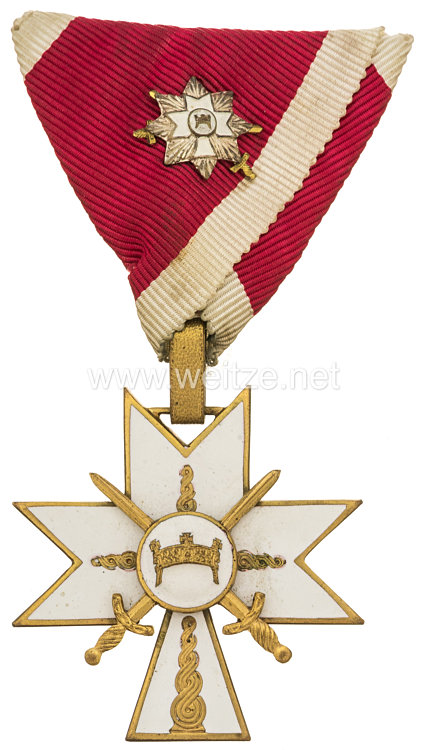
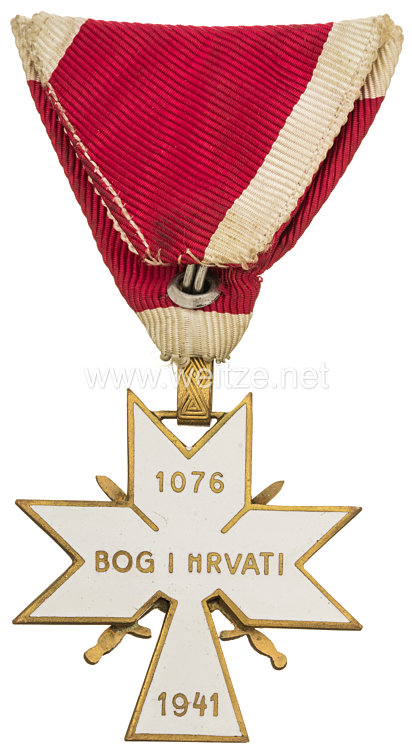
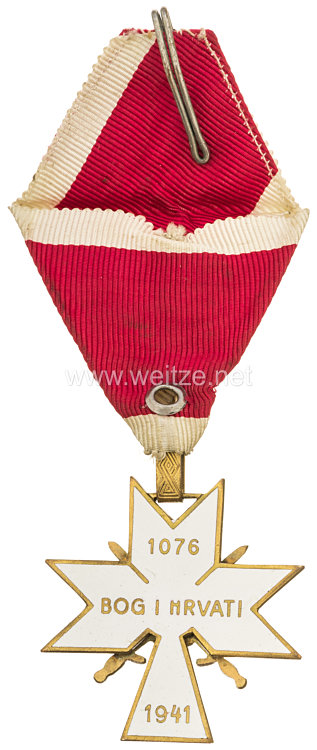
Croatia Order of the Crown of King Zvonimir: Cross 3rd Class with Swords with Miniature Decoration for the Grand Cross with Swords
The Order of the Crown of King Zvonimir (Croatian: Red Kralja Dmitra Zvonimira) represents one of the most significant decorations of the Independent State of Croatia during World War II. Established on May 18, 1941 by Poglavnik Ante Pavelić, only weeks after the proclamation of the Croatian state on April 10, 1941, this order was intended to recognize both military and civil merit.
The decoration was named after the medieval Croatian king Dmitar Zvonimir (r. 1076-1089), who is considered one of the most significant rulers of the Croatian kingdom and whose reign was regarded as a golden age of Croatian independence. This historical reference served to legitimize the new state entity through connection to the medieval Croatian monarchy.
The order was awarded in five classes: Grand Cross, Grand Officer, Commander, Officer, and Knight. Each of these classes could be bestowed with or without swords, where the swords indicated military merit, while the version without swords was intended for civil merit.
The piece described here is a 3rd Class Cross with Swords, thus a Commander's Cross for military merit, supplemented by a miniature decoration to the Grand Cross with Swords. This combination is exceptional and indicates that the bearer possessed both the Grand Cross and the 3rd Class. The miniature decoration, also known as a boutonniere or reduction, was worn on the triangular ribbon and allowed the bearer to present the award discreetly on less formal occasions or in certain uniform situations.
The order insignia displayed characteristic features: The order cross was a white, red-enameled cross with broadened ends, in whose center was the Croatian coat of arms with the red-and-white checkerboard pattern. The arms of the cross frequently bore the inscription “Za Dom” (For the Homeland). In awards with swords, crossed swords were placed between the cross arms. The ribbon was in Croatian national colors: red-white in triangular form.
Production was from gilt base metal (tombac or bronze) with enamel inlays, which was typical for orders of this period and this state entity. The economic situation of the Croatian state during the war made the use of precious metals like gold or silver increasingly difficult, necessitating the use of substitute materials.
The Order of the Crown of King Zvonimir was awarded between 1941 and 1945 to Croatian and foreign military and civilian personnel. Recipients included Croatian officers, members of the Ustaša movement, but also German and Italian allies. The awarding practice followed the statute issued in May 1941, which had to be personally approved by the Croatian head of state.
The historical classification of this order is complex and controversial. The Independent State of Croatia was a satellite state of the Axis powers, and the regime of Ante Pavelić was responsible for serious war crimes and crimes against humanity. After World War II, the order was therefore banned in Yugoslavia, and wearing it was punishable. This historical burden makes the order a difficult collectible object that should be viewed exclusively in the context of historical research and documentation.
From a military-historical perspective, such orders are nevertheless important historical documents that provide insight into hierarchies, awarding practices, and material culture of the period. The relative rarity of the order, especially in higher classes and with the miniature decoration, is explained by the short existence of the state (1941-1945) and the limited number of awards. Many insignia were destroyed or hidden after the war's end.
For collectors and historians, the examination of such objects offers insights into manufacturing techniques, material usage, and design developments during the war years. The indicated condition 2+ suggests light wear, which underscores authenticity and indicates that the decoration was actually worn.
Today, such pieces are primarily found in specialized military collections and museums, where they serve as testimonies to a dark chapter of European history. Their study contributes to understanding the symbolic and material aspects of totalitarian regimes and their systems of honors and recognition.