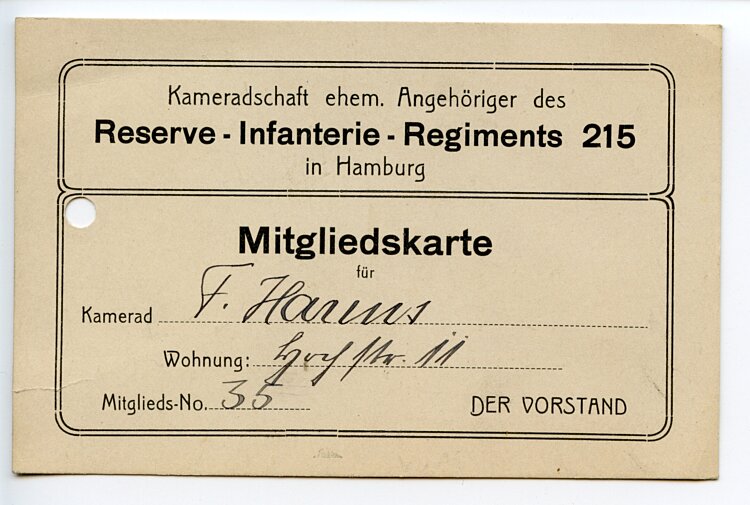
Veterans Association of Former Members of Reserve Infantry Regiment 215 - Membership Card
Membership Card of the Comradeship of Former Members of Reserve Infantry Regiment 215
This membership card documents the affiliation of a man from Hamburg with a veterans' association of Reserve Infantry Regiment 215. Such comradeships formed an essential component of German veterans' culture, particularly during the period between World War I and World War II.
Reserve Infantry Regiment 215
Reserve Infantry Regiment 215 was established during World War I as part of the Imperial German Army. Reserve infantry regiments were typically mobilized at the outbreak of war or during its course and consisted of reservists – men who had already completed their active service but remained available in case of war. These units formed the backbone of German war efforts and were deployed on various fronts.
The numbering of German infantry regiments followed a systematic pattern, with higher numbers in the 200s indicating reserve and replacement units established during the war. Regiment 215 was part of the extensive mobilization that the German Empire carried out after the outbreak of war in 1914.
Veterans' Associations in the Weimar Republic and Third Reich
After the end of World War I in November 1918, millions of German soldiers returned home. The experiences at the front, the hardships endured together, and the loss of comrades created strong emotional bonds. Comradeships and veterans' associations emerged in large numbers to maintain these connections and provide support to former soldiers.
These organizations fulfilled several functions: they offered social community, preserved the memory of fallen comrades, supported widows and orphans, and maintained the military traditions of their units. In Hamburg, a major port city with a strong military tradition, numerous such associations existed.
Membership cards served as proof of affiliation and entitled holders to attend meetings, participate in memorial events, and receive any support services. The perforation of the card suggests it may have been marked for cancellation or stored in a filing system.
Political and Social Context
In the Weimar Republic (1918-1933), veterans' organizations played a complex political role. Many evolved into nationalist groups that rejected the democratic order and propagated the “stab-in-the-back legend” – the claim that the German army had remained undefeated in the field and was forced to armistice only by internal enemies.
With the Nazi seizure of power in 1933, many veterans' associations were integrated into the NS system or subordinated to the NS-Reichskriegerbund (from 1938: NS-Reichskriegerbund “Kyffhäuser”). This coordination meant that originally autonomous comradeships became part of the National Socialist organizational structure.
Hamburg as Location
Hamburg, as Germany's second-largest city and an important military location, housed numerous garrisons and military installations. The city had a long military tradition dating back to its time as a fortress. After World War I, despite the demilitarization provisions of the Treaty of Versailles, Hamburg remained an important center for veterans' activities.
Significance for Historical Research
Such membership cards are important sources for social and military history. They document the post-war experiences of ordinary soldiers and the continuation of military identities in civil society. The systematic registration and organization of veterans provides insights into the structure and self-understanding of these communities.
The card also represents the culture of remembrance during the interwar period, in which World War I was preserved in collective memory as the defining experience of an entire generation. The cultivation of comradely relationships served not only social exchange but also the emotional processing of war trauma – even though this aspect was not yet conceptually understood in those terms at the time.
Material Characteristics
The physical condition of the card, including its perforation, tells its own story. Perforation typically indicated that the card had been processed administratively, possibly upon termination of membership, death of the holder, or for archival purposes. The fact that it originates from Hamburg provides geographical context and connects it to one of Germany's most significant urban centers.
These cards were typically printed documents featuring the association's name, the member's personal information, and often decorative elements such as regimental insignia or patriotic symbols. They represented both practical administrative tools and symbolic objects that connected veterans to their wartime service and comrades.
Conclusion
This membership card of the comradeship of former members of Reserve Infantry Regiment 215 is an authentic testimony to twentieth-century German veterans' culture. It connects the experiences of World War I with the social and political developments of the post-war period and illustrates how military identities persisted beyond the war's end and were organizationally maintained.