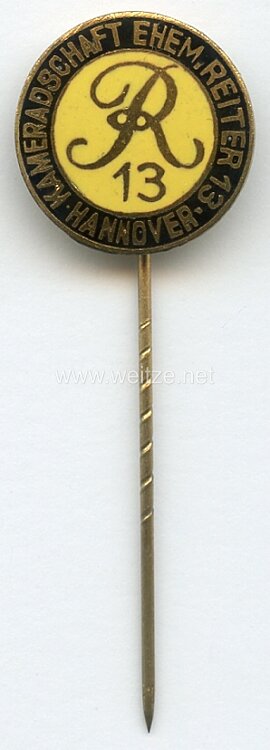
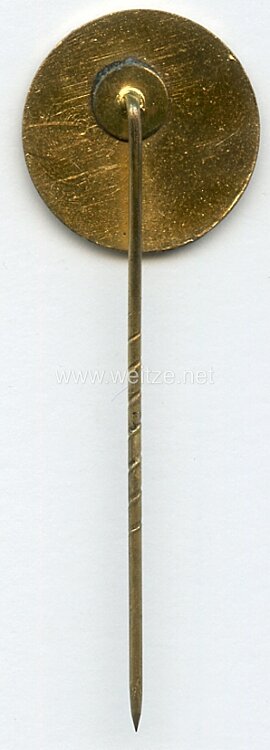
Prussia Commemorative Pin "Comradeship of Former Troopers 13 Hannover" (Kings Uhlan Regiment, 1st Hanoverian No. 13)

Garrison Hannover, enameled non-ferrous metal, 19 mm, on long pin, condition 2.
288951
45,00

Prussia Commemorative Pin "Comradeship of Former Troopers 13 Hannover" (Kings Uhlan Regiment, 1st Hanoverian No. 13)

The commemorative pin of the Comradeship of Former Troopers of the 13th Hannover represents a fascinating piece of Prussian military history and testifies to the long tradition of veterans' associations in the German Empire and the Weimar Republic. This small but significant badge was worn by former members of the König's Ulanen Regiment, 1st Hanoverian No. 13, one of Prussia's most prestigious cavalry units.

The König's Ulanen Regiment, 1st Hanoverian No. 13 had its origins in Hanoverian military tradition before the annexation of Hanover by Prussia in 1866. After the German War, the regiment was integrated into the Prussian Army and received its new designation. The garrison was located in Hannover, underscoring the close connection to the Lower Saxon metropolis. As an uhlan regiment, the unit belonged to the light cavalry and was armed with lances, a weapon of Polish origin that found use in many European armies during the 19th century.

The uhlans were considered the elite of the cavalry, recognizable by their characteristic czapkas (Polish caps) and colorful uniforms. The 1st Hanoverian Uhlan Regiment No. 13 participated in numerous military conflicts, including the Franco-Prussian War of 1870-71 and later World War I from 1914 to 1918. During the First World War, the cavalry experienced a fundamental change in its role, as modern warfare with machine guns, artillery, and trench systems made traditional cavalry charges largely obsolete.

After the end of World War I and the dissolution of the Imperial Army according to the Treaty of Versailles in 1919, former soldiers throughout the German Reich formed comradeships and veterans' associations. These organizations served several purposes: they maintained the memory of shared service time, provided social support for needy former soldiers and their families, and preserved the military traditions of their former units. The comradeships organized regular meetings, commemorative events, and support funds.

The present commemorative pin made of base metal with enamel work is a typical example of the badges that such veterans' organizations had manufactured. With a diameter of 19 mm and a long pin for attachment to clothing, it follows the common design of such commemorative badges from the 1920s and 1930s. Enameling was a popular technique because it enabled durable, colorful designs that clearly displayed the regimental colors and symbols.

The production of such badges was usually carried out by specialized militaria manufacturers and jewelers who specialized in military decorations and association badges. In Hannover and other German cities, there were numerous such workshops that produced both official military orders and private association badges. The quality of these pieces varied considerably, from simple stamped tin badges to elaborately crafted enameled specimens like the present one.

The historical context of these comradeships is complex. While they fulfilled legitimate social and charitable functions on one hand, many veterans' organizations in the Weimar Republic also became gathering places for conservative and nationalist forces. The preservation of military traditions often stood in tension with the democratic order of the young republic. Nevertheless, these associations formed important social networks for many former soldiers during a time of economic uncertainty and social upheaval.

The memory of the König's Uhlan Regiment No. 13 was preserved through such comradeships across generations. The badges served not only as identification signs at meetings but also as personal mementos of service time and comrades. Today, such pins are important military historical collectibles that provide insight into the veterans' culture of the interwar period and document the history of the Prussian cavalry.

The craftsmanship with enamel work on base metal shows the appreciation given to such commemorative pieces. The long pin enabled secure wearing on civilian clothing or association uniforms at official occasions. As part of the material culture of military veterans' associations, this small object tells of loyalty, comradeship, and the preservation of military identity in a fundamentally changing society.