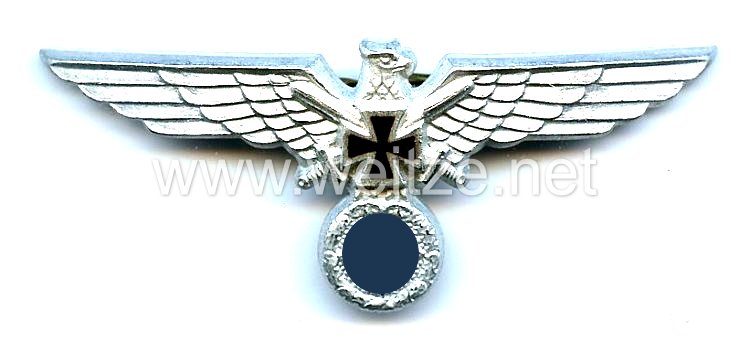
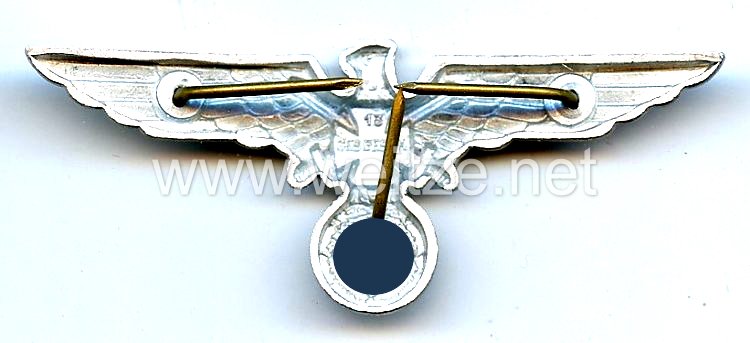
National Socialist Reich Warriors' League (NSRKB) Visor Cap Eagle
The Nationalsozialistischer Reichskriegerbund (NSRKB), or National Socialist Reich Warriors' League, represented a significant organization in Nazi Germany dedicated to the care of former soldiers. The visor cap eagle described here, made of aluminum with the manufacturer's marking “ges.gesch. 13,” represents a typical example of headgear insignia worn by members of this organization.
The NSRKB was established on March 4, 1938, through the merger of the Kyffhäuserbund and the NS-Reichskriegerbund. This consolidation was part of the Nazi policy of Gleichschaltung (coordination), by which all veterans' organizations were placed under central, party-loyal leadership. The Kyffhäuserbund itself had a long tradition as an umbrella organization for German veterans' associations dating back to the 19th century.
The uniforming of the NSRKB followed strict regulations. The visor cap was an essential component of the service uniform for leaders and members of the League. The eagle, the central symbol of Nazi rule, was prominently displayed on the front of the cap. This aluminum eagle design was characteristic of the late 1930s and early 1940s, when material shortages increasingly influenced production.
The manufacturer's marking “ges.gesch. 13” stands for “gesetzlich geschützt” (legally protected) and a registration number. This marking was common in German manufacturing law and protected the specific design from imitation. The number 13 refers to a specific manufacturer registered with the Reich Patent Office. Various manufacturers of military effects and insignia received such numbers, making the origin and quality of products traceable.
The NSRKB eagle differed in its design from other Nazi eagles through specific stylistic characteristics. The eagle faced right (from the viewer's perspective), held a swastika in its talons, and was crafted in a characteristic, stylized form. The aluminum construction allowed for cost-effective mass production while maintaining acceptable durability.
The organizational structure of the NSRKB comprised several million members. After the forced incorporation of traditional veterans' associations, membership reached its peak. The organization was divided into Gaue (regions), Kreise (districts), and Ortsgruppen (local groups), parallel to the structure of the NSDAP. Leading figures included Colonel Wilhelm Reinhard, who served as League leader.
The duties of the NSRKB extended beyond mere comradeship. The organization served ideological training, military fitness, and preparation for renewed warfare. Veterans were expected to pass their experiences to the younger generation and support the regime's militaristic ideology. Additionally, the League addressed social concerns of its members, organized celebrations for military commemorative days, and maintained war graves.
The uniform regulations of the NSRKB were established in official guidelines. The visor cap with eagle insignia could only be worn by authorized members. The correct placement of the eagle was precisely prescribed: it had to be positioned centrally above the visor, with specific distances from the cap edges.
With the progression of World War II, the significance of the NSRKB changed. Many members were reactivated or conscripted into home defense units. The organization itself increasingly focused on air defense duties and supporting the war economy. Production of uniform components and insignia was simplified and rationalized due to wartime conditions.
Following the unconditional surrender in 1945, the NSRKB was dissolved by the Allies. All Nazi organizations were banned, their symbols and uniforms confiscated or destroyed. Surviving pieces like the described visor cap eagle became historical objects that today document the material culture of the Third Reich.
From today's perspective, such objects serve historical research and education. They illustrate the penetration of all social spheres by Nazi symbolism and organization. The condition 2 rating of the described eagle indicates well-preserved condition, which is of documentary value for collections and museums.