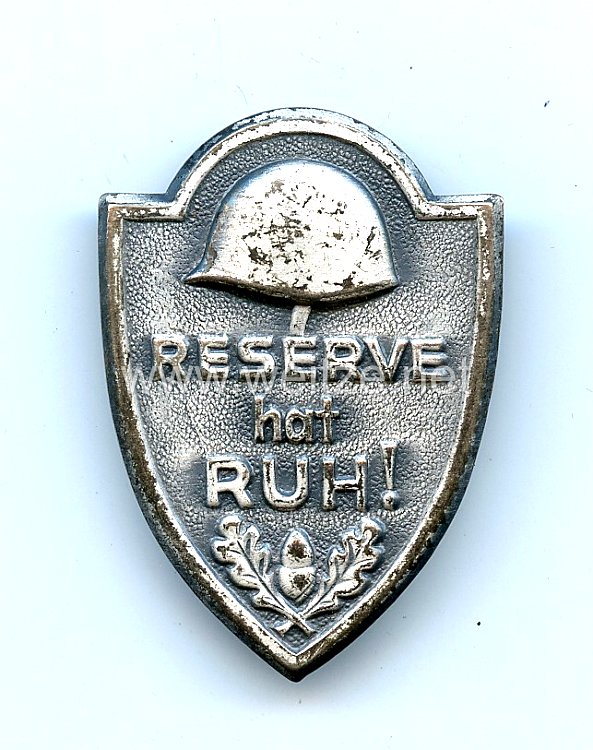
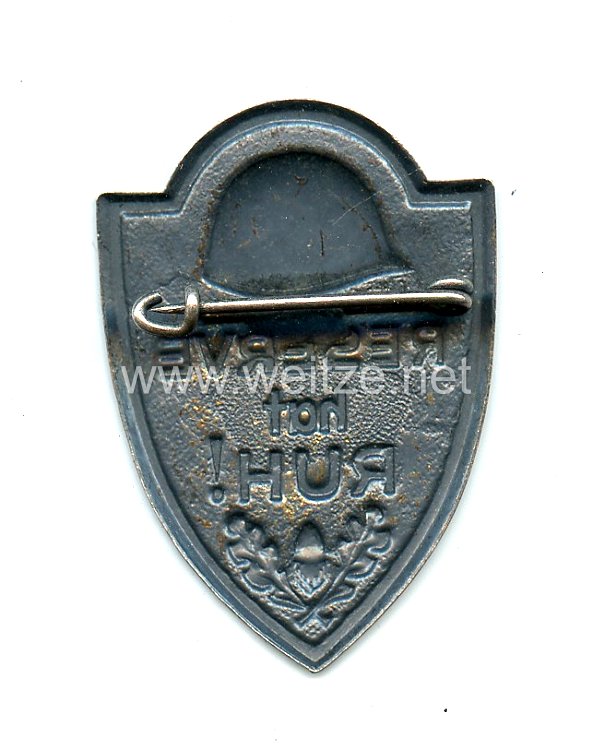
Federal Republic of Germany N.D. Badge/ Reserve Has Rest!
Reservist Badge "Reserve hat Ruh!" of the Federal Republic of Germany
The present metal badge bearing the inscription "Reserve hat Ruh!" (literally "The Reserve Has Peace" or "The Reserve Rests") represents a significant tradition in German military culture that continued from the Imperial era through the Weimar Republic into the Federal Republic of Germany. This type of badge belongs to the category of reservist insignia, worn by former conscripts and reservists to express their affiliation with the military community even after active service.
The history of reservist badges in Germany dates back to the 19th century. Following the introduction of universal conscription through military reforms under Gerhard von Scharnhorst and August Neidhardt von Gneisenau in Prussia, a distinctive reservist culture developed. Conscripts who had completed their active service entered the reserve and formed local reservist associations that significantly shaped social life in the German Empire.
The phrase "Reserve hat Ruh!" is a colloquial expression describing the reservist's status after completing active military service and theoretically having his "peace" – at least until a possible mobilization in an emergency. This ironic-humorous formulation became particularly popular in the post-war period and appeared on numerous reservist badges, beer steins, commemorative plates, and other memorabilia.
In the Federal Republic of Germany after 1955, when the Bundeswehr was established, the tradition of reservist badges experienced a revival. Conscription was reintroduced with the Military Service Act of July 21, 1956, and with it emerged a new large group of young men who transferred to the reserve after their service period. The Association of Reservists of the German Armed Forces (Verband der Reservisten der Deutschen Bundeswehr e.V.), founded in 1956, established itself as the umbrella organization for reservists and maintained camaraderie among former soldiers.
Metal badges like the present example were typically produced by specialized manufacturers of military memorabilia. They were worn at reservist gatherings, comradeship evenings, shooting festivals, and other social occasions, or acquired as souvenirs. Production usually involved stamping or pressing brass sheet or galvanized steel, which was subsequently enameled or lacquered. Attachment was achieved through a soldered or riveted pin on the reverse.
The social significance of such badges changed considerably over the decades. While during the Imperial period and partly in the early Federal Republic, military service was considered an honor and civic duty and was proudly displayed accordingly, this changed particularly from the 1960s and 1970s onward. The student movement, peace movement, and an increasingly critical attitude toward military traditions led to a shift in public perception. Nevertheless, reservist associations and their traditions remained significant in rural regions and conservative milieus.
The designation "without year" (O.J. - ohne Jahreszahl) for this badge indicates that it was not produced for a specific year group or particular discharge year, but served as a general reservist badge. This was common for badges sold over an extended period or conveying a timeless message.
Condition 2 in the grading scale for military antiques typically denotes good to very good preservation with slight signs of use but without significant damage. This suggests the badge was either worn infrequently or carefully preserved.
With the suspension of conscription in Germany on July 1, 2011, an era ended that had shaped the Federal Republic for over 55 years. The Bundeswehr was restructured into an all-volunteer force. This also marked the end of the traditional mass reservists who automatically transferred to the reserve after their conscription. Today, such badges have primarily historical and collector value and document a military and social culture that largely belongs to the past.
For collectors of military antiques and memorabilia, reservist badges represent an interesting collecting area that documents everyday culture and the social integration of the military – beyond official decorations and medals. They tell stories of camaraderie, humor, and the specific relationship between citizens and armed forces in different epochs of German history.