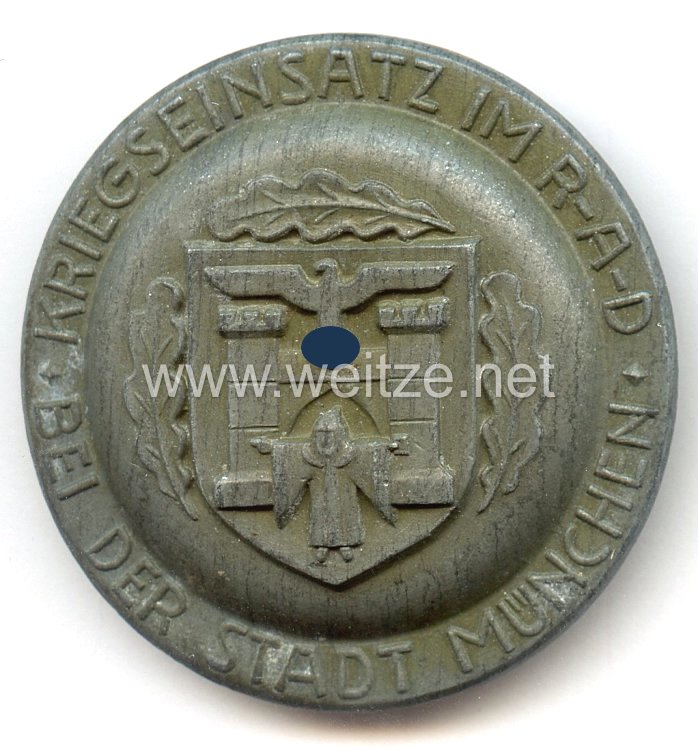
Reichsarbeitsdienst der weiblichen Jugend (RAD/wJ) - Service Brooch “Kriegseinsatz im RAD der Stadt München”
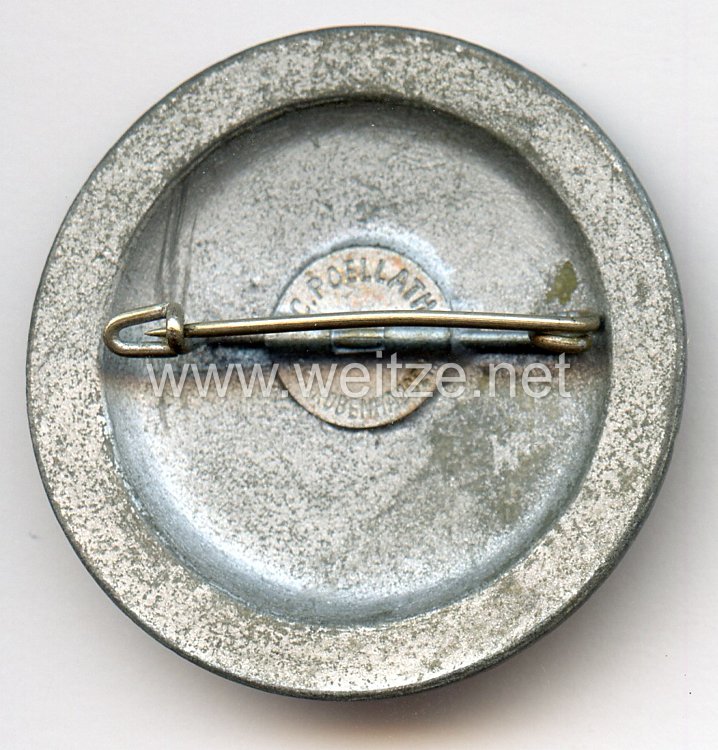
The Reichsarbeitsdienst der weiblichen Jugend (RAD/wJ) service brooch for wartime service in the RAD of the City of Munich represents a significant artifact of the National Socialist labor service organization during World War II. This brooch, manufactured by the renowned firm C. Poellath of Schrobenhausen, documents the specific involvement of female workers in the war efforts of the German Reich.
The Reichsarbeitsdienst (RAD) was established on June 26, 1935, through the Reich Labor Service Law as a mandatory institution for all German men and women between 18 and 25 years of age. The female division, the RAD/wJ (Reich Labor Service for Female Youth), was initially organized on a voluntary basis before becoming compulsory in 1939. With the outbreak of World War II in September 1939, the scope of duties for female labor service members expanded considerably.
The service brooch described here bears the specific designation “Kriegseinsatz im RAD der Stadt München” (Wartime Service in the RAD of the City of Munich), indicating local conferral by the Munich RAD office. Munich, designated as the “Capital of the Movement,” played a central role in the National Socialist organizational structure. The city housed numerous important administrative and training facilities of the RAD.
The manufacturing firm C. Poellath Schrobenhausen was among the most significant producers of orders, decorations, and badges during the NS period. Founded in 1778, the company had specialized in the production of high-quality metalware and continued to supply government agencies with decorations after 1945. The quality of Poellath products was widely recognized, and the manufacturer's mark on a piece is considered a hallmark of quality.
Female RAD members performed diverse services during wartime deployment. Their duties included agricultural work, auxiliary services in military hospitals and infirmaries, childcare and education, assistance with harvest work, and increasingly also services in the armaments industry and cleanup operations after bombing raids. Wartime service differed from regular labor service through its direct connection to war-essential activities and frequently through more difficult conditions.
Such service brooches were awarded in recognition of services rendered and were intended to strengthen identification with the organization as well as local ties. They were part of a comprehensive system of decorations and badges of honor that the National Socialist leadership employed to motivate and bind the population. Wearers attached these brooches to their service uniforms, typically on the left breast side.
The design of such local RAD brooches usually followed a uniform scheme but frequently integrated municipal or regional symbols. In Munich's case, this might include the city coat of arms with the Münchner Kindl (Munich Child) or other local references. Technical execution by Poellath guaranteed precise stamping and lasting quality.
The organizational structure of the RAD/wJ was strictly hierarchical. Service duration was initially six months but was frequently extended during the war. The young women lived in camps, wore uniforms, and were subject to quasi-military discipline. Ideological indoctrination formed an essential component of the service.
After the end of World War II, the Reich Labor Service was dissolved by the Allies. Control Council legislation prohibited all National Socialist organizations, including the RAD. Today, objects such as this service brooch represent historical sources that provide insight into the organization, hierarchy, and practice of the NS regime. They document the comprehensive mobilization of German society for war and the specific role assigned to women in this system.
For historical research, such artifacts are of considerable value as they represent material evidence of the everyday history of National Socialism. They complement written sources and enable a more comprehensive understanding of the social structures and practices of this era. Research on the RAD/wJ has gained increasing importance in recent decades as the role of women in National Socialism is examined more differentially.