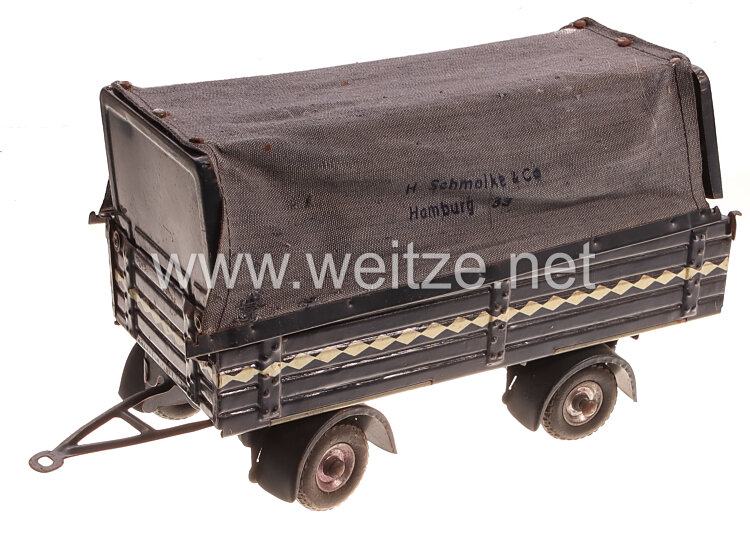
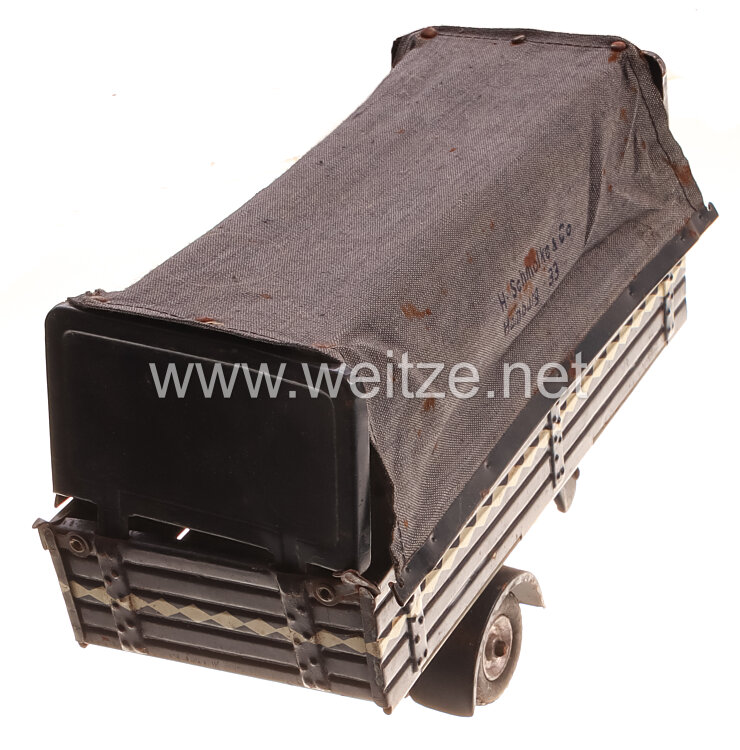
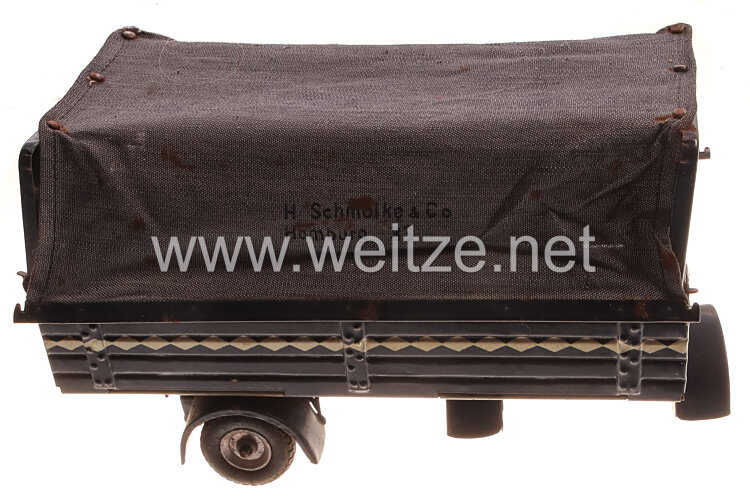
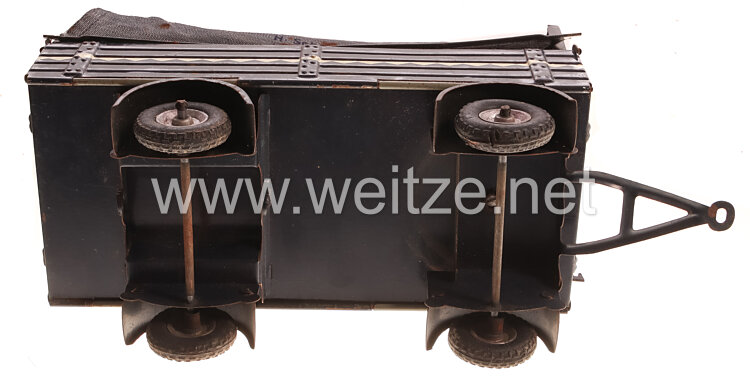
Tin Toy - Tractor Trailer

in blue, with canvas tarp cover, by H. Schmolke & Co. Hamburg 33, minor rust spots, condition 2-3
455150
180,00

Tin Toy - Tractor Trailer

The object in question is a tin toy tractor trailer in blue with a canvas cover, manufactured by H. Schmolke & Co. in Hamburg. This toy represents a significant era of the German toy industry in the post-war period and exemplifies the transformation of production capacities after World War II.

The company H. Schmolke & Co. from Hamburg was among the numerous German tin toy manufacturers active during the period between the 1940s and 1960s. The German toy industry, traditionally concentrated in regions such as Nuremberg, Göppingen, and Hamburg, had to fundamentally restructure its production after 1945. Many companies that produced for armament purposes during the war or whose capacities were requisitioned for such purposes turned to consumer goods manufacturing in the post-war period.

Tin toys had a long tradition in Germany, dating back to the 19th century. Lithography techniques made it possible to process printed tin cost-effectively and produce detailed, colorful toys. In the post-war period, tin was a relatively available material while other raw materials were scarce. This favored the rapid resumption of tin toy production.

The present tractor trailer with canvas cover reflects the everyday life of the 1950s and early 1960s. During this time, West German agriculture experienced significant mechanization. Tractors and agricultural trailers became common sights, which were also reflected in the toy world. Children played out what they saw in their environment, and agricultural vehicles were as popular as automobiles or trains.

The blue coloring and canvas cover are typical design features of this period. Canvas covers protected loads from weather conditions and were widespread on real trailers. Toy manufacturers strived for realistic representations to increase play value and stimulate children's imagination.

Hamburg as a production location is noteworthy. While Nuremberg was considered the center of the German toy industry, there were also significant manufacturers in Northern Germany. The port city of Hamburg offered logistical advantages for import and export, which was important for the post-war economy. The designation “Hamburg 33” refers to a historical postal code or district designation of the old Hamburg system before the introduction of five-digit postal codes in 1961.

The manufacturing technique of tin toys involved several steps: First, the tin was stamped and formed, then lithographically printed or painted, and finally riveted or soldered together. Moving parts such as wheels were attached with simple axles. These production methods enabled relatively cost-effective mass production, making toys affordable for broader segments of the population.

The condition with “light rust spots” and the rating “condition 2-3” is typical for tin toys from this era. Tin was susceptible to corrosion, especially when the paint was damaged or the toy was exposed to moisture. That the object has survived these decades testifies to a certain quality of workmanship.

In the 1960s, the gradual decline of the German tin toy industry began. Plastic became the dominant material, as it was more cost-effective, more versatile to form, and less susceptible to corrosion. Many traditional manufacturers had to cease production or adapt. Today, preserved tin toys from the post-war period are sought-after collector's items that represent a piece of German everyday culture and industrial history.

The tractor trailer from H. Schmolke & Co. thus stands not only for a children's toy but documents important economic, social, and technological developments in German post-war history. It connects artisanal tradition with industrial manufacturing and reflects the everyday world of a generation that experienced reconstruction.