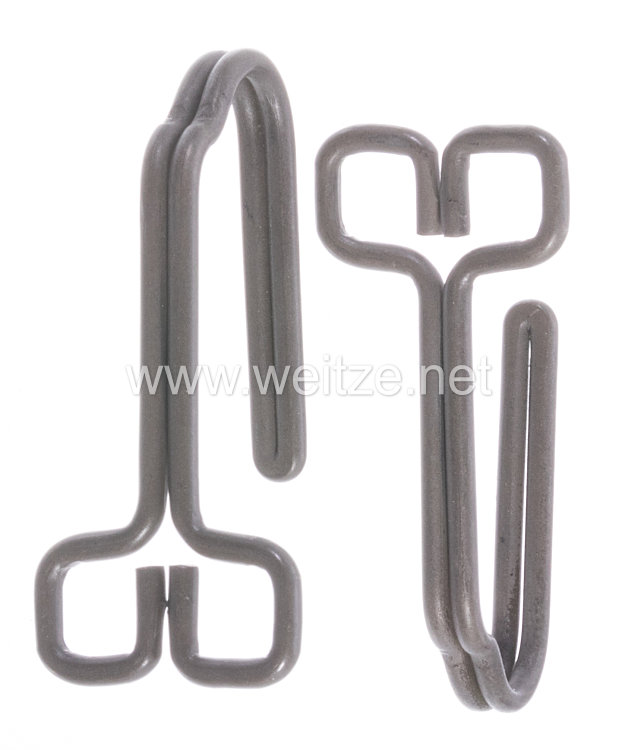
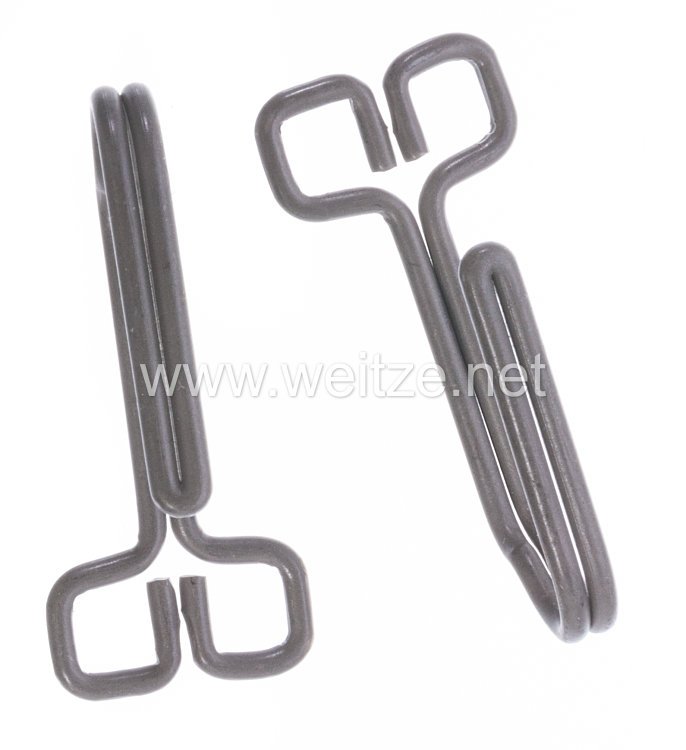
Wehrmacht Pair of Belt Support Hooks for the Field Tunic

Steel, field-gray painted, condition 2.

342449
15,00

Wehrmacht Pair of Belt Support Hooks for the Field Tunic

Wehrmacht Belt Support Hooks for the Field Tunic: An Essential Equipment Element

The Koppeltragehaken (belt support hooks or belt loops) represented a small but essential element of the German Wehrmacht uniform during World War II. These inconspicuous metal hooks fulfilled an important practical function in the field equipment system and were an integral component of the Feldbluse (field tunic), the standard field uniform of the Wehrmacht.

The Wehrmacht, which existed from 1935 to 1945 as the unified armed forces of the German Reich, placed great emphasis on standardized and functional equipment. The development and standardization of every piece of equipment, even seemingly insignificant components like the belt support hooks, was subject to strict military regulations and was defined in detailed clothing regulations.

Function and Construction

The belt support hooks were attached in pairs to the inside of the field tunic, typically at waist height. Their primary function was to stabilize the Koppelzeug (leather belt with attached pouches and equipment items) and to distribute the weight of the equipment more evenly across the body. Without these hooks, the heavily loaded belt would slide downward and significantly restrict the soldier's freedom of movement.

The specimens described here are made of steel and are field-grey painted, which corresponds to the standard design during most of the war. The field-grey paint served not only for camouflage but also for corrosion protection. The construction was simple yet robust: a bent hook firmly attached to the uniform jacket, usually by sewing or riveting.

Production and Materials

Throughout the war, the production of military equipment underwent significant changes due to increasing material shortages and the necessity for mass production. While the early war years still showed higher quality materials and more careful workmanship, simplifications increasingly had to be made from 1942/43 onward. However, steel components remained largely standard as they were cost-effective to produce and sufficiently durable.

Production took place in numerous facilities throughout the Reich territory, from large industrial companies to smaller supplier operations. Strict standardization ensured that these components were interchangeable regardless of the manufacturer.

The Field Tunic in Context

The Feldbluse M36 and its later variants (M40, M42, M43) formed the centerpiece of the Wehrmacht field uniform. These four-pocket uniform jackets were produced in various versions for all branches of service. The integration of belt support hooks was part of the design from the beginning, as the Wehrmacht placed great value on a functional carrying system.

The entire system of field tunic, belt, bread bag, canteen, ammunition pouches, and other equipment was carefully coordinated. The belt support hooks formed the connection between uniform and equipment and were thus indispensable for the soldier's combat readiness.

Condition and Collector Value

The stated Condition 2 designation indicates, according to common collector nomenclature, a good to very good state of preservation with slight signs of use. For steel items over 75 years old, this is remarkable, as such small components frequently show corrosion or damage. The preserved field-grey paint is particularly valuable for collectors and historians, as it allows conclusions about manufacturing techniques and materials used.

Today, authentic Wehrmacht equipment items, even seemingly insignificant components like belt support hooks, are sought-after collector's items. They serve historical research and help to paint a complete picture of 20th-century military history. For museums and private collectors, such objects provide important insights into the material culture and logistics of the Wehrmacht.

Historical Significance

While belt support hooks may appear trivial compared to weapons or vehicles, they represent the attention to detail that characterized Wehrmacht equipment development. Every element of a soldier's kit was designed to work as part of an integrated system. These small components remind us that military history encompasses not just grand strategy and major battles, but also the practical realities of soldiers' daily lives and the industrial capacity required to equip millions of men in the field.