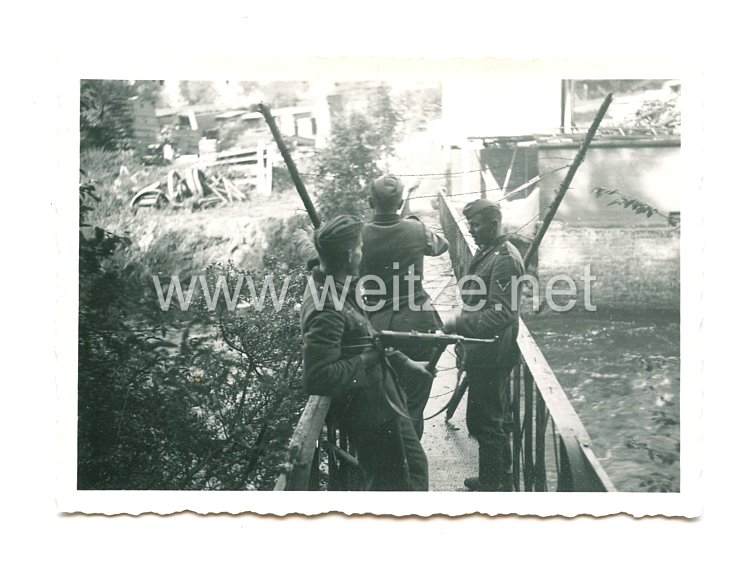
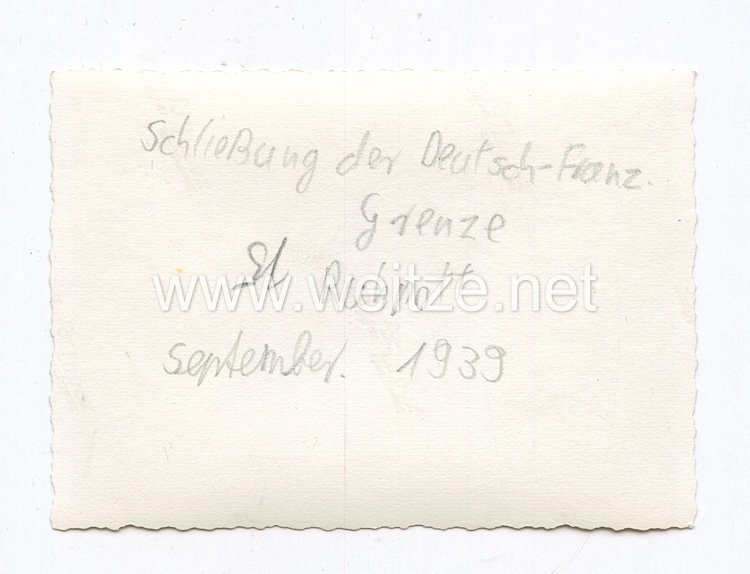
Wehrmacht Heer Photograph, German Soldiers Closing the German-French Border 1939

Dimensions approximately 6.2 x 8.8 cm. Used condition.

355949
25,00

Wehrmacht Heer Photograph, German Soldiers Closing the German-French Border 1939

Wehrmacht Army Photograph: German Soldiers Closing the German-French Border in 1939

This historical photograph documents a significant moment in the early phase of World War II – German soldiers of the Wehrmacht closing the German-French border in 1939. The image, measuring approximately 6.2 x 8.8 cm, corresponds to the typical format of private photographs from that era and represents an important aspect of German military history.

The German-French border had held central strategic importance in European history for centuries. After World War I, the Treaty of Versailles of 1919 demilitarized the Rhineland. Germany had to accept significant territorial losses, including the cession of Alsace-Lorraine to France. This border region remained a flashpoint of German-French tensions until 1939.

On September 1, 1939, World War II began with the German invasion of Poland. France and Great Britain subsequently declared war on Germany on September 3, 1939. During this critical phase, extensive border closures and military security measures were implemented along the German-French border. The Wehrmacht established border controls, roadblocks, and military posts to secure the border against potential French advances.

The period between September 1939 and May 1940 is often referred to as the “Phoney War” or “Sitzkrieg.” Despite the formal declaration of war, there were initially few major military confrontations on the Western Front. Both sides remained largely in their fortified positions – the French behind the Maginot Line, the Germans behind the Westwall (also known as the Siegfried Line).

Photographs like this were widespread during the war. Wehrmacht soldiers were allowed to carry private cameras and take photographs under certain restrictions. The Wehrmacht's Propaganda Companies (Propagandakompanien or PK) produced professional photographs for propaganda purposes, but many soldiers also took private snapshots of their wartime experiences. These images were often sent home or kept as personal mementos.

The typical format of approximately 6 x 9 cm corresponds to the roll film cameras commonly used at the time, particularly the popular 6x9 format from cameras such as Zeiss Ikon, Agfa, or other German manufacturers. These cameras were compact enough to be carried by soldiers while still providing high-quality negatives.

The military-historical significance of such photographs lies in their function as primary sources. They document the actual conditions, uniforms, equipment, and daily life of soldiers at the front. While official propaganda photographs were often staged and manipulated, private photographs frequently show more authentic insights into the reality of war.

The uniforms of the depicted soldiers correspond to the Wehrmacht's Army Service Regulations of 1939. The typical field uniform consisted of the field-grey tunic (M36 or M40), the field trousers, the steel helmet M35 or M40, boots, and personal equipment such as belt buckle, bread bag, canteen, and gas mask container.

The historical context of 1939 is of particular significance. After years of rearmament and territorial expansion by the National Socialist regime – including the remilitarization of the Rhineland in 1936, the annexation of Austria in 1938, and the occupation of Czechoslovakia – September 1939 marked the beginning of a devastating global conflict.

For collectors and historians, such original photographs represent important documents. They complement written sources and official records with visual evidence. The “used condition” of the photograph underscores its authenticity and its journey through the decades. Many such photographs were preserved in family albums, sent in letters, or passed down through personal estates.

Today, such photographs serve historical research and education. They remind us of the tragic events of World War II and the millions of people affected by this conflict. The scholarly examination of such objects enables a differentiated understanding of this dark epoch in German and European history.

r