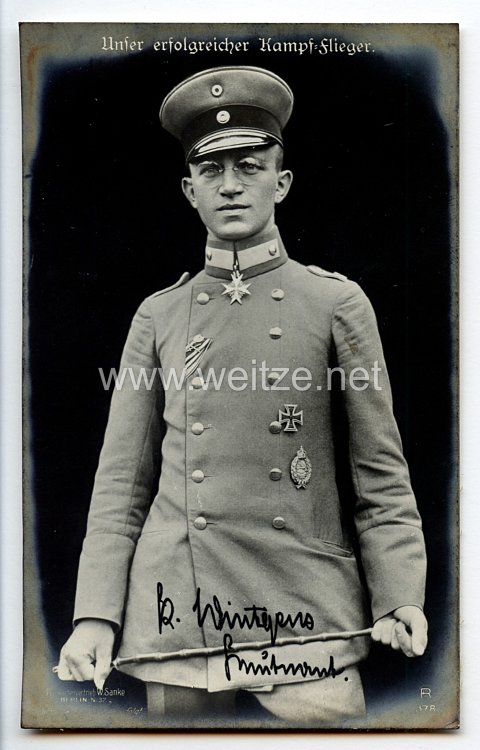
WWI Aviation - Photo Postcard - German Flying Aces "Lieutenant Wintgens"
This Sanke postcard No. 378 depicts Lieutenant Kurt Wintgens, one of the most significant German fighter pilots of World War I. The card belongs to the famous series of aviation photographs published by the Berlin publisher Gustav Liersch & Co. under the name “Sanke” and ranks among the most important photographic documents of early military aviation.
Sanke cards were produced from 1914 until the end of World War I. The photographer Sanke specialized in portraits of aviators, submarine commanders, and other military personalities. These postcards served multiple functions: they were used for war propaganda, boosted morale on the home front, and created a cult of personality around the “flying heroes.” The cards were produced in large quantities and were extremely popular among both soldiers and civilians. Collectors acquired entire series, and the cards were often kept as mementos or sent to relatives.
Kurt Wintgens was born on August 1, 1894, in Neustadt an der Haardt. He joined the Baden Foot Artillery Regiment No. 14 as an officer cadet in 1912. At the outbreak of World War I, he initially fought on the Western Front before volunteering for the air service in 1915. After his training, he was assigned to Feldflieger-Abteilung 67 (Field Aviation Section 67), which was equipped with armed reconnaissance aircraft.
Wintgens is considered one of the pioneers of aerial combat. On July 1, 1915, he achieved the first documented aerial victory by a German pilot with an armed monoplane over an Allied aircraft. This success occurred when Wintgens, flying his Fokker Eindecker equipped with the revolutionary synchronization gear machine gun developed by Anthony Fokker, shot down a French Morane-Parasol. This technical innovation made it possible for the first time to fire through the rotating propeller without damaging the propeller blades.
Although this victory was later not officially recognized because it occurred over enemy territory and lacked confirmation, it nevertheless marked a turning point in the history of aerial warfare. Wintgens developed into a successful fighter pilot in the following months and achieved a total of 19 confirmed aerial victories. For his achievements, he was awarded the Pour le Mérite, the highest Prussian military order – an honor reserved only for the most successful aviators.
The significance of such postcards in the context of World War I cannot be underestimated. They were part of a comprehensive propaganda strategy aimed at glorifying the new branch of air forces. Aviators were portrayed as modern knights fighting individual duels in the sky – a romanticized image that stood in stark contrast to the anonymous mass slaughter in the trenches. This heroization helped combat war weariness among the population and recruit young men for aviation service.
The condition 2 rating of this card indicates very good preservation, which is remarkable for postcards over a hundred years old. The fact that the card is unused – meaning it was never sent through the postal system – further increases its collector value. Such cards were often pasted into albums or kept as part of collections.
Kurt Wintgens' life ended tragically on September 25, 1916, when he fell in combat over Villers-Carbonnel on the Somme at the age of only 22. His early death was exemplary of the fate of many young aviators, whose average life expectancy at the front was frighteningly short.
Today, Sanke cards are sought-after collectibles and important historical documents. They offer insights into the visual propaganda of World War I and document the men who fought in the earliest days of military aviation. For military historians and collectors, they represent an indispensable source for researching the history of aerial warfare and German military culture during World War I.