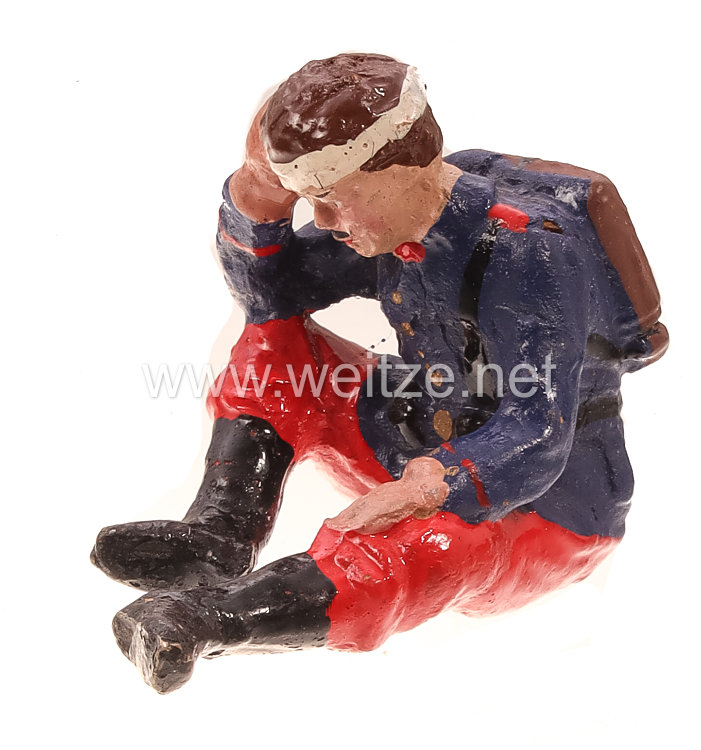
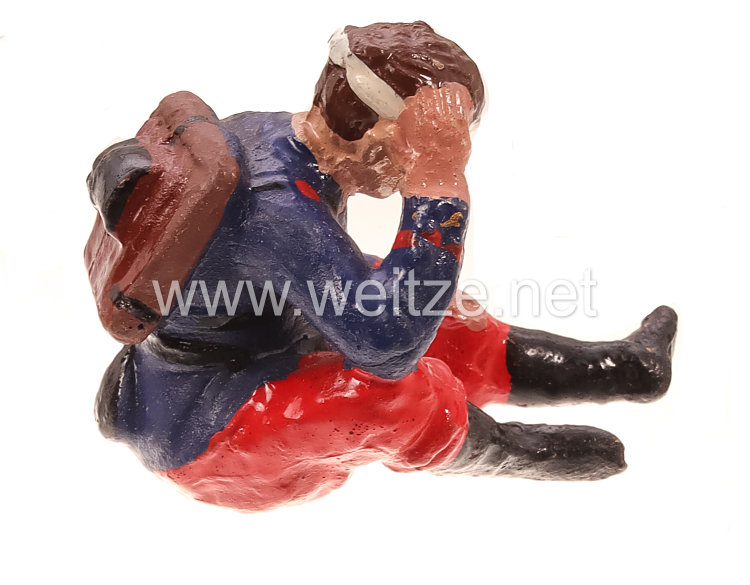
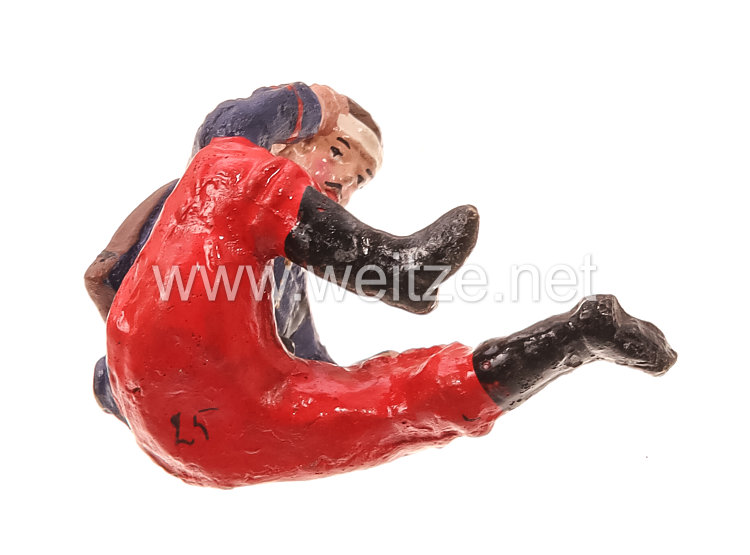
Elastolin - World War I Wounded French Soldier, Seated
Elastolin Figures of World War I: The Wounded French Soldier
This Elastolin figure depicting a seated, wounded French soldier from World War I represents a significant chapter in German toy manufacturing history while simultaneously documenting the grim realities of the Great War from 1914 to 1918. Standing 10 cm tall, this figure corresponds to the typical scale of Hausser-Elastolin production, which significantly shaped the toy industry in Germany between the 1920s and 1950s.
The company O. & M. Hausser was founded in 1904 in Ludwigsburg and developed the revolutionary material Elastolin around 1910, a composite of casein, chalk, glycerin, and other components that proved ideal for manufacturing toy soldiers. Unlike the previously dominant lead figures, Elastolin offered decisive advantages: the material was non-toxic, lighter, and allowed for finer details in the execution of uniforms and equipment.
The depiction of a wounded French soldier in a seated position holds particular historical significance. It reflects the brutal reality of World War I, in which millions of soldiers were wounded. The French Army suffered approximately 4.2 million wounded during the war, out of a total of over 6 million casualties. The typical French uniform of World War I underwent significant changes: at the war's outbreak, French soldiers still wore the conspicuous red-and-blue uniform with characteristic red trousers and blue tunic. This colorful uniform, inherited from the 19th century, proved disastrous under modern machine-gun fire.
From 1915 onward, the French Army was gradually equipped with the more practical “bleu horizon” uniform, a light blue color that offered better camouflage. The characteristic Adrian steel helmet, introduced in 1915, became the hallmark of French troops and was the first modern steel helmet deployed on a large scale.
The production of military toys at Hausser-Elastolin reached its peak during the interwar period. The detailed figures were valued not only as children's toys but also as collectors' items. The depiction of wounded soldiers was by no means unusual – it belonged to the realistic representation of military scenarios and possibly also served to process the collective war experience of German society.
Condition grade 2 for collectibles typically indicates good to very good preservation with minimal signs of use. For Elastolin figures, this may include slight paint chipping, minimal damage, or age-related patina. The state of preservation is crucial for collectors, as well-preserved examples from the interwar period or earlier have become rare today.
The historical significance of such figures extends beyond their character as toys. They document the culture of remembrance in the postwar period and show how military conflicts were processed in popular culture. The fact that wounded soldiers were also depicted testifies to a certain realism in representation that did not completely obscure the horrors of war.
After World War II, Hausser continued producing Elastolin figures until the 1980s, with the company finally closing in 1984. Today, original Elastolin figures, particularly those from the World War I theme range, are sought-after collectibles of significance both for military history and toy history. They offer insights into the material culture of the 20th century and the manner in which war experiences were translated into consumer goods. These figures serve as tangible connections to a pivotal period in world history, preserving in miniature form the uniforms, equipment, and human cost of the conflict that reshaped the modern world.