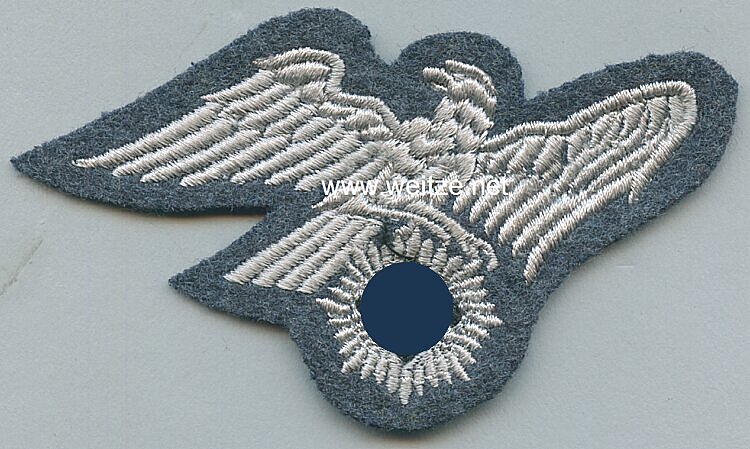
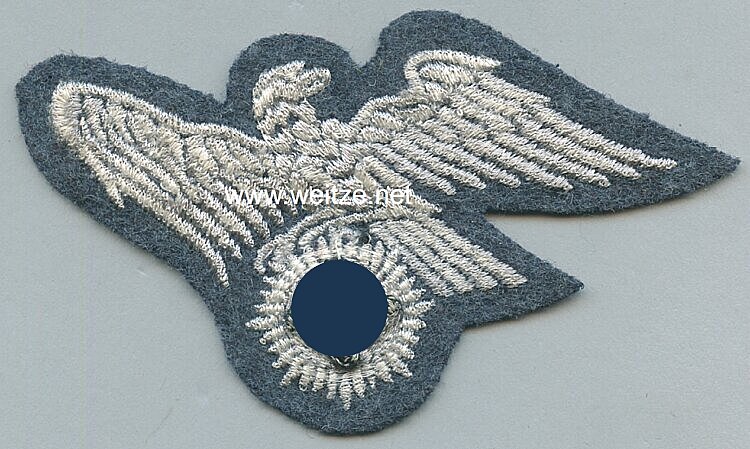
RLB Reichsluftschutzbund Sleeve Eagle for Enlisted Men
The Reichsluftschutzbund (RLB), or Reich Air Protection League, was established on April 29, 1933, as the central organization for civilian air defense in the German Reich. This paramilitary mass organization quickly developed into the largest civil defense organization of the Nazi era, reaching a membership of over 22 million people by 1944. The RLB was subordinate to the Reich Aviation Ministry under Hermann Göring and was tasked with preparing the civilian population for possible air raids and providing protection in emergencies.
The object described here is a sleeve eagle for enlisted personnel of the RLB in machine-embroidered execution. Such insignia were an integral part of the uniforming within the Reichsluftschutzbund and served to identify membership in the organization as well as to distinguish between different ranks. The sleeve eagle was worn on the left upper arm of the RLB uniform and was part of the official service dress.
The uniforming of the RLB was introduced gradually from 1933 onwards and modified several times. For enlisted personnel, meaning ordinary members without leadership functions, a blue uniform was prescribed that was modeled on military examples. Uniform items had to be procured by members themselves, with various quality grades available. Machine-embroidered insignia, such as the sleeve eagle presented here, were part of the standard equipment and were cheaper to produce than hand-embroidered variants, which were usually reserved for higher ranks.
The design of the sleeve eagle followed typical National Socialist symbolism. The stylized eagle with spread wings and head turned to the left held a swastika in its talons. This representation corresponded to the official design guidelines for national emblems in the Third Reich. Machine embroidery was typically done on dark blue or black base fabric, with the eagle itself executed in silver-gray or white thread.
The quality rating “Condition 2+” and the designation “unworn” indicate that this specimen was probably never attached to a uniform. Such unworn pieces can have various origins: they may come from warehouse stocks, were procured as replacements but never used, or belonged to uniform items that were not issued until the end of the war. The fact that the piece is unworn makes it an interesting historical document that has preserved its original production condition.
The Reichsluftschutzbund systematically organized the preparation of the population for aerial warfare from 1933 onwards. Tasks included training in air protection measures, organizing blackout exercises, constructing air raid shelters, and coordinating rescue and recovery operations after air raids. The organization was hierarchically structured and divided into local, district, and state groups. Enlisted personnel formed the basis of this structure and were responsible for practical tasks such as firefighting, debris clearance, and first aid.
With the beginning of Allied air raids from 1942 onwards, the RLB gained considerable importance. The organization was significantly involved in managing the consequences of aerial warfare. RLB enlisted personnel were deployed after every air raid to extinguish fires, rescue those trapped under rubble, and restore infrastructure. The psychological significance of uniform dress should not be underestimated: it conveyed order and authority in chaotic situations.
From a collecting and historical perspective, RLB insignia today are significant testimonies to civil defense history under National Socialism. They document the mobilization of the entire society for war and the preparation of the home front. Unworn specimens in good condition are rarer today than worn pieces, as most insignia were actually used. Such objects are preserved in military historical collections and serve the scientific research of everyday history during World War II.
Engagement with such objects requires historical sensitivity. They are relics of a criminal regime, but at the same time material testimonies to the experiences of millions of people who served as air raid wardens. Their scientific documentation and museum presentation contribute to understanding the totalitarian penetration of society under National Socialism.