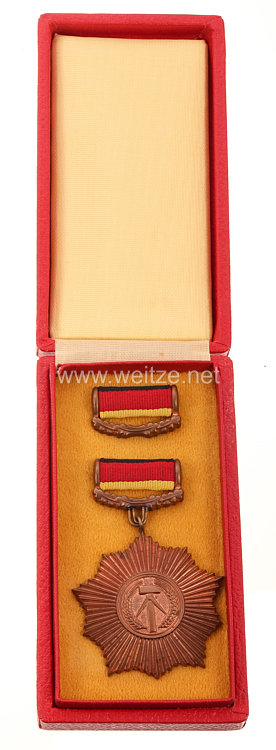
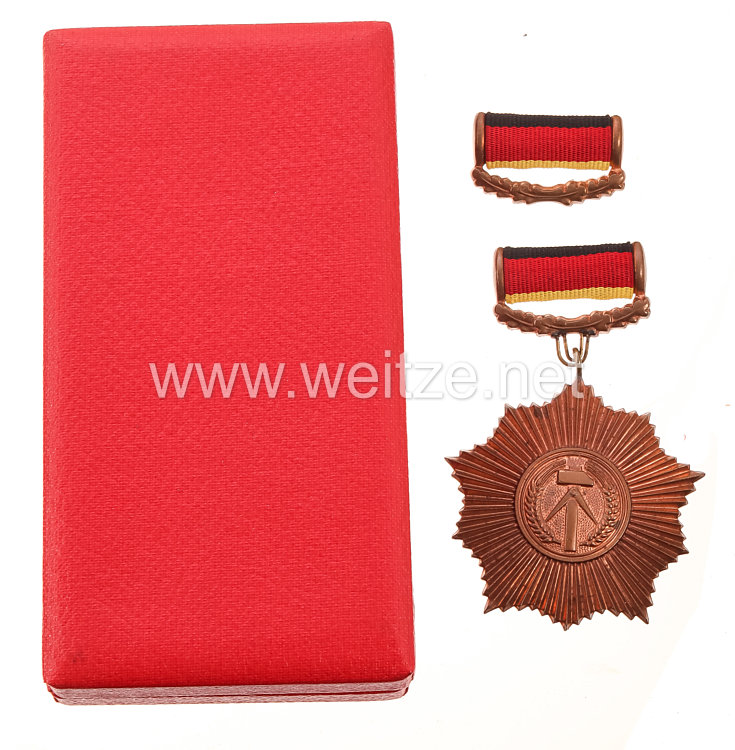
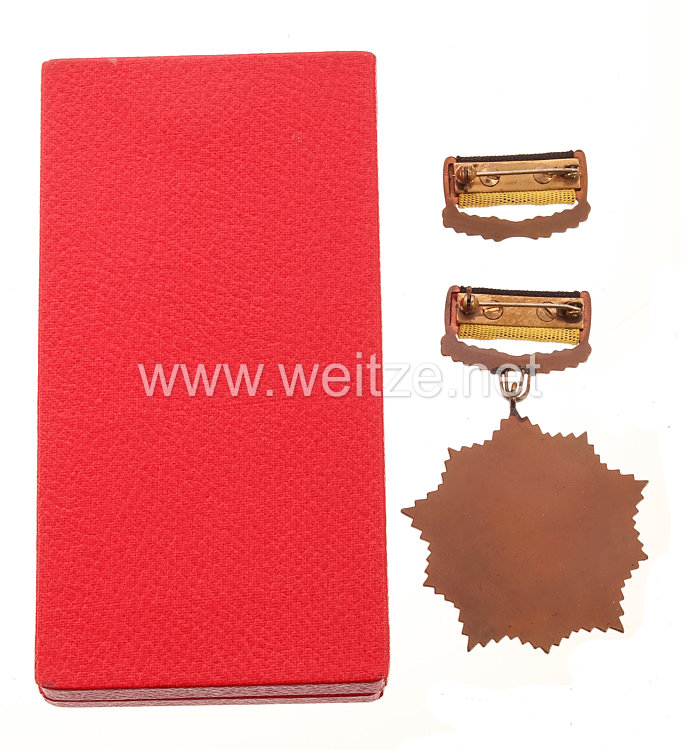
German Democratic Republic (GDR) Patriotic Order of Merit in Bronze
The Patriotic Order of Merit (Vaterländischer Verdienstorden) of the German Democratic Republic (GDR) was among the most significant state decorations of the socialist German state. The Bronze Class presented here represents the entry level of this multi-tiered order system, which was awarded from 1954 until the dissolution of the GDR in 1990.
The Patriotic Order of Merit was established on October 14, 1954 by the Council of Ministers of the GDR and officially announced through the Law Gazette of the GDR No. 103 dated October 28, 1954. It was intended to honor citizens of the GDR and foreign nationals for outstanding services in building and strengthening the GDR, as well as for special achievements for the welfare of the people. After the Karl Marx Order, it was the second-highest state decoration of the GDR.
The order system originally comprised three classes: Gold, Silver, and Bronze. In 1958, the hierarchy was expanded with the introduction of the Grand Star as the highest class. The Bronze Class described here thus formed the fourth and lowest class of the complete system and was the most frequently awarded.
The design of the order followed the socialist iconography of the GDR. The order cross consists of a five-pointed star with an applied red-enameled medallion. At the center is the state emblem of the GDR featuring hammer, compass, and wreath of grain. The reverse side, as noted for this specimen, is smooth without engraving or numbering. This corresponded to the standard design for the Bronze Class.
The order ribbon displays the national colors of the GDR: Black-Red-Gold in equal-width horizontal stripes. The ribbon bar, which could be worn on military or civilian dress, allowed the decoration to be worn without the full order cross. Awards were always presented in the original red case, which served for representative storage and presentation.
The awarding practice of the Patriotic Order of Merit was strictly regulated. Enterprises, institutions, social organizations, and state organs were authorized to make nominations. Awards were made by the State Council of the GDR, and later also by the Chairman of the State Council. The Bronze Class was typically awarded for long-term exemplary work in economy, science, culture, the state apparatus, or social organizations.
Between 1954 and 1990, several hundred thousand examples of the Patriotic Order of Merit in all classes were awarded, with the Bronze Class accounting for the largest share. Particularly in the 1970s and 1980s, the number of awards increased significantly, which partly led to an inflation of the order's value.
Manufacturing took place in state-owned enterprises of the GDR, primarily in the mint facilities. The specimen described here, made of base metal, corresponds to the standard design. Unlike the higher classes, which sometimes featured gilded or silver-plated material, the Bronze Class consisted of simpler material, materially expressing the hierarchical gradation.
After German reunification in 1990, all orders and decorations of the GDR lost their official status. The Orders Law of 1990 of the Federal Republic of Germany did not recognize these awards but permitted private wearing under certain conditions. Today, these orders primarily possess historical and collector value.
The condition grade 2 specified for this specimen corresponds in the numismatic and phaleristic evaluation scale to a very good to good preserved condition with minimal signs of wear. This indicates that the order was worn but carefully preserved.
From today's historical perspective, the Patriotic Order of Merit in Bronze documents an important chapter of German history. It reflects the decoration system of a socialist state and serves as material testimony to the political culture and social order of the GDR between 1949 and 1990.