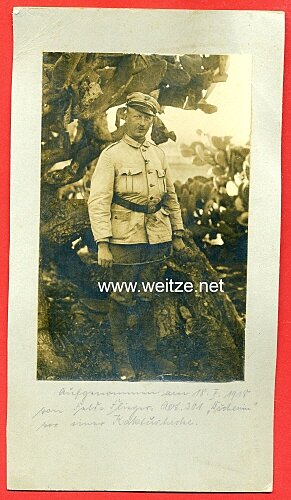
The Feldflieger-Abteilung 301 (abbreviated as Flieger-Abteilung 301 or FA 301) represents a fascinating chapter of German military aviation during World War I, particularly in the often-overlooked theater of the Palestine Campaign.
The unit was established on July 12, 1917, at a time when the Ottoman Empire was under increasing pressure from British forces under General Edmund Allenby. The German leadership recognized the strategic importance of the Middle Eastern front and dispatched several aviation units to support their Turkish ally. Under the command of Captain Hellmuth Bieneck, FA 301 was tasked with conducting reconnaissance missions, observing enemy troop movements, and occasionally carrying out bombing raids.
The operational base at Jenin (Dschenin in German) was located in a strategically important position in northern Palestine. The town sat at critical transportation junctions and served as a hub for Turkish-German forces. The mention of the “cactus hedge” in the photograph's caption is indicative of the unfamiliar environment in which these German aviators operated – far removed from the familiar landscapes of the Western Front.
The date of the photograph, January 18, 1918, falls during a critical phase of the Palestine Campaign. General Allenby had already captured Jerusalem in December 1917, and British forces were continuing their northward advance. German and Turkish troops were increasingly on the defensive. Aviation units played a crucial role in reconnaissance of British troop movements and in attempting to disrupt enemy supply lines.
German Feldflieger-Abteilungen (field aviation units) were typically equipped with various aircraft types. In the Middle East, Rumpler C-types, Albatros C-types, and LVG C-types were commonly deployed. These two-seater reconnaissance aircraft were robust enough to operate under the extreme climatic conditions of the region, where heat, sand, and dust posed particular challenges for both equipment and personnel.
Living conditions for German aviators in Palestine were considerably harsher than on the Western Front. Beyond the climatic extremes, units suffered from supply shortages, as spare parts and equipment had to be transported over vast distances. Nevertheless, contemporary reports show that troop morale was often remarkably high, sustained by a sense of camaraderie and the importance of their mission.
Non-commissioned officers (Unteroffiziere) formed the backbone of aviation units. They served as observers, mechanics, aerial gunners, and in various other technical capacities. Their expertise was indispensable for the daily operation of the unit. Training to become an aviation NCO was demanding and included both theoretical and practical components in navigation, reconnaissance, photography, and weapons technology.
Photographic documentation of military life was widespread during World War I. Such photographs served not only as personal memories but also for official documentation. Photographs mounted on cardboard were typical of the period and were frequently provided with handwritten or printed captions noting location, date, and context.
The Flieger-Abteilung 301 operated until the end of the Palestine Campaign in September 1918, when British forces achieved a decisive breakthrough in the Battle of Megiddo. Ottoman and German troops had to retreat hastily, and many units, including aviation detachments, were either dissolved or transferred back to Europe.
Historical photographs like this are valuable documents today, offering insights into a lesser-known aspect of World War I. They reveal not only the military presence but also the human dimension of the conflict – young men far from home, in a foreign environment, serving their country. The mention of the specific unit, date, and location makes such objects important sources for military historical research and for reconstructing the operational history of individual units.
The Palestine Campaign remains one of the more neglected theaters of World War I in popular memory, overshadowed by the massive battles on the Western Front. However, for the men who served there, including the personnel of FA 301, it was a challenging and significant deployment that tested their skills and endurance under extraordinary circumstances. Documents and photographs from this period provide invaluable evidence of Germany's global military engagement during the Great War.