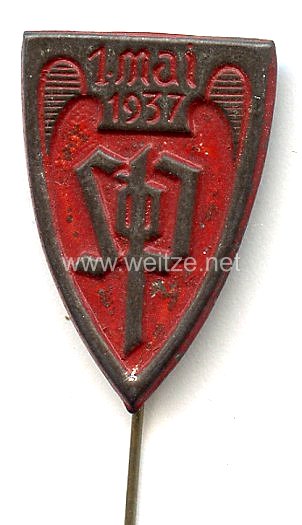
Sudetenland - Sudeten German Party (SdP) - May 1st, 1937
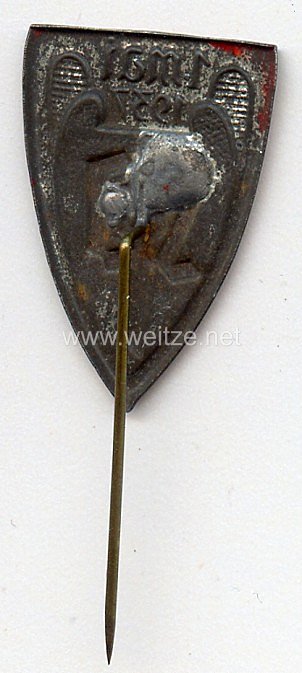
This iron tin badge, partially red lacquered and fitted with a long pin, represents a significant chapter in Central European history during the interwar period. It is a May Day badge of the Sudeten German Party (Sudetendeutsche Partei, SdP) from 1937, a political organization that played a central role in the Sudeten Crisis within the former Czechoslovak Republic.
The Sudeten German Party was founded on October 1, 1933, by Konrad Henlein, initially as the Sudeten German Home Front (Sudetendeutsche Heimatfront), after the German National Socialist Workers' Party (DNSAP) and the German National Association had been banned in Czechoslovakia. In April 1935, it was renamed the Sudeten German Party. The organization rapidly developed into the strongest political force among the German-speaking population in the border regions of Bohemia, Moravia, and Silesia.
In the parliamentary elections of 1935, the SdP achieved spectacular success, becoming the strongest single party in Czechoslovakia with over 1.2 million votes. Initially, the party presented itself as a loyal democratic force within the Czechoslovak state, but under the increasing influence of National Socialist Germany, its politics became progressively radicalized.
The year 1937, from which this badge originates, marks a decisive phase in this development. The SdP intensified its contacts with the Nazi regime and received financial support from Berlin. The party used all legal means available in democratic Czechoslovakia to spread its propaganda and mobilize the German minority. Badges such as this one played an important role in the movement's public self-presentation.
May 1st held particular symbolic significance as the traditional workers' holiday. While in democratic Czechoslovakia the day was celebrated as a festival of the labor movement, the SdP used this occasion to demonstrate its own mass base and organizational strength. The distribution of special May Day badges was common practice among political organizations of that era to demonstrate belonging and manifest solidarity.
The material execution of the badge – iron tin with red lacquer – corresponds to the typical manufacturing method of political lapel pins from the 1930s. The red color could reference both socialist traditions and National Socialist color symbolism. The long pin enabled secure attachment to clothing, which was important at mass events and public rallies.
After 1937, the Sudeten Crisis increasingly escalated. In March 1938, Henlein, on Hitler's instruction, demanded complete autonomy for the Sudeten German areas, which effectively amounted to separation from Czechoslovakia. These demands culminated in the Munich Agreement of September 29, 1938, through which the Sudeten territories were ceded to the German Reich without the consent of the Czechoslovak government.
Following the annexation, the SdP dissolved itself, and its members were transferred into the NSDAP. Henlein was appointed Reich Commissioner and later Reich Governor (Reichsstatthalter) in the Sudetenland. The party had fulfilled its function as an instrument of German expansionist policy.
From a historical perspective, such badges document the complex national tensions in interwar Czechoslovakia. They bear witness to the instrumentalization of democratic institutions by authoritarian movements and the collapse of the Versailles peace order. For collectors and historians, such objects represent important material testimonies of a fateful development that ultimately led to World War II.
The preservation of such historical artifacts serves scientific research and the culture of remembrance. They enable subsequent generations to understand the propagandistic methods of totalitarian movements and to recognize the fragility of democratic systems in times of crisis.