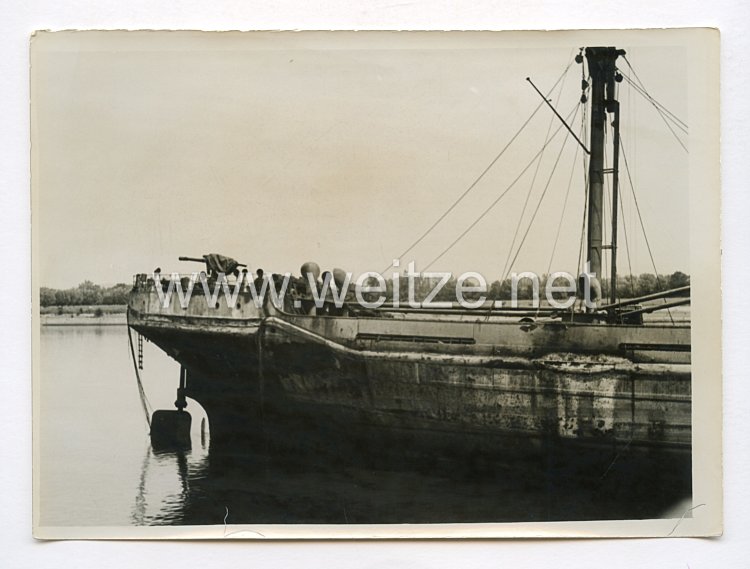
Press Photograph, Occupation of France 1940:
This press photograph documents one of the most significant military campaigns of World War II: the German occupation of France in 1940. With dimensions of approximately 13 x 18 centimeters, it corresponds to the standardized formats common in press photography of that era, enabling efficient distribution in newspapers and propaganda materials.
The Western Campaign, as this military offensive is known in German military history, began on May 10, 1940, with the invasion of the neutral states of Belgium, the Netherlands, and Luxembourg, along with the simultaneous attack on France. The German Wehrmacht employed the innovative strategy of Blitzkrieg (lightning war), which relied on rapid armored thrusts, close coordination between ground forces and air power, and the circumvention of fortified positions. Under the leadership of generals such as Heinz Guderian and Erich von Manstein, German panzer divisions broke through French lines at Sedan and penetrated the Ardennes, which had been considered impassable.
The Wehrmacht's Propaganda Companies, often abbreviated as PK (Propagandakompanien), played a central role in the photographic documentation of the campaign. These units were directly attached to combat troops and were tasked with recording the events of war in accordance with National Socialist propaganda objectives. The photographers wore regular uniforms and were equipped with military gear, but moved to the front lines with special cameras and photographic materials.
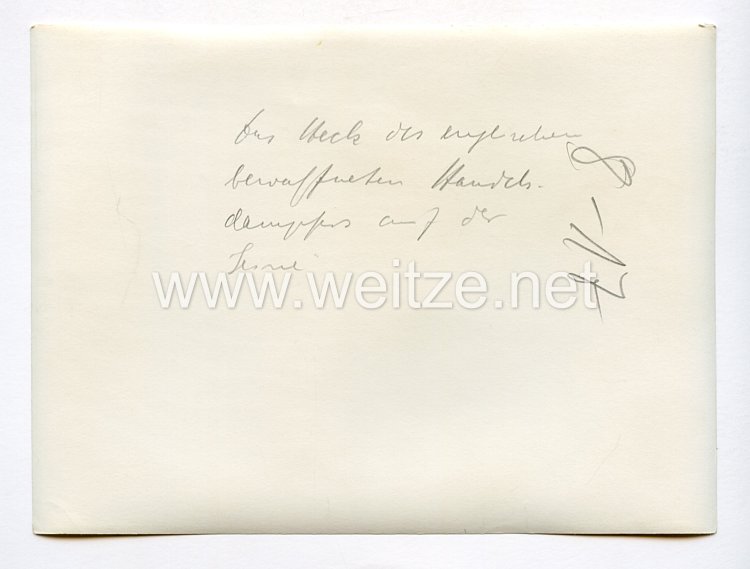
Press photographs like the present one served multiple purposes: They were used for domestic reporting in German newspapers and illustrated magazines such as the “Völkischer Beobachter,” the “Berliner Illustrirten Zeitung,” or “Signal,” a multilingual propaganda magazine. Selected images were also made available for foreign propaganda and neutral press services. The reverse sides of such photographs often bore stamps from the Oberkommando der Wehrmacht (OKW, High Command of the Armed Forces), censorship marks, and brief captions.
The military success of the French campaign was unprecedentedly swift: As early as June 14, 1940, German troops marched into Paris, and on June 22, 1940, the armistice was signed in the Forest of Compiègne—symbolically in the same railway car where Germany had capitulated in 1918. France was divided into an occupied zone in the north and west, and the unoccupied Zone libre in the south under the Vichy government of Marshal Philippe Pétain.
The photographic documentation of these events followed strict guidelines. Images were meant to demonstrate the Wehrmacht's military superiority, boost morale on the home front, and present the “final victory” as inevitable. Photographs of fallen German soldiers or destroyed German equipment were censored, while images of victorious troops, conquered cities, and captured Allied soldiers were preferred.
From a historical perspective, such press photographs are now significant primary sources. They document not only military events but also the mechanisms of war propaganda and the visual staging of power. Collectors and researchers value these photographs as historical documents, with critical examination of their original propaganda function being essential.
The 13 x 18 cm format was standard for press photography of the time and allowed for relatively cost-effective reproduction. The condition grade of “2” indicates, according to common collector standards, good to very good preservation, which is remarkable for photographs over 80 years old. Typical signs of aging may include slight discoloration, minimal edge damage, or faint impressions on the reverse.