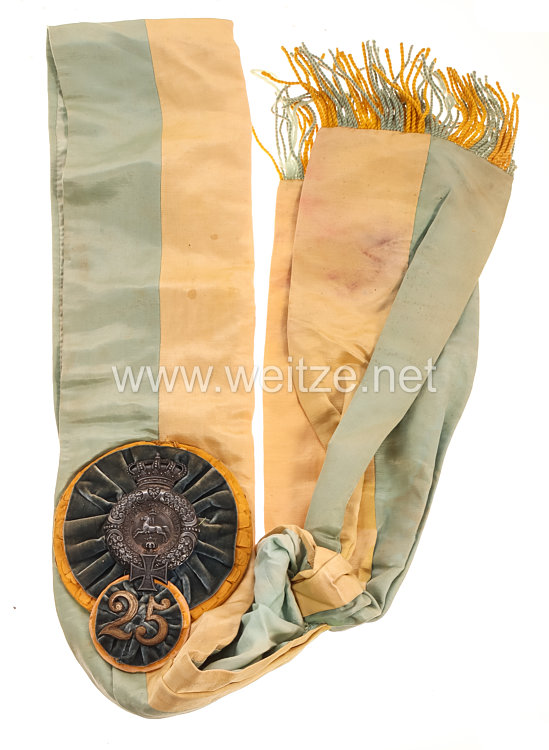
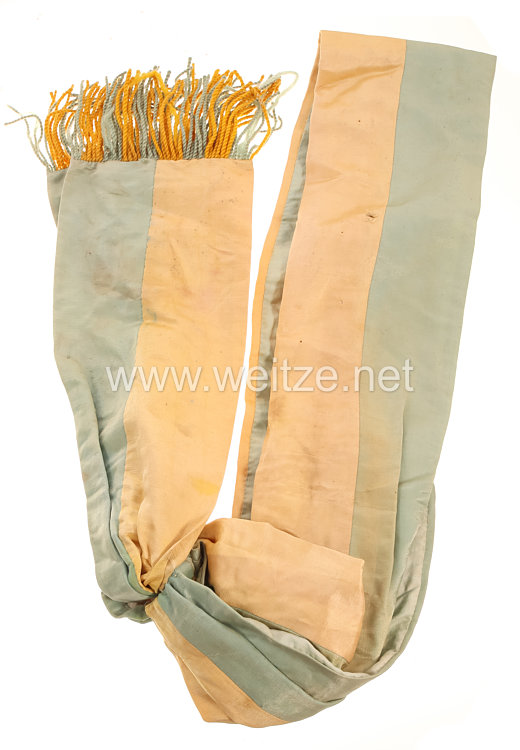
This sash made of blue and yellow silk documents a significant jubilee in the history of German veteran associations: the 25th anniversary of the Braunschweiger Landwehr-Verband in 1900. This magnificent commemorative piece combines military tradition with the social importance of veteran organizations in the German Empire.
The Braunschweig Landwehr Association was founded in 1875, during a time of profound changes in German military affairs. After the founding of the Reich in 1871 and the experiences of the Franco-Prussian War of 1870/71, veteran associations experienced a renaissance. The Landwehr associations served not only for the cultivation of camaraderie among former soldiers, but also for maintaining military readiness and patriotic sentiment among the civilian population.
The Duchy of Braunschweig, as a federal state of the German Empire, possessed its own military tradition. Braunschweig troops had particularly distinguished themselves in the Wars of Unification, and the memory of these achievements shaped the identity of veteran associations. The colors blue and yellow incorporated in the sash represented the traditional state colors of the Duchy of Braunschweig.
At the time of the 1900 jubilee, the association had developed into a considerable organization. Historical sources document that the Braunschweig Landwehr Association comprised 7 district associations with 264 clubs and 23,871 members. This impressive membership number testifies to the deep roots of military affairs in Imperial society and the significance of veteran status.
The inscription on the sash, “Mit Gott für Kaiser und Reich 1875 1900” (With God for Kaiser and Reich 1875 1900), reflects the political and religious ideology of the Wilhelmine era. The Iron Cross as the central symbol refers to Prussian-German military tradition. This decoration, instituted in 1813 by King Friedrich Wilhelm III of Prussia, had become a symbol of German heroism and military valor. The use of the Iron Cross on club badges and commemorative pieces was widespread in the Empire and expressed loyalty to Crown and Reich.
Jubilee sashes like this one were important components of the club culture of Landwehr associations. They were worn at festive occasions, parades, and memorial ceremonies, demonstrating membership in a military community. The craftsmanship in silk underscores the representative character of these objects. Such items of honor were frequently manufactured by specialized workshops that focused on military equipment and association paraphernalia.
The jubilee celebration of 1900 took place during what can be considered the zenith of the German Empire. Kaiser Wilhelm II had consolidated his rule, and Germany presented itself as a rising industrial nation and military power. Veteran associations played an important role in cultivating monarchical and national ideals. Their events were social occasions that attracted attention far beyond the circle of members.
The Landwehr associations differed from other veteran organizations through their specific reference to the Landwehr, the reserve component of the German Army. Landwehr men were reservists who had completed their active service but remained mobilizable. The Landwehr formed an important second line in the German military system behind the active troops and those on leave status.
It is noteworthy that the Braunschweig Landwehr Association has survived the political upheavals of the 20th century. While many veteran associations came to an end after 1918 and 1945, this association exists in modified form to this day. This speaks to the organization's ability to adapt to new social frameworks and redefine its role beyond its original military orientation.
From today's perspective, such objects are valuable sources for researching the military and social history of the Empire. They document not only military organization, but also everyday culture, symbolic language, and the social networks of their time. The sash represents an era in which military virtues and national identity were closely intertwined, and in which veteran associations fulfilled an important function as bearers of patriotic tradition.