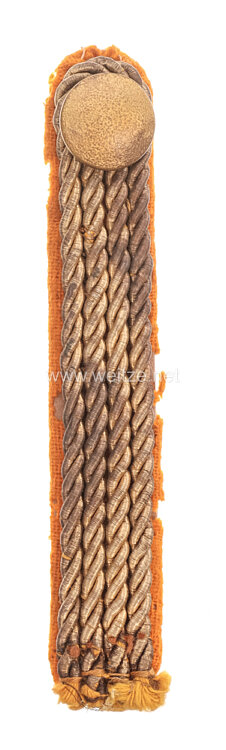
SA Single Shoulder Board for an SA-Sturmführer to Sturmhauptführer SA Gruppe Elbe

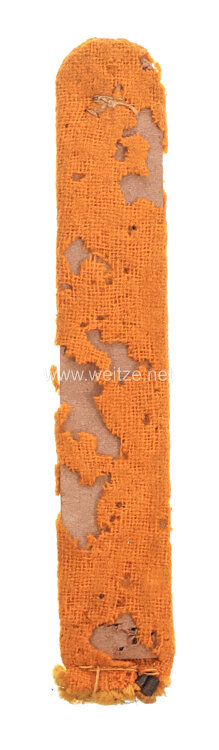
Fabric base heavily damaged, worn, condition 3-.
460846
125,00

SA Single Shoulder Board for an SA-Sturmführer to Sturmhauptführer SA Gruppe Elbe

This object is a single shoulder board for an SA-Sturmführer to Sturmhauptführer of the SA-Gruppe Elbe. These rank insignia belong to the characteristic uniform components of the Sturmabteilung (SA) during the National Socialist period and reflect the hierarchical structure of this paramilitary organization.

The Sturmabteilung, commonly known as the SA, was founded in 1920/21 as the security force of the NSDAP. Under the leadership of Ernst Röhm, it developed into a mass organization with several million members. The SA played a decisive role in the NSDAP's rise to power, particularly through street terror and the intimidation of political opponents. After the seizure of power in 1933 and especially after the so-called “Röhm Putsch” in June 1934, however, the SA increasingly lost political significance.

The SA-Gruppe Elbe was one of the regional divisions of the SA in the area of central Germany. The SA was territorially divided into various groups named after geographical regions or rivers. The Gruppe Elbe encompassed areas in Saxony and adjacent regions. Each SA-Gruppe had its own group leader and was further subdivided into brigades, standards, storm battalions, and storms.

The shoulder board (also called shoulder strap or epaulette) served to identify the rank and affiliation to a specific SA unit. The rank insignia were worn on the brown SA uniform, which became the characteristic identifying feature of the organization and earned it the popular name “Brownshirts.”

The SA-Sturmführer corresponded approximately to the military rank of First Lieutenant, while the SA-Sturmhauptführer was equivalent to Captain. These ranks belonged to the middle leadership levels of the SA hierarchy. The rank insignia were represented by various elements: the base color of the shoulder boards, the number and arrangement of stars, braids or laces, as well as specific color combinations identified the respective rank.

According to the SA uniform regulations, which were modified several times, Sturmführer and Sturmhauptführer wore shoulder boards with specific markings. The exact design changed over time, with the regulations of the SA Clothing Office determining the details. The shoulder boards were typically manufactured on a cloth backing and decorated with metal threads, braids, or sewn-on elements.

The described condition of the object - “heavily damaged” and “worn” - is not unusual for historical SA uniform pieces. After World War II, many Nazi memorabilia were destroyed or hidden. Control Council Law No. 2 of September 1945 ordered the dissolution of all Nazi organizations including the SA, and the wearing of their uniforms and insignia was prohibited.

From a historical perspective, such objects are important witnesses to uniform studies and the organizational structure of the SA. They document the visual representation of hierarchy and affiliation in an organization that significantly contributed to the establishment of the Nazi dictatorship. At the same time, they are relics of a criminal system responsible for terror, persecution, and the Holocaust.

The scholarly examination of such objects today occurs in the context of Nazi research and military-historical uniform studies. Museums and research institutions preserve such pieces as educational and documentation material, whereby the historical context and the criminal nature of the organization must always be emphasized.

The preservation condition with heavily damaged cloth backing indicates decades of storage or intensive previous use. Such damage is typical for textiles from this period and often makes precise identification of details and manufacturing characteristics difficult.