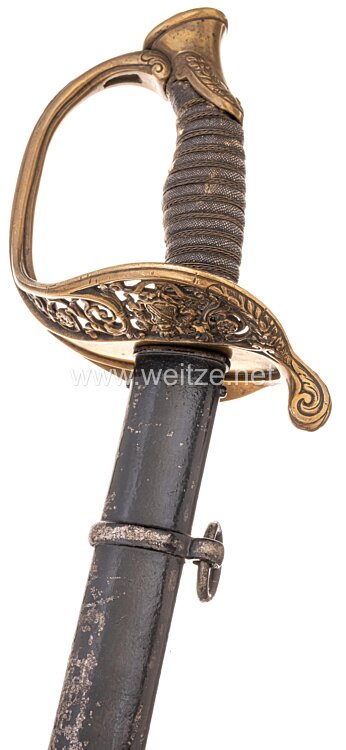
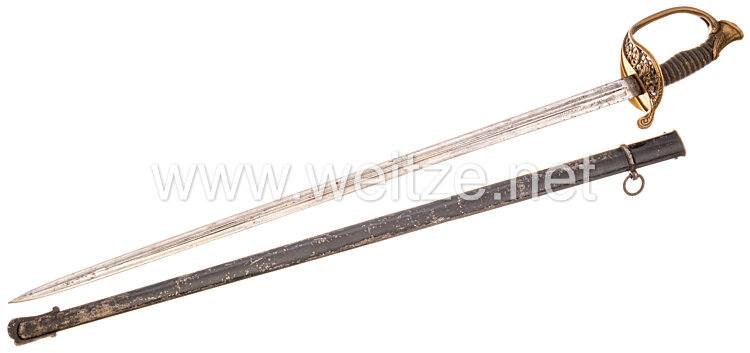
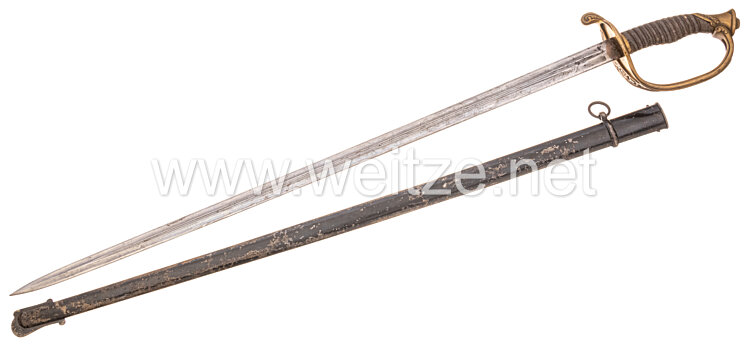
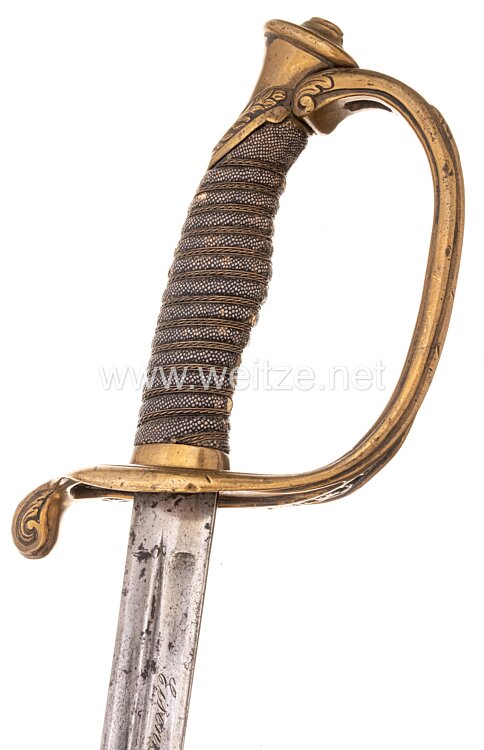
Saxony Infantry Officer's Sword (IOD) M 1867
Blade length approximately 770mm
Overall length approximately 950mm
The Saxon Infantry Officer's Sword Model 1867 represents a significant epoch in German military history, characterized by the restructuring of German states following the Austro-Prussian War of 1866. The Kingdom of Saxony, which had fought on Austria's side against Prussia, was forced to reorient itself after its defeat and joined the North German Confederation. This political realignment led to comprehensive military reforms and the standardization of equipment according to Prussian models.
The Model 1867 was introduced at a time when the Saxon army had to reconcile its traditions with the new requirements of the North German Confederation. The sword served as a sidearm for infantry officers and was both a functional combat instrument and an important status symbol. The introduction of this model occurred as part of the general modernization of Saxon armed forces, which had to adapt their equipment and organization to Prussian standards.
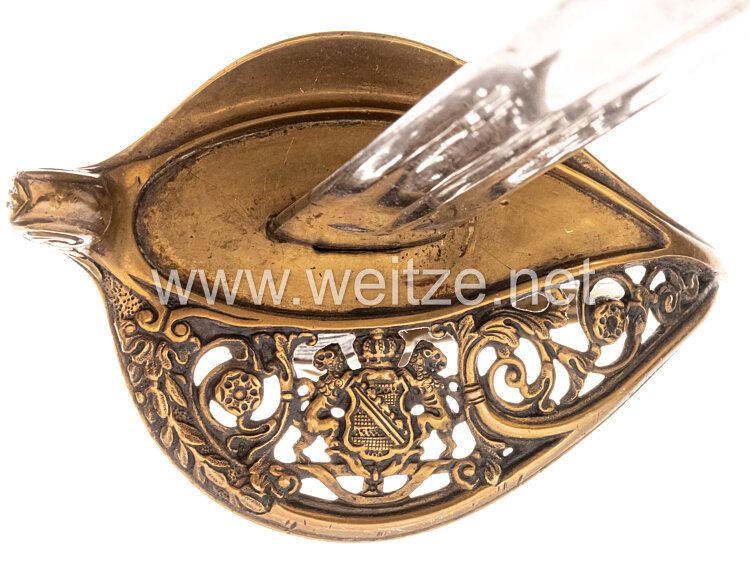
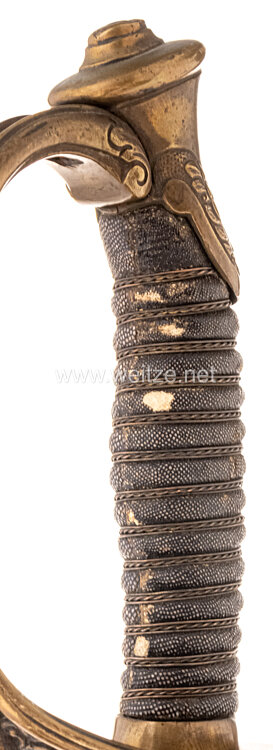
The characteristic brass hilt with rigid basket guard provided the wearer with considerable protection for the sword hand. This basket construction was typical of German infantry officer swords of the 19th century and combined functionality with representative elegance. The ray skin grip (also known as galuchat) was a particularly valued material that was not only aesthetically pleasing but also offered excellent gripping properties, even in wet conditions. The wire wrapping laid over it, usually of brass wire, additionally reinforced the grip and prevented the hand from slipping.
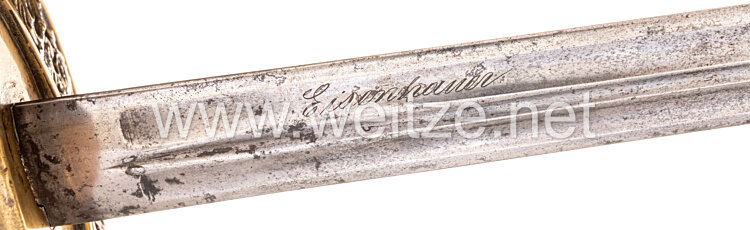
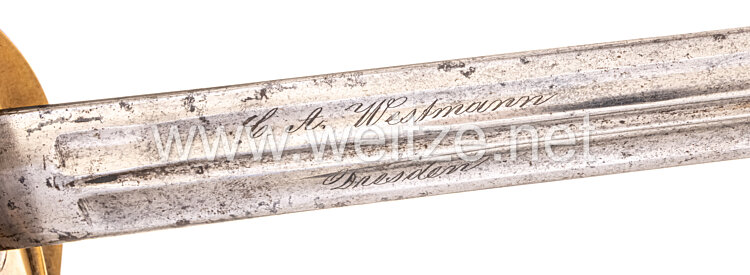
The double-edged blade with triple fuller was a masterpiece of blade smithing. The fullers served several purposes: they reduced the weight of the blade without compromising its structural integrity, improved the weapon's balance, and increased its flexibility. This technical sophistication was characteristic of high-quality officer swords of the era.
The manufacturer's mark “C.A. Westmann Dresden” refers to one of the renowned sword makers in the Saxon capital. Dresden was an important center for the manufacture of edged weapons in the 19th century and housed several respected manufactories that produced for both the Saxon army and other German states. The workshops in Dresden were known for their high craftsmanship and their ability to combine both functional and decorative aspects in their products.
The quality designation “Eisenhauer” (iron hewer) on the blade was a traditional quality seal that indicated the special hardness and cutting ability of the steel. This designation had a long tradition in German blade manufacturing and assured the buyer that the weapon was made from high-quality material and hardened according to proven methods. The term alluded to the legendary ability to cut through even iron and was an important marketing tool for blade manufacturers.
The sword's scabbard was typically made of leather with metal fittings. The single carrying ring indicates that the sword was worn on a baldric, as was customary for infantry officers. The scabbard not only protected the blade from weather and mechanical damage but was also an important part of the overall aesthetics of the officer's uniform.
In the tactical context of the 1860s and 1870s, the officer's sword had already lost much of its original combat function. With the increasing spread of firearms and the development of modern combat tactics, the edged weapon became primarily a command instrument and insignia of rank. Officers used the sword to visually emphasize commands, direct troop movements, and demonstrate their authority. Nevertheless, the weapon retained its practical significance in individual situations and close combat.
After the founding of the German Empire in 1871, the Saxon army initially retained its own traditions and uniforms, including its specific sword models. The Kingdom of Saxony was one of four kingdoms within the Empire and enjoyed a certain military autonomy, which was also reflected in the details of officer equipment. Only in later years did further standardization occur within the German army.
The Saxon Infantry Officer's Sword M 1867 thus embodies an important transitional moment in German military history: the period between regional independence and national unification, between traditional edged weapons and modern firearm tactics, between artisanal individual production and industrial standardization. As a collector's item, it offers today a valuable insight into the military culture of the 19th century and the high craftsmanship of Saxon weapon smiths.