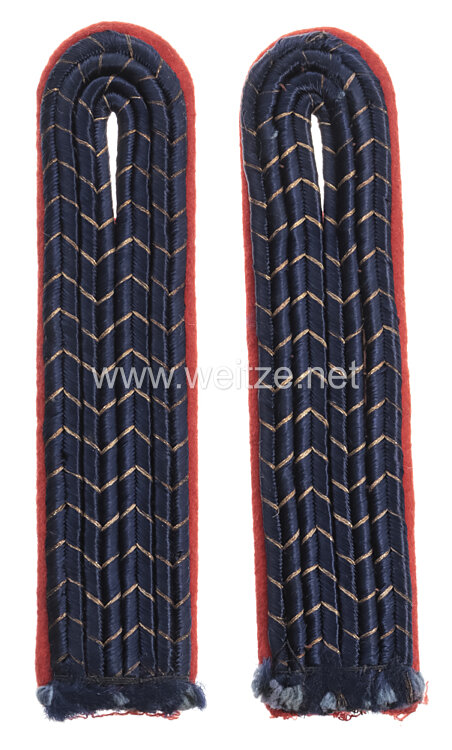
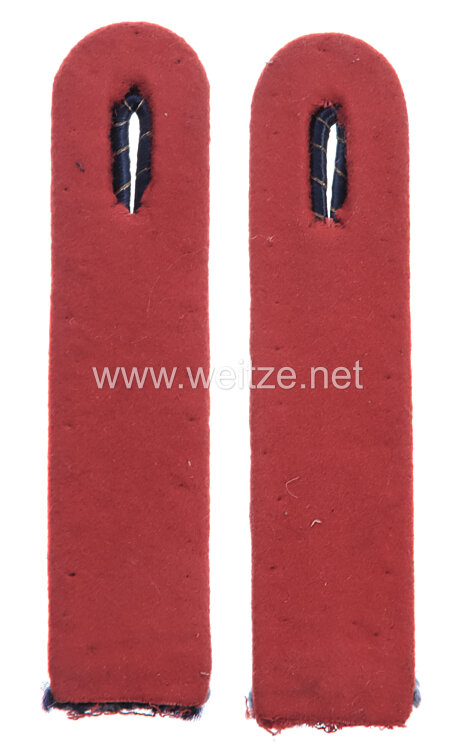
Reichsbahn Pair of Shoulder Straps

Pay grade 17a and 17, for railway gatekeepers for sewing in. Unworn, condition 2.
468145
25,00

Reichsbahn Pair of Shoulder Straps

The present shoulder boards of the Deutsche Reichsbahn represent a significant piece of German transportation and administrative history of the 20th century. These rank insignia belonged to the service uniform of pay grades 17a and 17, typically worn by railway guards (Bahnwärter), an essential occupational group within the German railway system.

The Deutsche Reichsbahn was officially founded on April 1, 1920, through the Reich Railway Law and emerged from the merger of the state railways of the German federal states after World War I. As a state enterprise, it assumed all railway traffic in the German Reich and developed into one of the largest transport companies in Europe. At its peak, the organization employed several hundred thousand workers and required a clearly structured rank system.

The pay scale of the Reichsbahn was hierarchically structured and oriented toward the general civil service pay system of the German Reich. Pay grades were numbered in ascending order, with higher numbers corresponding to lower ranks. Grades 17 and 17a were in the lower part of the hierarchy and primarily included workers and lower-level officials in track service.

Railway guards had an indispensable function within railway operations. They were responsible for monitoring and securing specific track sections, operating switches and signals, and inspecting track facilities. These employees often worked in remote railway guard houses along the routes and contributed significantly to operational safety through their vigilant activities. Their duties included reporting irregularities, securing level crossings, and performing simple maintenance work.

Shoulder boards as rank insignia were an essential component of the Reichsbahn uniform. They were worn in accordance with the clothing regulations of the Deutsche Reichsbahn, which specified in detail which uniform parts and insignia were prescribed for which service grades. The shoulder boards were sewn into the uniform, ensuring their permanent attachment and corresponding to the official character of the service clothing.

The specimens described here have survived unworn, suggesting storage or non-use. This was not uncommon, as the Reichsbahn maintained large stocks of uniform parts and equipment. The classification as condition 2 indicates a very good state of preservation, with possibly minimal storage traces.

The uniforming of the Reichsbahn followed military models, although the Reichsbahn was a civilian organization. This reflected the paramilitary organizational structure typical of state enterprises of this magnitude. The clear recognizability of service grades through shoulder boards and other insignia was essential for the hierarchical command structure and orderly operational procedures.

Throughout its history, the Deutsche Reichsbahn was subject to various political influences. During the period of National Socialism from 1933, it became increasingly involved in the war economy and played a tragic role in the deportation of millions of people. After World War II, the Reichsbahn continued as the Deutsche Reichsbahn in the Soviet occupation zone and later in the GDR, while the Deutsche Bundesbahn was founded in West Germany.

Such shoulder boards are now sought-after collectibles that provide insight into the organizational structure and uniforming practices of German transportation history. They document the importance attached to visual hierarchy and professional appearance in public service. For collectors and historians, they offer valuable information about the social history of railway workers and the development of the Reichsbahn as an institution.